
At a glance
Swipe to compare all columns.
| Station decision | Bag or plant input | Engineering selection |
|---|---|---|
| Pack format boundary | 500–1000 kg four-loop FIBC vs 25 kg or 50 kg sacks | Bulk bag filler vs open mouth bagger or valve bag filling machine |
| Weighing architecture | Material characteristics, required capacity, available space, and tare | Gross weighing of the bag versus net weighing in a separate weighing hopper |
| Spout and dust control | Bag inlet size, aerated material that can trap air, and dust-collector port | Sealed spout, bag inflation, optional densification, and dust extraction |
What Is a Bulk Bag Filler, and When Does It Replace Smaller Baggers?
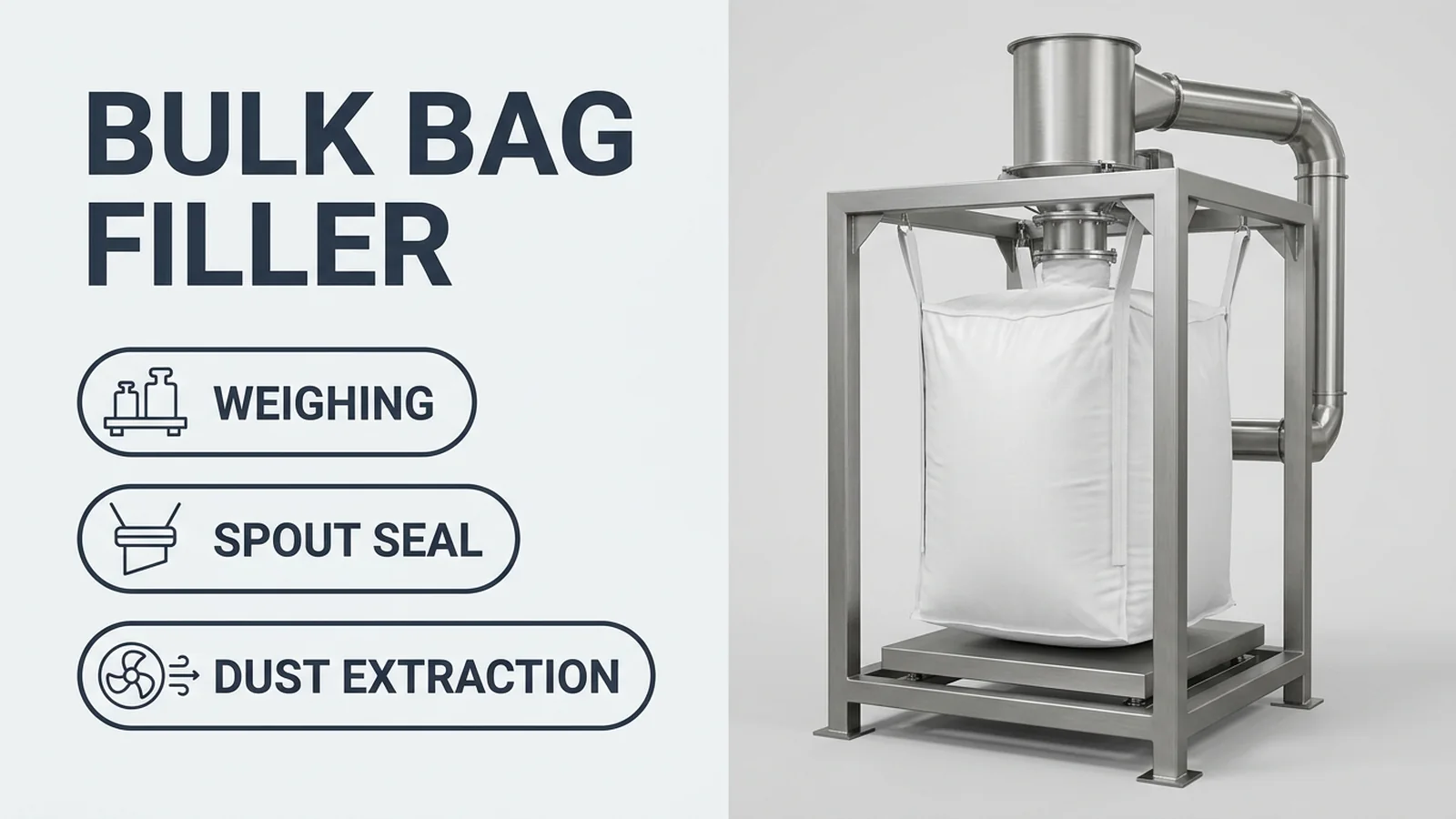
A bulk bag filler is an industrial packaging system that transfers a controlled amount of dry bulk material into an FIBC (Flexible Intermediate Bulk Container). These large industrial bags commonly handle hundreds of kilograms of material during each filling cycle. A typical system supports the FIBC, feeds material from the upstream hopper or feeding system, measures the filling weight on load cells, and stops material flow at the target weight. The operator positions an empty FIBC below the filling head, attaches the lifting loops to the support points, and connects the bag inlet to the filling spout. For many applications the machine uses fast filling during the main part of the cycle and fine filling that reduces the feeding rate as the weight approaches the target, so the system can account for product that may continue falling after the stop signal. Weighing is either gross weighing of the bag while material enters it or net weighing in a separate weighing hopper. When filling cement, mineral powder, flour, or fine chemicals, a dust-control system may include an enclosed filling connection, a sealed filling spout, a dust extraction port, and controlled material feeding. Bond and ground conductive equipment where finely divided dust can become explosible.
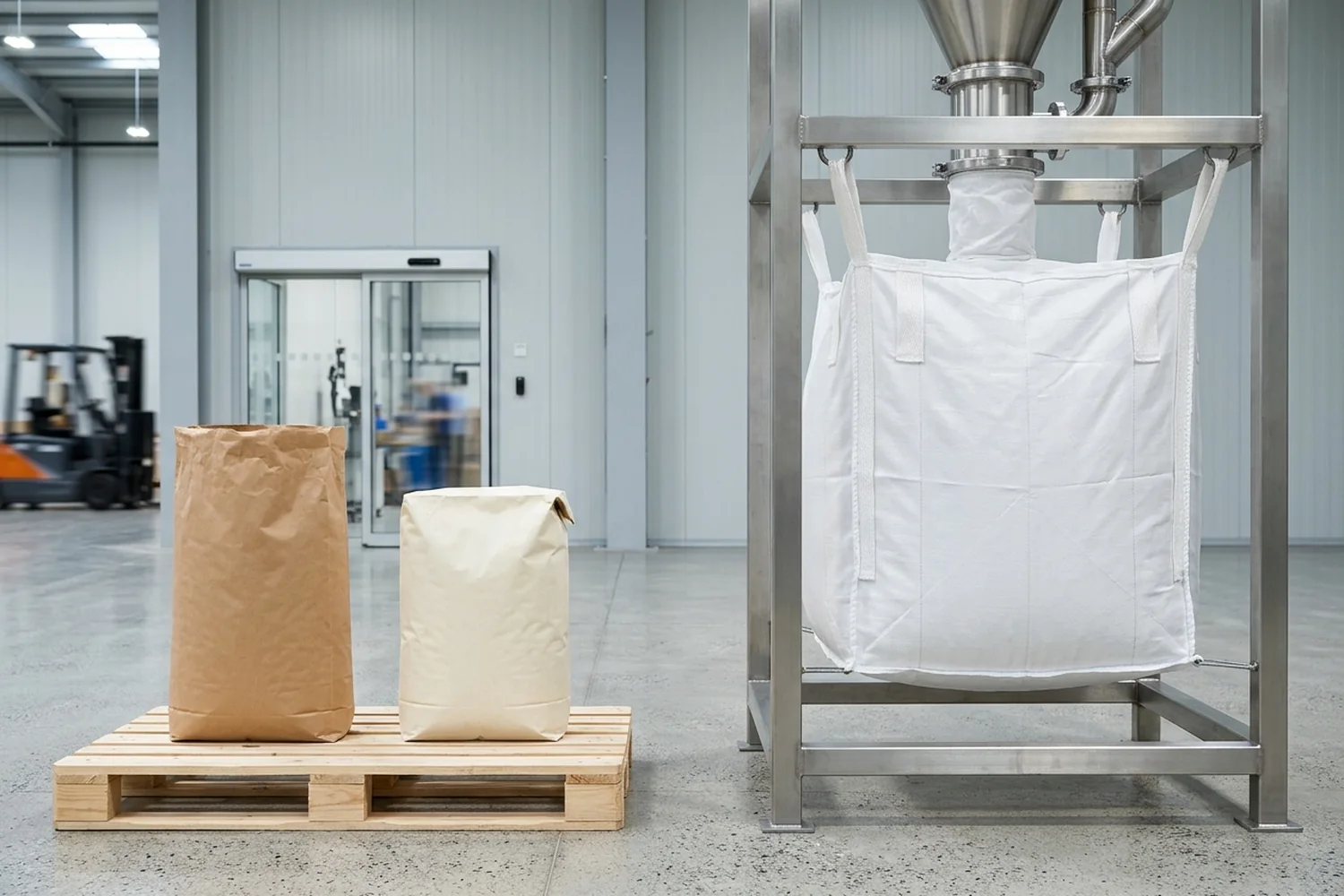
The correct machine depends first on bag type and target filling weight. If the target bag size is 25 kg or 50 kg, an open mouth bag filling machine may be more suitable. A valve bag filler normally fills smaller industrial bags through a valve opening, and common applications include cement, dry mortar, mineral powder, and other fine products. If the need is approximately 500–1000 kg FIBC bags, a bulk bag filling machine is usually the correct equipment category. On this site, the granule filling machines page connects feeding, portion measurement, and bag forming for dry foods such as nuts and dried fruit, records net weight in grams, and keeps damage observations separate from the weight result. If the project is still fixing its package format, work through how to choose a filling machine in this order: product, pack, dose, accepted output, then equipment scope.
| Equipment category | Typical bag format and weight range | Filling interface and typical applications |
|---|---|---|
| Bulk bag filler (FIBC station) | Four-loop FIBC commonly handling hundreds of kilograms, approximately 500–1000 kg | Support frame, filling spout, gross or net load-cell weighing, and dust extraction for dry bulk material |
| Open mouth bagger | Smaller open-top industrial sacks at 25 kg or 50 kg targets | Open mouth bag filling machine for a 25 kg or 50 kg target bag |
| Valve bag filling machine | Smaller industrial bags filled through a valve opening | Valve opening for cement, dry mortar, mineral powder, and other fine products |
How Do Frame Geometry, Four-Loop Hanging, and Bulk Density Shape the Station?
The filling frame supports the filling head and the FIBC during operation, and the frame dimensions can be customized according to bag height, width, filling weight, and factory space. The FIBC normally uses four lifting loops, and the operator connects these loops to the machine before filling. Common filling-weight requirements may include 500 kg, 800 kg, 1000 kg, or another customized value. Two bags rated for 1000 kg can have different heights, inlet sizes, and lifting-loop positions, so a station needs to fit the bag as well as the target weight.
A bulk bag filler hopper provides temporary material storage above the filling station. Load cells measure the filling weight during the cycle, and the control system uses this weight data to switch between fast filling and fine filling before stopping at the preset target. Some product may continue falling after the stop signal, so the system needs to account for this material during fine filling. The correct hopper size depends on material bulk density, filling weight, filling speed, upstream material supply, and available installation height. A low-density powder needs more volume than a high-density mineral for the same 1000 kg filling weight, so bulk density affects hopper size, bag volume, filling time, feeder size, material flow, and installation height. A volumetric dosing setting and a net weight result are not the same thing. If the product is sold in millilitres but checked on a balance, temperature, density, and package tare have to be agreed, and the proposal has to state the measurement basis rather than an accuracy percentage alone. See net-weight vs volumetric filling for that record.
Should You Specify Gross Weighing or Net Weighing for FIBC Filling?
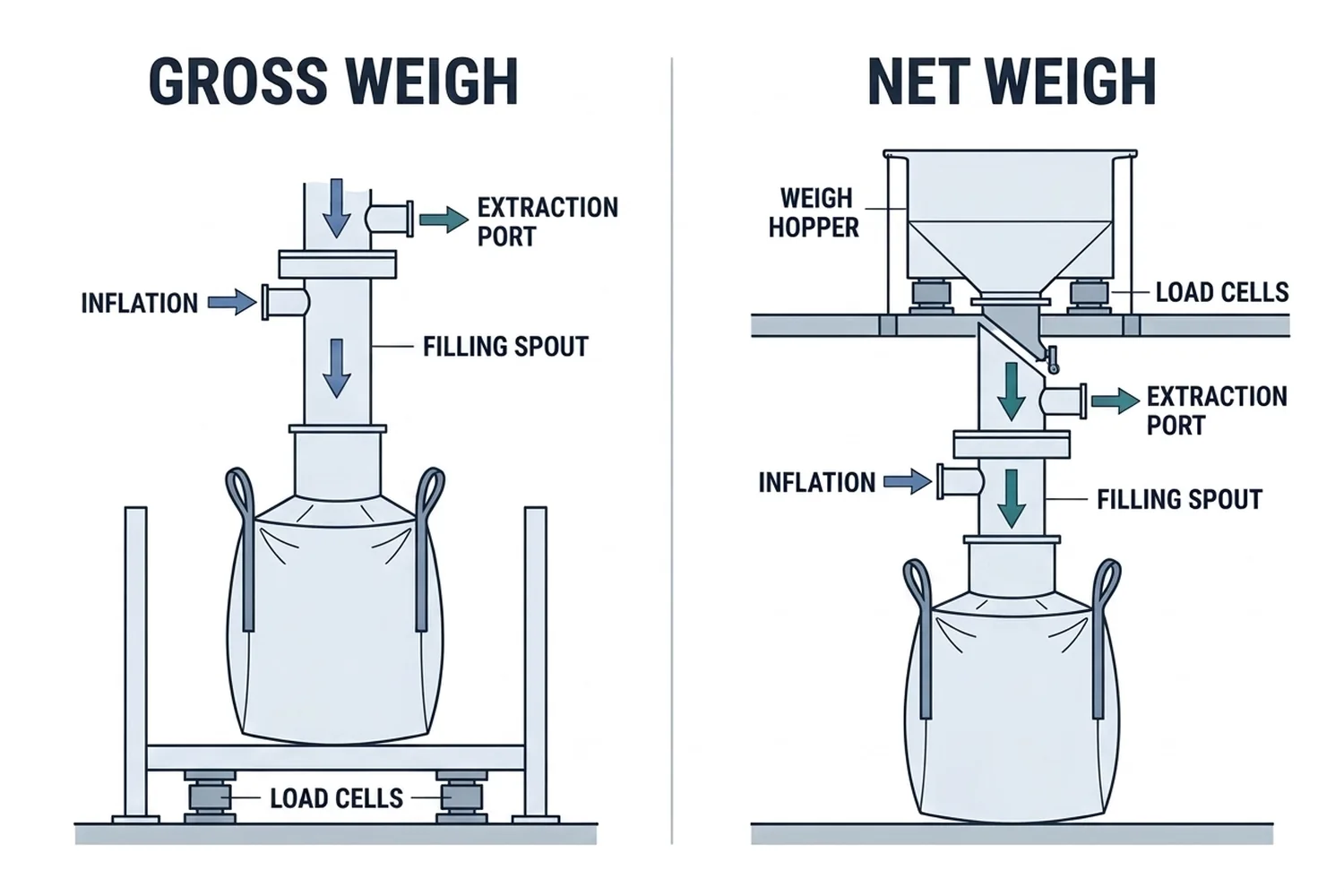
With gross weighing, the machine weighs the bag while material enters it. This method combines filling and weighing at the same station. With net weighing, the system first measures material in a separate weighing hopper and then releases the measured batch into the FIBC. The choice between gross weighing and net weighing depends on material characteristics, required capacity, available space, and project design. A tare mechanism is designed for determining or balancing out the weight of packaging material, containers, vehicles, or other materials that are not intended to be included in net weight determinations, as Appendix D of NIST Handbook 44 (2026) defines it.
In the 2026 edition of NIST Handbook 44, Section 2.22 applies to automatic bulk weighing systems adapted to the automatic weighing of a commodity in successive drafts of predetermined amounts, automatically recording the no-load and loaded weight values and accumulating the net weight of each draft. Section 2.22 does not apply to batching systems. For automatic bulk weighing systems used to receive, or weigh in, the no-load reference value is determined and recorded only at the beginning of each weighing cycle. For automatic bulk weighing systems used to deliver, or weigh out, the no-load reference value is determined and recorded only after the gross-load reference value for that cycle has been indicated and recorded. An automatic bulk weighing system must show the operator the position of the gates leading directly to and from the weigh hopper, and it must not print a weight if either of those gates is open. On an automatic bulk weighing system, the weigh hopper shall be equipped with an overfill sensor which will cause the feed gate to close, activate an alarm, and inhibit weighing until the overfill condition has been corrected. An indicating or recording element shall not indicate or record any values when the gross load is in excess of 105 % of the capacity of the system. Section 2.24 includes automatic gravimetric filling machines that weigh discrete loads or single loads of loose materials and determine package and production lot compliance with net-content representations, and Section 2.24 does not apply to automatic bulk-weighing systems. Section 2.24 states that, on the average, the contents of the individual packages in a lot, shipment, or delivery must contain at least the quantity declared on the label, and approval of a device within tolerance is not a legal justification for packages to contain, on the average, less than the labeled quantity. OIML R 61 specifies the metrological and technical requirements, metrological controls, and tests for automatic gravimetric filling instruments (AGFIs), which produce a predetermined mass of individual fills of products from one or more loads by automatic weighing. On the OIML R 61 publication page, the 2017 edition is marked Current and the 2004 and 1996 editions are marked Superseded.
How Do Spout Seals, Inflation, and Extraction Control Combustible Dust?
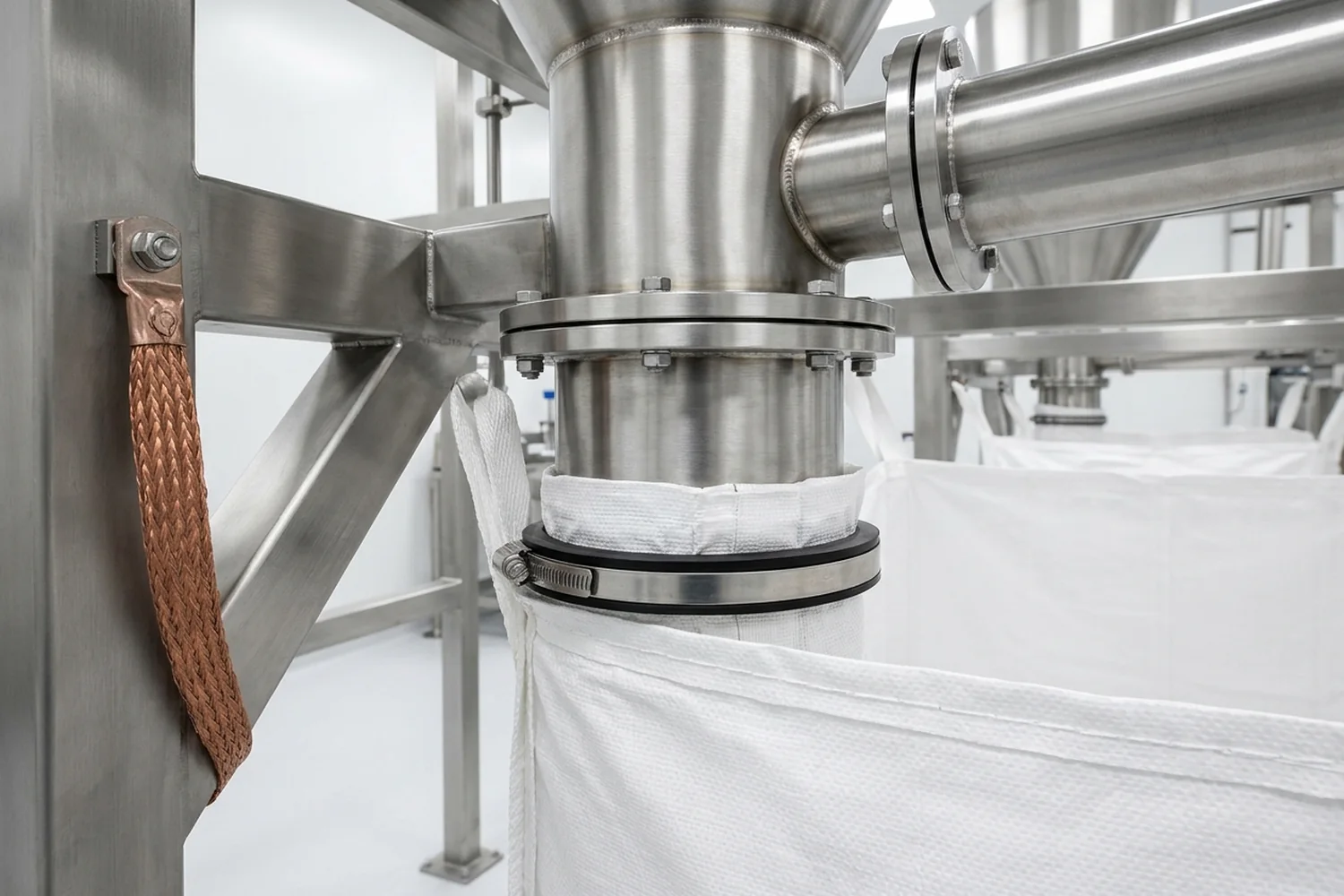
Bag inflation helps open and shape the empty FIBC before filling, which can improve bag positioning and help material enter more evenly. Light or aerated materials can trap air inside the bag, so a vibration or densification system can help settle the material and improve bag stability. Not every product requires these options. The filling spout guides material into the bag, and a suitable spout design can help reduce material leakage and control dust around the filling point. When filling cement, mineral powder, flour, or fine chemicals, a dust-control system may include an enclosed filling connection, a dust extraction port, a central dust collector connection, a sealed filling spout, and controlled material feeding. On the powder filling machines page, powder escaping the intended path can affect housekeeping and the sealing area, and dust-control equipment that must be supplied separately has to be identified in the scope.
Any combustible material can burn rapidly when in a finely divided form. If such a dust is suspended in air in the right concentration, under certain conditions, it can become explosible. Even materials that do not burn in larger pieces, such as aluminum or iron, can be explosible in dust form given the proper conditions. OSHA lists food materials such as sugar, spice, starch, flour, and feed, plus grain, tobacco, plastics, wood, paper, pulp, rubber, pesticides, pharmaceuticals, dyes, coal, and metals, as examples of materials that can be explosible in dust form. CCOHS describes a combustible dust as any finely divided solid that can disperse in air and catch fire and explode when exposed to an ignition source, including powders, flakes, fines, and fibers. CCOHS quotes the NFPA definition from Standard 652-2019, The Fundamentals of Combustible Dust: a finely divided combustible particulate solid that presents a flash-fire hazard or explosion hazard when suspended in air or the process-specific oxidizing medium over a range of concentrations. A dust explosion needs dispersion of dust particles in the right concentration and confinement of the dust cloud, in addition to fuel, oxygen, and an ignition source. CCOHS names fuel, oxygen, and an ignition source as the fire triangle, and names the dust pentagon for the added dispersion and confinement elements. The primary dust explosion is the first explosion, in a dust suspension inside a confined space such as a container, room, or piece of equipment. It can shake accumulated dust into the air, and that secondary explosion is often more destructive. HSE publication HSG103, dated 2003, is advice on the prevention and mitigation of dust explosions and fires. CCOHS says to determine combustible-dust risk with a risk assessment by a competent person, and that rules of thumb about dust thickness or visibility are not always reliable. Use a dust extraction and collection system designed to control combustible dust, with the inlet as close to the dust-producing process as possible, and locate dust collectors outdoors where possible. Ordinary fans can stir dust into the air. Do not create dust when cleaning with brooms or compressed air hoses. Only use wet methods or vacuums approved for dust collection. Bond and ground conductive equipment, check the bonds regularly, and keep open flames, sparks, friction, and heat away from the dust.
What Should You Send in a Bulk Bag Filler Specification Checklist?
Send the bag and plant inputs that change the station. Send bag height, width, inlet size, and lifting-loop positions for each filling weight, such as 500 kg, 800 kg, 1000 kg, or another customized value, because two bags rated for 1000 kg can have different heights, inlet sizes, and lifting-loop positions, and a station needs to fit the bag as well as the target weight. Send material bulk density, filling weight, filling speed, upstream material supply, and available installation height, because those inputs set hopper size, and note whether light or aerated material can trap air. State whether gross weighing or net weighing fits the material characteristics, required capacity, available space, and project design, and how a tare mechanism determines or balances out packaging weight. State the dust extraction port or central dust collector connection, and the bonding and grounding of conductive equipment. When a balance checks a product sold in millilitres, agree temperature, density, and package tare, and state that measurement basis in the proposal instead of an accuracy percentage alone.
| Checklist item to send | Project details to record from your bag and plant | Station interface affected |
|---|---|---|
| Bag inlet size and loop layout | Dimensioned FIBC drawing showing bag height, width, top inlet spout size, four lifting-loop positions, and target fill weight (such as 500 kg, 800 kg, or 1000 kg) | Frame dimensions for bag height, width, filling weight, and factory space, plus filling-spout fit to the inlet size |
| Material flow and bulk density | Material bulk density, whether light or aerated material can trap air, product that may continue falling after the stop signal, upstream material supply, and available installation height | Hopper size, fast filling and fine filling, bag inflation, and a vibration or densification system when the material traps air |
| Gross or net weigh preference | Whether the station weighs the bag while material enters it or measures the batch in a separate weighing hopper, plus required capacity, available space, and how tare is determined | Load cells measuring the bag during filling versus a separate weighing hopper that releases the measured batch |
| Dust-collection interface and bonding | Dust extraction port or central dust collector connection, a competent-person combustible-dust risk assessment, bonding and grounding of conductive equipment, and cleaning with wet methods or vacuums approved for dust collection | Enclosed filling connection, dust-extraction inlet close to the fill point, bonding and grounding, and housekeeping where powder leaves the intended path |
Common questions
When should you choose a bulk bag filler instead of an open mouth bagger or valve bag filling machine?
Match the machine to bag type and the target filling weight. A 25 kg or 50 kg open-top bag may call for an open mouth bag filling machine. A valve bag filler normally fills smaller industrial bags through a valve opening, and common applications include cement, dry mortar, mineral powder, and other fine products. An approximately 500–1000 kg FIBC usually belongs on a bulk bag filling machine. That station normally uses four lifting loops on a support frame, measures filling weight with load cells, and may include a sealed filling spout in the dust-control system.
What is the difference between gross weighing and net weighing on an FIBC station?
Gross weighing follows the bag weight as material enters, so the scale shares the station with filling. Net weighing measures the batch in a separate weighing hopper first, then releases it into the FIBC. Decide from the material characteristics, the required capacity, the available space, and the project design.
How do bulk bag fillers control dust and static hazards when filling fine powders?
Dust can become a major issue when filling cement, mineral powder, flour, or fine chemicals. A dust-control system may include an enclosed filling connection, a dust extraction port, a central dust collector connection, a sealed filling spout, and controlled material feeding. Locate the extraction inlet as close to the dust-producing process as possible, and locate dust collectors outdoors where possible. Because finely divided combustible dust can become explosible when suspended in air in the right concentration, CCOHS says to determine the risk with a risk assessment by a competent person, to bond and ground conductive equipment and check the bonds regularly, and to clean only with wet methods or vacuums approved for dust collection rather than brooms or compressed air hoses.