
Explore the options
Start with the paste as it reaches the filler
A paste filling machine handles products whose flow, transfer and cutoff need a closer review than those of a freely pouring liquid. Ketchup, dressings and other pumpable condiments are typical starting applications for this equipment family. Product names alone are not enough to define a configuration: two sauces can differ in temperature, suspended pieces, oil separation and the way they leave a nozzle.
Describe the material under normal filling conditions and include a representative sample when arranging an assessment. Useful observations include how it moves through a hose, whether it settles during a pause and whether it forms a tail when dispensing stops. The purpose is to connect the actual recipe with a practical dosing and packaging arrangement before discussing a finished machine specification.
Review the hopper and transfer path as one system
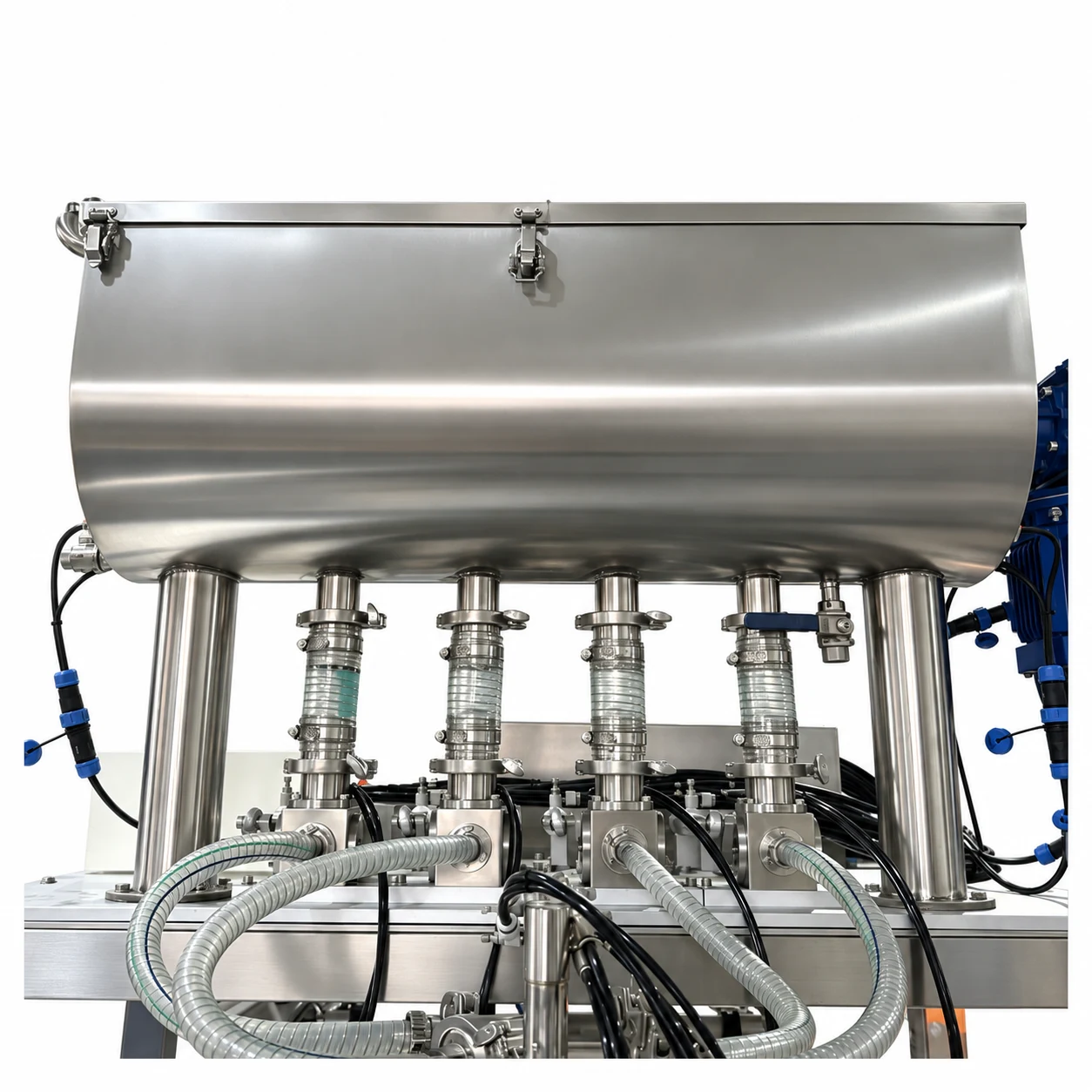
The supply hopper is part of the product path, so its behavior counts as a filling variable rather than an accessory detail. Its position, refill method and connection to the metering unit should be considered together. Explain whether product arrives from a preparation tank, transfer pump or manually handled container. Include the expected holding period and the condition of the product near the beginning and end of a batch.
Agitation or heating may be relevant to a particular recipe, but neither should be treated as an automatic requirement. State the purpose of any requested option and the conditions it needs to maintain. Ask how the offered hopper and connections are opened, drained and cleaned. This makes the supply arrangement part of the configuration review instead of leaving it as an unspecified accessory beside the filling machine.
Match metering, valves and outlets to the recipe
A piston-based arrangement is one route to discuss for pumpable sauces and pastes. Its suitability depends on the complete product path, including the inlet, valve and outlet. Review the dosing range and adjustment method in relation to the actual product. Where a portion is declared by weight, agree a weighing procedure for evaluating the filled output.
For sauces with seeds or other pieces, provide the maximum particle dimensions, concentration and acceptable condition after filling. A larger passage may address one concern while introducing different tooling or package-clearance questions. Evaluate the representative recipe through the proposed path. The team needs to assess the complete combination, rather than assuming compatibility from a viscosity description or a photograph of a similar product.
Coordinate the end of filling with sachet sealing
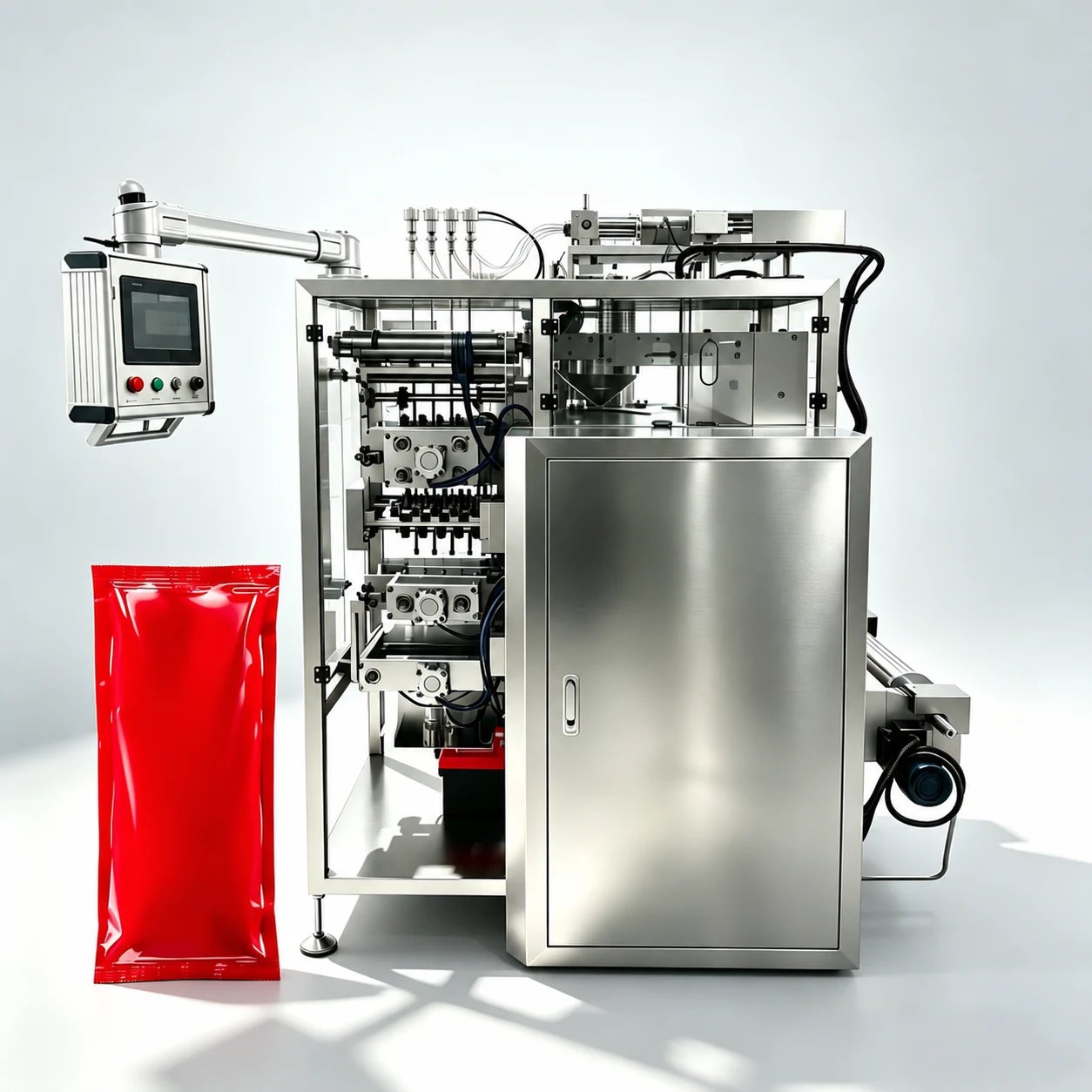
A sauce-sachet machine brings dosing together with film transport, package formation and sealing. The end of the fill deserves particular attention because trailing product or splashes can reach the area that must be closed. Observe the nozzle position and the interval between dose completion and the next packaging movement during a sample run.
Specify the intended seal layout and provide film samples or a film specification. Sachet dimensions, portion volume and the space above the product should be considered together. An equipment configuration that can dispense the portion still needs to produce an acceptable finished pack. Assess weight, seal appearance, opening features and external cleanliness as related outcomes rather than treating them as separate demonstrations.
Separate flexible-pack choices from recipe choices
A small condiment sachet and a larger premade pouch have different handling requirements. One is formed from roll stock during production; the other arrives as a supplied bag that needs presentation and opening. Describe the incoming packaging material first, then define the recipe and portion planned for it. As a rule, the incoming packaging material determines the packaging machine, and the recipe then determines the dosing arrangement.
If multiple pack sizes are required, provide the smallest and largest drawings plus the sizes expected to run most often. Include print registration, tear features and any special closure. Ask which format changes involve tooling and which can use adjustments. A broad size range is most useful when translated into a specific list of approved packs and the parts needed to run each one.
Plan cleaning around residue and product-contact access
Thick product can make draining and access relevant topics during equipment selection. Ask the team to identify the product-contact components in the proposed arrangement and explain how they are removed or reached. Include hoses, valves and outlet connections in that review, alongside the more visible hopper. Your intended cleaning procedure and utilities provide the context for discussing compatibility.
Consider how a change between recipes is completed and checked. Explain any need to separate flavors, colors or ingredients, and agree where removed parts will be cleaned and stored. The equipment discussion should identify practical tasks and access requirements. A stainless exterior or a photograph of an open machine does not establish the complete cleaning method for every formulation used at your factory.
Evaluate production with representative pauses and changes
A useful sauce trial can focus on quantity measurements, particle condition, cutoff behavior and sachet closure. Define which questions the run is intended to answer and which product and packaging samples will be used. Include an agreed pause and restart if those events are important to the process. The result should describe the tested conditions as well as the observed output.
For production planning, distinguish the machine cycle from acceptable packs collected over a period. Include product replenishment, packaging changes and routine checks in the operating discussion. Ask how the offered configuration responds when the hopper supply or downstream handling pauses. These observations support a more realistic comparison than a single speed figure without the recipe, portion, film and measurement conditions.
Prepare a paste-filling inquiry with clear priorities
Send the complete product description, normal filling temperature, intended portion and unit, package drawing and required output. Add information about pieces, separation, foaming or stringing where these are relevant. Photographs of the product leaving an existing dispenser can help explain the question, while representative material and packaging samples are needed for a focused equipment assessment.
Identify the recipes and formats planned for startup and the changes expected later. Our team can use the brief to review the dosing family, packaging route and sample requirements. The resulting proposal should identify included supply components, contact parts, tooling and inspection scope. Use the sauce-sachet machine page for a closer look at the packaging sequence and the application page for recipe-specific planning questions.
Common questions
What type of filling machine is used for thick sauces and pastes?
A piston dosing arrangement is a common starting point for pumpable sauces and pastes, because it moves a set volume through a valve and outlet on each stroke. Its suitability still depends on the complete product path, so review the hopper, valve, outlet and package opening together using a representative sample at the normal filling temperature.
Can a paste filling machine handle sauce with seeds or pieces?
Only after the product path has been checked against the pieces. Send the largest particle dimensions, their concentration and the acceptable condition after filling, together with the full recipe and filling temperature. A wider passage can solve one problem while creating tooling or package-clearance questions, so the valve, outlet and pack opening are reviewed as one combination.
Does a paste filler need a heated or agitated hopper?
Not always. Heating and agitation are options chosen for a specific recipe, not default equipment. Specify the behavior you need to control, such as thickening as the product cools or separation while it waits, and the product conditions your team permits. The equipment review can then decide whether either option serves that purpose.
Updated: