
At a glance
Swipe to compare all columns.
| Input or item | Value or source to provide | Why it matters |
|---|---|---|
| Product and temperature | Complete formula and filling-temperature range | Checks fluid-path compatibility |
| Dose and acceptance band | Your target in mL or g and agreed limits | Defines the measurement task |
| Vial mouth and closure | Dimensioned component drawing | Checks nozzle fit and closing handoff |
| Output, run and changeovers | Accepted vials per shift, batches, run length and pauses | Sets the trial window and cost comparison |
Which dosing path should you shortlist?
A vial filling machine can use peristaltic dosing to keep liquid inside a replaceable tube, or ceramic rotary piston dosing to meter it through a reusable precision chamber. Start with the tube route when changing the product-contact path between recipes is your main constraint. Shortlist the ceramic route when you can support its cleaning and reassembly process and demonstrate repeatable doses with the actual formula. Neither mechanism alone establishes a tighter fill tolerance or a sterile process.
This comparison addresses small liquid doses, including projects considering 1–30 mL essential oils, oral liquids or reagents; confirm the exact dosing range against the supplier's pump head and nozzle specification for your formula. Keep the product classification attached to the brief: a cosmetic oil, a nonsterile supplement and a sterile injectable can share a glass vial shape while needing very different facilities and process controls.
What actually contacts the product?
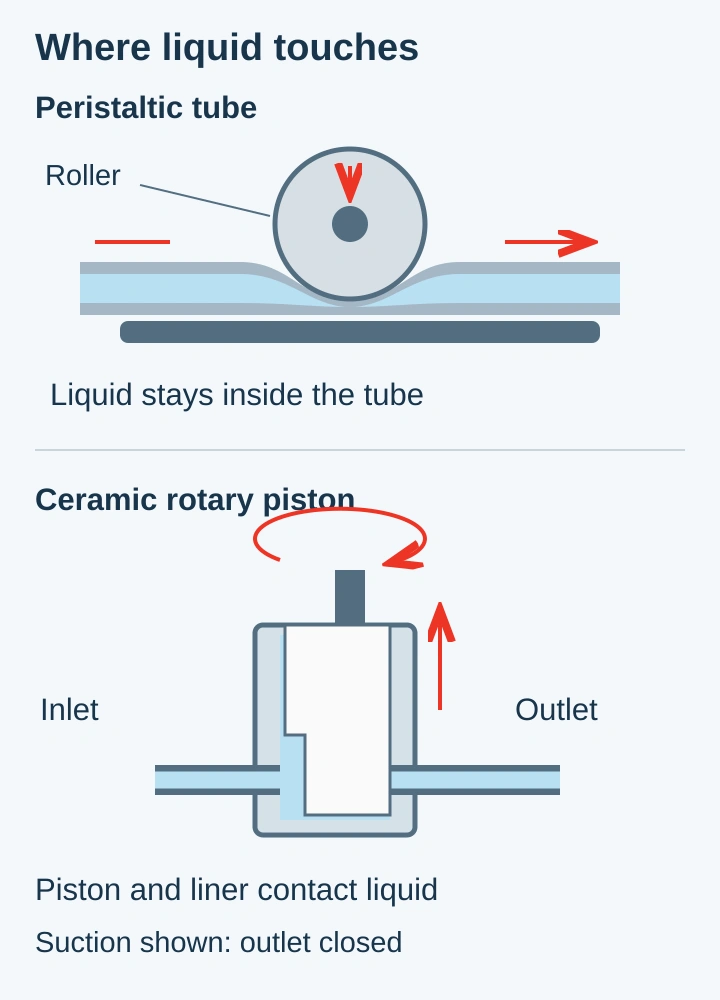
In a peristaltic head, rollers squeeze a flexible tube and its recovery draws in liquid. The pump mechanism stays outside that tube. The complete contact path still includes the supply connection, tube joints and filling tip, so changing only the short pumping segment does not replace every wetted surface. Record exactly which parts are discarded, reused or cleaned before calling a changeover complete.
A ceramic rotary piston combines rotation with reciprocating movement inside a matched liner. The piston opens the inlet during suction and the outlet during discharge. This valveless arrangement differs from a conventional piston filler with separate check valves; ask the proposal to identify its architecture. A reusable piston path also includes connections and the nozzle. Ask for a contact-material list for the whole assembly rather than accepting “ceramic pump” as a complete compatibility specification.
Silicone is one tubing candidate, not a default approval for every essential oil, solvent mixture or reagent. Give the supplier the complete formulation and temperature range, and request compatibility evidence for the proposed tube, connector and nozzle materials. Keep any sterilization requirement separate from chemical compatibility. Tube replacement reduces the cleaning boundary only for the components you actually replace.
Compare the same operating questions
Compare both candidates on the same formula, temperature, vial, dose and run duration. A short water demonstration cannot settle an oil or reagent project. Ask for individual fill records rather than a single advertised percentage. The useful distinction is which source of variation your team can control through the full run, including a pause and restart.
The tube is a working consumable: its dimensions, recovery and compatibility matter. A ceramic chamber removes that flexible pumping segment from the metering mechanism, but introduces reusable contact parts to inspect and clean. Ask the supplier to explain the likely failure location for your formulation and how the trial will expose it. Do not assign a universal accuracy winner from the pump category.
| Dosing route | When to shortlist it | Dominant Failure Mode & Prevention |
|---|---|---|
| Peristaltic | Frequent recipe changes where a replaceable contact path is valuable; verify the complete set. | Dose drift as tubing condition changes or air enters the path. Match the tube to the head and formula; check calibration, connections and end-of-run fills. |
| Ceramic rotary piston | A reusable metering chamber with an agreed cleaning, handling and inspection process. | An incompletely filled chamber or residue after cleaning/reassembly can disrupt the next dose. Verify priming and inspect matched contact parts under the supplier procedure. |
| Either route | The proposed nozzle fits the vial and cutoff leaves the neck ready for closure. | Liquid at the tip or vial rim can spoil presentation and closing. Observe cutoff, alignment and pause/restart behavior using the intended vial. |
Translate the small dose into a measurable error
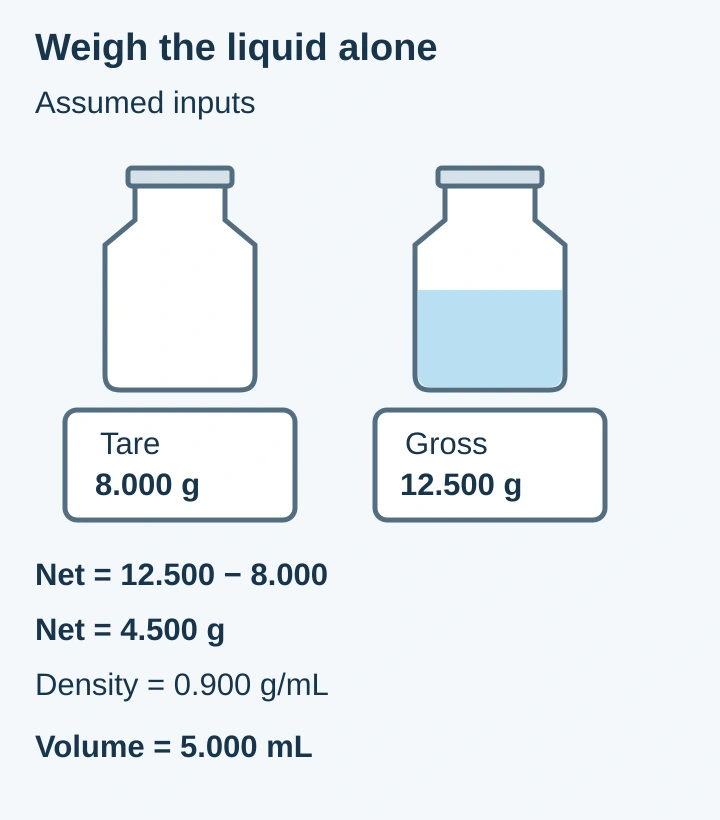
Use net liquid mass and density measured at the stated product temperature to check a volume target. The dimensional relationship is V = (m_gross − m_tare) / ρ, where mass is in grams and density ρ is in g/mL. Density is a measured input for the actual product; a convenient water assumption can misstate an oil dose.
Example calculation (assuming an 8.000 g empty vial tare, 12.500 g filled gross mass, 0.900 g/mL product density at the recorded filling temperature, and a buyer-agreed ±1% acceptance band): V = (12.500 − 8.000) / 0.900 = 5.000 mL. Around 5.000 mL, that band gives an allowed volume deviation is ±0.050 mL, equivalent to ±0.045 g at 0.900 g/mL. Substitute your vial tare distribution, measured product density at filling temperature, and target acceptance band to set the gravimetric check limits for factory acceptance testing.
Keep average offset separate from the spread of individual doses. A mean close to target can conceal light and heavy vials. Record each result, its station and its position in the run. Ask the quality team to select a calibrated balance and measurement method capable of resolving the agreed acceptance band, accounting for uncertainty and evaporation. Recheck density when the formulation or temperature changes materially.
Use physical thresholds in the trial brief
Rule of thumb: if a candidate’s observed absolute dose error exceeds your agreed maximum error at any required test condition, keep it off the accepted shortlist until the supplier resolves the cause. In the 5.000 mL example calculation above, a 0.060 mL error exceeds the buyer’s 0.050 mL band. A category-level promise of “high precision” cannot close that gap.
Check the vial opening before discussing cycle rate. If the nozzle outside diameter is equal to or larger than the minimum mouth inside diameter, that nozzle cannot enter the vial. A smaller nozzle still needs positioning clearance agreed against vial and handling tolerances. Send the mouth drawing, not just the nominal bottle capacity. This matters particularly when a small bottle filling machine quote covers several neck finishes.
Agree a trial sequence that includes startup after priming, stable operation, the end of the intended run and a restart after the expected pause. Record supply level, tube or pump-set identity, recipe settings and any adjustment. Collect neck-condition observations with dose results so the comparison includes what reaches the vial. Use the sample assessment page to prepare representative material and packaging; the proposed trial scope must be agreed for the project.
Count changeover and product loss over the same period
Compare the operating ledger over the same number of batches and saleable vials. Include tube sets or reusable-part spares, cleaning labor and utilities, setup and recalibration time, discarded startup fills, unrecovered liquid and rejects. A reusable chamber with cheap consumables can still be costly to clear between short runs. A tube route also has a cost for each replacement and the product retained in the rest of its path.
Use C_period = C_consumables + C_cleaning + C_labor + C_lost_product + C_downtime, keeping each cost in the same currency and period. Avoid counting operator time twice if your downtime rate already includes that labor. Measure product loss as L = N × ΔV + H, where N is accepted vial count, ΔV is average positive overfill and H is discarded startup and residual liquid over that period.
Example calculation (assuming 30 monthly batches): a 45-minute changeover occupies 22.5 hours per month, whereas a 15-minute changeover occupies 7.5 hours—a 15-hour difference in changeover window. The faster route breaks even on changeovers when its extra monthly consumable cost is less than 15 × your recoverable downtime cost per hour, after accounting for cleaning and startup losses. Separately, assuming 10,000 accepted vials with 0.020 mL average overfill accounts for 200 mL of excess product before adding startup loss.
The pump is only one handoff. Vial presentation, filling, closing and inspection must fit the same accepted-output requirement. Use filling-line integration planning to record who supplies each neighboring stage, how stops are communicated and where finished output is counted. Align the upstream vial feed, filling head, closure station and reject handoff in the written line-integration brief before locking the equipment scope.
Send one brief for scope and sample assessment
Send the formula and temperature, target dose with acceptance band, density and tare method, vial-mouth drawing, expected batches and run length, and the closing process. Add the product classification and destination market so the conversation starts with the correct process boundary. If you lack a measurement, mark it as open rather than substituting a catalog number.
The liquid filling equipment family describes this site’s published pouch and sachet routes. The supplement powder application covers dry blends and dosing caps. Use those pages to distinguish the existing packaging scope from a liquid vial inquiry, then send your vial brief through the WhatsApp project handoff below for a scope discussion and the next sample-assessment questions. Confirm the specific dosing head configuration, target accuracy band and enclosure requirements during the technical scope review.
Method, sources and process boundary
Updated November 9, 2026. This guide compares publicly documented peristaltic and ceramic rotary piston mechanisms and uses example calculations with stated inputs for gravimetric volume, error bands and monthly changeover time. Verify final dosing tolerances and contact-material ratings through sample testing with your actual formulation and vial.
For US sterile drug products made by aseptic processing, FDA’s aseptic-processing guidance and current CGMP questions and answers address equipment, cleaning and process validation in a broader control system. A disposable path or ceramic pump alone does not establish sterility. Keep injectables and other sterile-drug projects under the responsible quality team’s process assessment; ordinary essential-oil and oral-liquid projects do not inherit that regulatory scope merely because they use vials.
Common questions
Is 1–30 mL a guaranteed range for the equipment?
No. It is the reader project range considered in this guide. Confirm the proposed pump, tubing or chamber, nozzle and dose range with the actual product and vial before accepting a configuration.
Does replacing silicone tubing eliminate cross-contamination?
Replacing the tube changes only that part of the contact path. Identify the supply fittings, connectors and nozzle as well, and define which parts are replaced or cleaned. Compatibility and cleaning assessment still apply to the complete path.
Does a vial filling pump establish an aseptic process?
No. A pump is one component. Sterile-drug projects require a separate assessment of equipment, contact parts, environment, closing and process validation under the applicable quality requirements.
What to send us
Swipe to compare all columns.
| Item | Why we need it | Example format |
|---|---|---|
| Formula and temperature | Review the contact path and assessment conditions. | Composition sheet with temperature range |
| Dose, density and acceptance band | Agree measurement units and the trial record. | mL target, measured g/mL, tare method and buyer limits |
| Vial and closure drawing | Check the mouth, presentation and closing boundary. | Dimensioned PDF with revision |
| Output, run and changeover schedule | Compare recurring work over the same period. | Accepted vials per shift, batches per month, run duration and pauses |
| Classification and destination | Keep the project scope and quality requirements explicit. | Product category, country and required documentation |
We reply within 24 hours.