
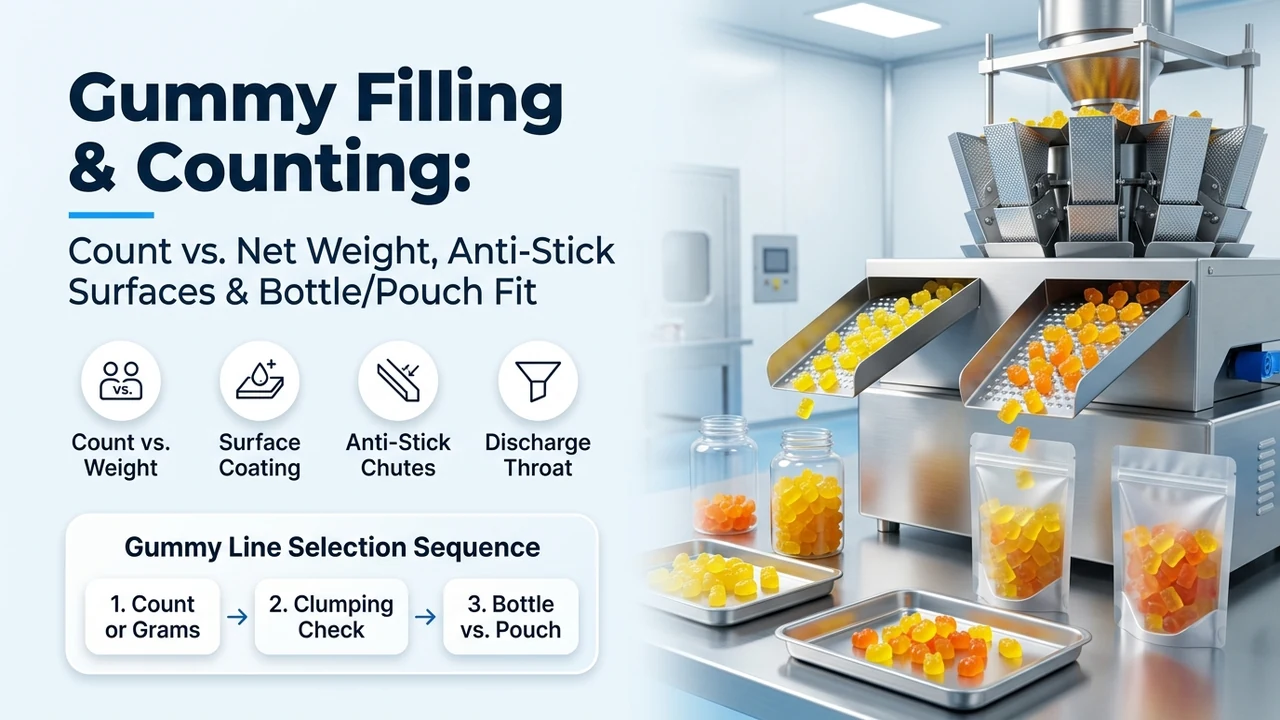
Quick Specs
Swipe to compare all columns.
| Equipment route | What sets the portion | Product & scope boundary |
|---|---|---|
| Piece counting (optical lanes) | Photoelectric or optical count of discrete pieces | Cured gummies sold by exact piece count; outside this site's catalog |
| Net-weight dosing (combination or linear weigher) | Load-cell mass calculation across weigh hoppers | Cured gummies sold by net weight; pouch route aligns with our granule scope |
| Hot-syrup mold depositing | Heated manifold pump strokes into starch or silicone molds | Upstream liquid-candy manufacturing; not finished-gummy packaging |
Separate piece counting, net-weight dosing and syrup depositing first
Searching for a filling machine for gummies without naming the product state and quantity basis mixes three incompatible machines and leads to wrong quotations, failed pouch seals or miscounted containers. Before comparing equipment proposals, separate upstream candy cooking from downstream finished-piece packaging: hot-syrup depositors pump heated gelatin or pectin slurry into molds before curing, whereas packaging fillers handle demolded, cured gummies ready for retail bags or rigid jars.
Once the product is a cured gummy, the packaging choice splits between electronic piece counting and gravimetric net-weight dosing. This guide turns that decision into a count-versus-weight by pouch-versus-bottle boundary matrix and a fillable sample trial record. Within this site's published catalog, our granule filling machines cover weighing and vertical form-fill-seal bag packaging for discrete food pieces. Multi-channel optical tablet/gummy counters, rigid bottle unscrambling and capping lines, and heated mold depositors are explained from public engineering descriptions so you can scope the right route without assuming bottle-line or optical-counter supply here.
Match count or weight to the label claim and piece-weight spread
The quantity printed on the retail label decides how net contents are inspected. For a buyer evaluating a filling machine for gummies in USA distribution, NIST Handbook 133 (2023 Edition) separates the two verification methods: Chapter 2 governs gravimetric testing for packages labeled by weight (checking sample-lot average net mass and individual Maximum Allowable Variation after tare), while Chapter 4, Section 4.2 governs packages labeled by numerical count. Even when an inspector uses gravimetric auditing to screen a count-labeled lot quickly, official violation determinations for count-labeled containers require opening packages and counting the actual pieces inside.
Individual gummy mass variation is what forces a choice between counting and weighing. Mold-fill differences and drying gradients leave finished gummies with piece-to-piece weight spread across a batch. When a combination scale doses to a target net weight, a batch of slightly heavier gummies can reach the gram target with one fewer piece in the pack, while lighter pieces can add an extra piece. Conversely, when an optical counter drops an exact number of gummies into every container, the total net mass of the container fluctuates with the individual piece weights.
Before requesting a machine trial, weigh a representative sample of individual gummies from your production lot and record the lightest, heaviest and typical piece mass on the worksheet. If your package declares both a piece count and a net weight, your trial record must track both quantities separately rather than converting grams to pieces with an assumed average weight. Use the net weight vs volumetric filling guide for the general tare and unit-recording rules.
Map count versus weight against pouches and rigid bottles
Choosing between counting and weighing is only half the specification; the discharge chute and closing sequence must match the container format. A filling machine for gummies pouch project (either roll-film VFFS pillow/gusset bags or premade stand-up zipper pouches) needs timed portion release so the entire charge clears the pouch throat before the zipper or heat-seal jaws close. A rigid bottle or wide-mouth jar eliminates heat-seal jaw entrapment, but requires container unscrambling, indexed conveyor gating under a funnel spout, and downstream capping, induction sealing and labeling.
Public confectionery packaging descriptions show four common combinations of dosing method and container format. Use the boundary matrix below to locate your project before comparing supplier quotations, and mark whether any downstream checkweigher or metal detector belongs inside the same supply boundary.
When a project combines weighing with vertical bag forming and downstream inspection, use our integrated filling lines page to define where responsibility shifts between the feed elevator, the weigher, the bagger and the discharge conveyor.
| Dosing & pack route | Flexible pouch (VFFS or premade bag) | Rigid bottle or wide-mouth jar | Site scope boundary |
|---|---|---|---|
| Piece counting (multi-channel optical / photoelectric lanes) | Unit-count pouches where label claims exact piece count; requires timed dump gate so trailing pieces clear the seal zone | Standard route for count-labeled vitamin or confectionery bottles; pairs counting lanes with indexed bottle gating | Public engineering explanation only; optical counters and bottle lines are not supplied on this site |
| Net-weight dosing (combination or linear weigher) | Retail pouches sold by net mass; weigh buckets release grouped portions through a timing hopper into VFFS or premade bags | Bulk or net-weight jars; requires a transition funnel sized to the jar neck so multi-piece dumps do not bridge | Weighing + VFFS bag filling aligns with /granule-filling-machines; rigid jar handling is outside site scope |
| Count + downstream checkweigh verification | Counts pieces at the filler and rejects bags outside a gross-weight window downstream | Counts pieces into bottles and weighs capped containers to screen for double-drop overfills or short counts | Record as a separate downstream inspection module on the trial sheet |
| Hot-syrup mold depositing | Not applicable — liquid slurry cannot be dosed directly into retail pouches | Not applicable — forms gummies in starch or silicone molds prior to curing and demolding | Upstream confectionery manufacturing equipment; outside packaging filler scope |
Check surface finish, twinning and feeder separation
Finished gummies behave differently from dry nuts or hard tablets because their surface finish changes friction and adhesion across metal and plastic contact parts. Public gummy-packaging engineering notes distinguish four common surface conditions: sugar-sanded, sour-acid dusted, carnauba or MCT oil-coated, and uncoated pectin or gelatin. Sugar-sanded and acid-dusted gummies shed free crystals onto vibratory pans and photoelectric sensor windows, whereas oil-coated and high-moisture pectin gummies tend to cling to flat stainless steel or stick together in pairs under hopper weight and warm room humidity.
In a multi-channel photoelectric counting machine, single-file separation along the vibratory track is essential. Public counting-machine descriptions point out a specific failure mode when two sticky gummies adhere together: if a stuck pair drops through the optical sensor beam simultaneously, the sensor sees one interruption and registers two pieces as a single count, creating an unrecorded overfill. Irregular shapes—bears, rings, domes or flattened pieces—can also overlap on flat lanes unless the track geometry holds them in single file.
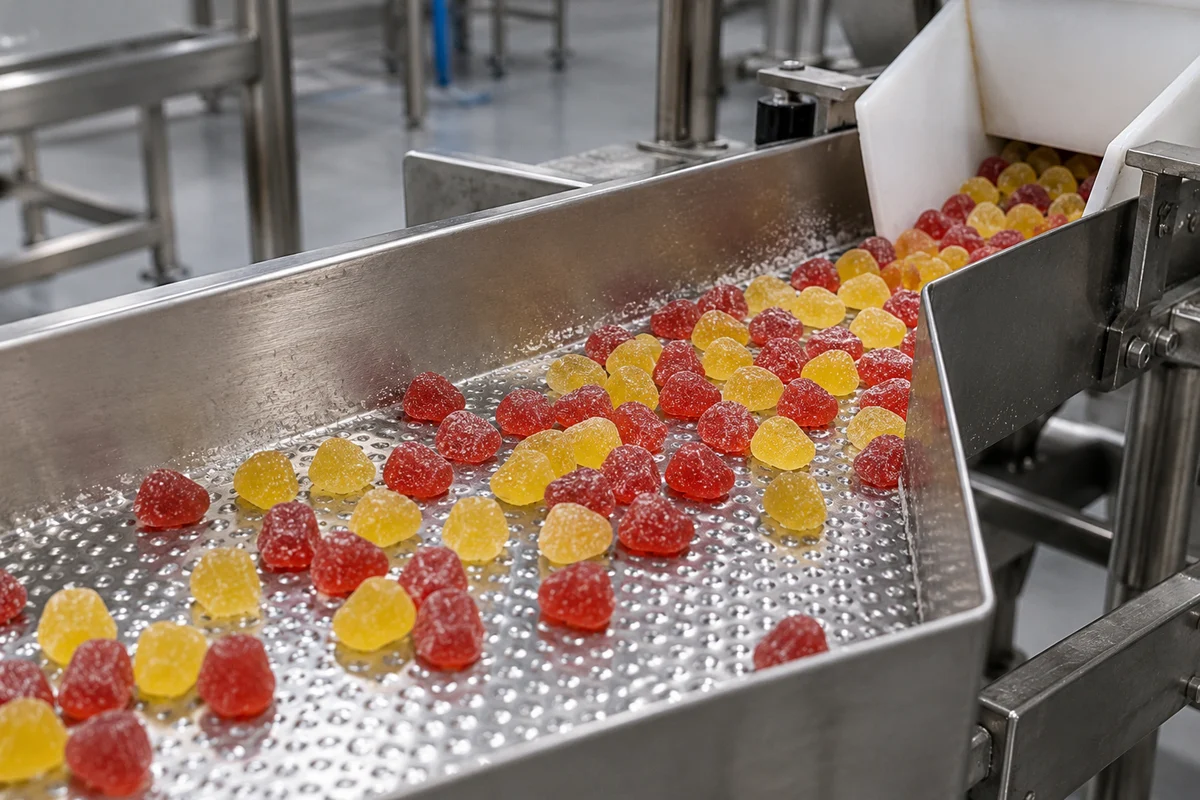
To keep sticky pieces moving without clumping, public combination-scale and soft-candy counter references describe specific anti-stick contact hardware: dual counter-rotating de-clumping rollers at the hopper throat, embossed or dimpled stainless steel feeder pans that reduce surface contact area, cellular or corrugated PTFE-coated vibrating channels, and steep PTFE-lined discharge chutes. Treat those features as configuration items to verify in writing for your exact coating rather than assuming a standard dry-granule feeder pan will feed soft candy cleanly.
Inspect pouch seal tracks, bottle necks and transfer damage
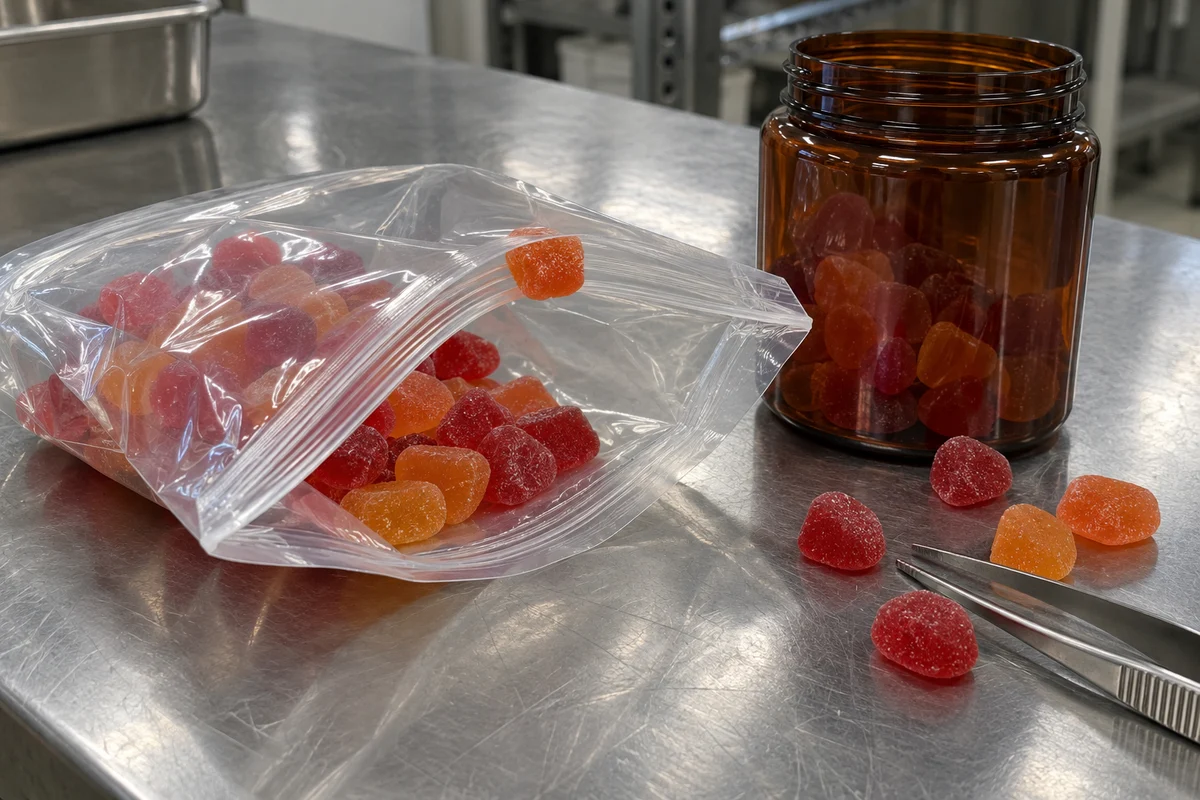
A portion that leaves the weigh bucket or counting gate accurately can still fail at the package opening. On a flexible pouch line, watch the drop timing from the discharge chute through the forming tube or pouch opener. If a trailing gummy bounces or slides late, it can lodge in the premade zipper track or get crushed between the horizontal heat-seal jaws, leaving an open channel across the seal. Loose sugar crystals or oil film transferred onto the inner seal land also interfere with polymer fusion.
On a rigid bottle or jar line, heat-seal entrapment disappears, but neck-diameter clearance takes its place. When a combination weigher or multi-lane counter releases a full dump of 30 to 90 gummies at once, pieces arriving together at a narrow bottle neck can bridge across the throat or bounce out onto the conveyor before the capper and induction sealer.
During any sample trial, inspect the discharged gummies and the contact path at the end of a continuous run, not just after a few hand-fed cycles. Log transfer damage (scuffed sugar coating, bruised corners, stretched pieces) separately from residue build-up on feeder pans, optical windows, chutes and seal jaws. Our filling accuracy and production speed guide explains how to count accepted closed packs over a timed run so seal rejects and cleaning stops stay visible.
Fill in the gummy trial worksheet during sample runs
Download the blank 11-column CSV worksheet below and use a separate row for each finished gummy SKU, coating type and package format. The template contains column headers and an empty row only—no pre-filled machine ratings, tolerances or test numbers. Fill in the product description, target count or target mass, package format and individual piece-mass samples before the trial starts.
During the sample assessment, record both actual_count and actual_net_mass for every sampled package, even if your label only declares one of them. Seeing the piece count beside the net gram reading on the same container immediately reveals whether piece-weight variation or twin-clump overfilling is driving deviations. Leave any unmeasured field blank or enter Unknown / verify on the unit rather than estimating values.
Before shipping production gummies for an evaluation, agree sample quantities, room temperature and humidity conditions, and packaging film or pouch drawings in writing through the sample assessment process.
| Worksheet column | What to record | Why it belongs in the trial file |
|---|---|---|
| finished_gummy_product | SKU name, shape, dimensions, pectin/gelatin base and surface finish (sugar-sanded, oil-coated, acid-dusted, uncoated) | Identifies the exact cured piece condition entering the feeder |
| target_count_if_applicable | Declared pieces per pack (e.g., 30 pcs) or Not applicable if sold strictly by weight | Establishes whether numerical count compliance applies |
| target_mass_if_applicable | Declared net weight with unit (e.g., 150 g) and empty-pack tare method | Establishes the gravimetric target and tare basis |
| bag_or_bottle | VFFS pillow/gusset bag, premade zipper stand-up pouch, or rigid bottle/jar with neck/opening dimensions | Defines discharge throat clearance, closure method and site scope alignment |
| individual_mass_samples_if_measured | Measured mass range and sample count of individual pieces (g), or Unknown | Shows how much piece-weight spread will shift count or net weight |
| separation_or_clumping_observation | Single-file separation vs twinning/clumping in hopper, rollers and vibratory lanes, with room temp/RH | Exposes double-drop miscounts and hopper bridging early |
| actual_count | Counted pieces inside each sampled pack (recorded separately from weight) | Verifies piece count directly instead of inferring count from weight |
| actual_net_mass | Measured net mass (g) of the same sampled pack on a stated scale | Verifies gravimetric net content alongside piece count |
| transfer_damage_observation | Deformed pieces, bruising, or stripped sugar/acid coating after transfer | Checks whether feeder vibration or chute drop damages the product |
| residue_observation | Sugar crystals, acid dust or oil buildup on dimpled pans, sensors, chutes and seal jaws | Determines cleaning intervals and seal-contamination risk |
| supply_scope_to_confirm | Included contact surface finish (dimpled/PTFE), bagger/conveyor handoff, and open questions | Separates included pouch-weighing scope from bottle or counter routes |
What to send us for a finished-gummy pouch brief
If your project packs cured gummies into flexible bags and you want to evaluate a weighing-and-bagging setup, send your sample and pack drawing along with the completed or partially completed worksheet rows. Include photographs of typical and largest gummies, their surface coating, the target weight or piece count with units, and any clumping or seal-track issues seen in current production.
Send those records through the Request a Quote page. We review the inputs against the granule weighing and bag-filling scope published on this site. If your project requires a dedicated optical tablet/gummy counter, a rigid bottle unscrambling and capping line, or an upstream hot-syrup candy depositor, keep that requirement visible in the supply_scope_to_confirm column so the scope boundary stays explicit. This guide and any scope review provide no regulatory compliance, dosage potency or shelf-life guarantees.
Method, sources and scope limits
Compiled in October 2026 from public US net-content inspection standards (NIST Handbook 133, 2023 Edition) and public engineering descriptions of confectionery combination scales and photoelectric soft-candy counting machines. Third-party manufacturer identities, retrieved pages and claim locations are retained in the internal editorial evidence record. Supplier-specific speeds, accuracy percentages and pricing have been excluded because they do not establish performance for your gummy formulation, coating or package.
The three photographs are editorial workshop scenes illustrating sugar-sanded versus oil-coated gummy surfaces, a dimpled stainless feeder trough, and a pouch zipper-track inspection beside a wide-mouth jar; they do not depict a customer installation, a supplied model or a completed trial. The downloadable CSV is an empty recording template. Regulatory compliance, active-ingredient potency uniformity, cleaning validation and final machine selection remain the responsibility of the buyer's quality and engineering teams.
Common questions
Should a filling machine for gummies dose by piece count or net weight?
Match the dosing principle to your package label declaration and your piece-weight variation. Under US NIST Handbook 133 procedures, count-labeled packages are verified by actual numerical piece count, whereas weight-labeled packages are tested gravimetrically. If individual gummies vary in mass, net-weight dosing can change the piece count per pack, while exact piece counting lets total net weight vary.
Why do sticky or oil-coated gummies miscount on an optical counting filler?
Public soft-candy counting descriptions note that when two sticky gummies adhere together in the hopper or vibratory lane and drop through the photoelectric sensor window simultaneously, the beam registers the stuck pair as a single piece, causing an unrecorded overfill. Record clumping behavior and verify de-clumping rollers and dimpled or PTFE-coated contact surfaces during a trial.
What is the main failure point when filling gummies into premade zipper pouches?
Late-falling or bouncing gummies and loose sugar crystals can lodge in the zipper track or horizontal heat-seal jaws, preventing the film layers from fusing cleanly. Check drop timing, funnel clearance and seal-land residue across a continuous run, and count any pack with a compromised seal as a reject.
Does this site supply rigid bottle lines or hot-syrup gummy depositors?
No. Hot-syrup depositors are upstream candy-molding machines, and rigid bottle unscrambling, counting and capping lines are outside the granule bag-filling scope published on this site. Both routes are explained here from public engineering sources so you can separate them before requesting quotations.