
At a glance
Swipe to compare all columns.
| Input or item | Typical value or source | Why it matters |
|---|---|---|
| Product flow | Formula record at filling temperature | Compare the same material condition |
| Nozzle clearance | Package opening and nozzle drawing, mm | Check entry and withdrawal |
| Cutoff | Close-up video after each dose | Separate drips from a persistent thread |
| Thermal window | Formulator-approved temperature and hold time | Define whether heating is appropriate |
| Pack and output | Drawing, dose unit and good packs per shift | Review filling and closing together |
Choose the flow path before choosing a machine size
A lotion filling machine needs a matched feed path, metering unit and outlet; a cream filling machine also needs to move the product reliably after waiting between doses. Select the nozzle shut-off and any hopper heat against the actual formulation and packaging. A diving nozzle changes where the dose enters the pack. It does not remove air already mixed into the product, and it cannot replace a cutoff mechanism that leaves a persistent thread.
This guide supports the personal-care filling application review, especially flexible sachets and small pouches. Bottle and jar examples explain nozzle geometry, not a claim that a sachet machine handles rigid containers. Foundation, light lotion and dense face cream should each have a separate condition record. Their marketing names do not establish equivalent flow or the same filling arrangement. Start with the primary pack and the formula that creates the hardest startup or cutoff condition.
Record viscosity at the actual filling condition
Use viscosity as a measured condition rather than a single label such as thick. For a non-Newtonian formulation, the reported apparent viscosity changes with the measurement conditions. Record the instrument, spindle or geometry, speed or shear rate, product temperature, elapsed test time and sample preparation. Keep those fields identical when comparing batches. The unit conversion is 1 cP = 1 mPa·s; matching units alone does not make different test methods comparable.
Ask the product team to identify the filling temperature and permitted holding conditions. Measure the product after the relevant waiting period as well as after preparation, using its approved method. Brookfield’s rheology reference explains why shear history, time and temperature belong in this record. Avoid converting one room-temperature reading into a universal nozzle-size rule. The proposal should name the actual cream, dose and package for the sample assessment, including how material reaches the dosing inlet.
Separate diving motion from positive shut-off
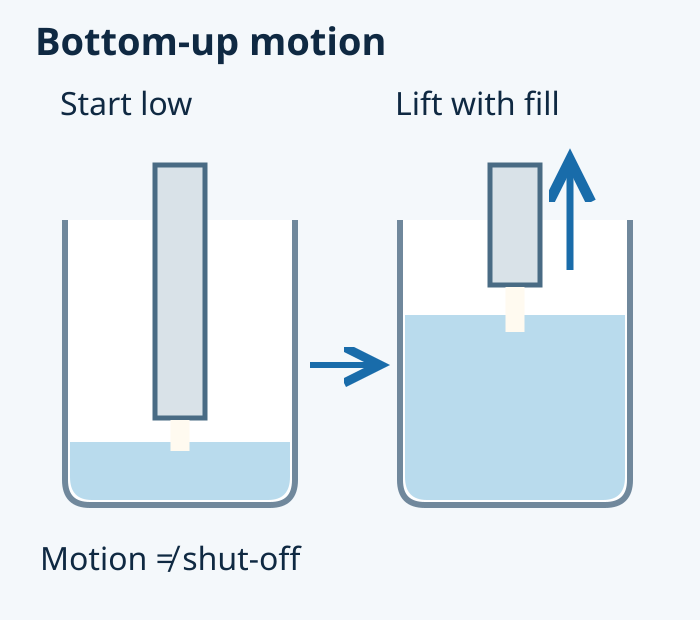
Compare nozzle motion and the means of stopping flow as separate features. With bottom-up filling, the nozzle starts lower in a suitable container and withdraws as filling progresses. This can reduce the free fall of product during a foam-prone fill. A tip shut-off closes the outlet; controlled suck-back retracts residual product. These functions may be combined, but a quotation should state which are included and how they operate at the intended pack opening.
Use a geometric rule of thumb before requesting a diving nozzle: D_nozzle + 2e < D_opening, where e is the required radial allowance for positioning error and container variation. If the available opening fails that inequality, resolve the nozzle diameter or pack handling before adding vertical travel. For a flexible pack, use its supported opening at the filling station, not its flat printed width. Ask the supplier to review the actual drawing and filled-pack removal path; no universal clearance allowance suits every container.
| Configuration to evaluate | Decision condition | Dominant Failure Mode & Prevention |
|---|---|---|
| Top fill with shut-off | Product enters cleanly without excessive free fall | Splash or foam: review outlet height and dose profile on the actual pack |
| Bottom-up / diving with shut-off | Opening and motion clearance permit controlled withdrawal | Nozzle touches wall or rising product overtakes outlet: verify centering and lift profile |
| Shut-off with controlled suck-back | A residual droplet or thread remains after the dose | Residue or air pulled into the path: evaluate timing and retraction together |
| Jacketed supply path | Approved product condition requires temperature control | Hopper is warm but outlet cools: compare hopper, hose and tip conditions |
Specify what stops the thread at the nozzle tip
A positive shut-off creates a physical closure; suck-back changes the residual product at the outlet after dosing. For a pneumatic internal-plug proposal, request a section drawing showing where the plug seats and what volume remains downstream. The phrase anti-drip does not specify that geometry. A valve farther upstream can leave product between its seat and the nozzle tip. Ask how that remaining product behaves while the next pack moves into position.
Run the cutoff observation at startup, during steady filling and after the intended pause. Film the tip and the receiving pack together, including the interval before the next dose. Record a hanging drop, a stretched filament and residue transferred to the seal area separately. Review closing timing, withdrawal timing and any adjustable retraction with the supplier. Excessive retraction can introduce a different startup condition, so compare the next fill as well as the one that just ended.
The acceptance question is whether the actual product clears the package’s closing area within the agreed sequence. For a sachet, keep cream away from the future seal area; for a jar, inspect the rim and cap interface. Define the permitted residue with the packaging and quality teams before the trial. Do not use a clean still photograph as the sole cutoff record, because it omits the thread that may stretch as the pack indexes away.
Use a water-jacketed hopper only within the formula window
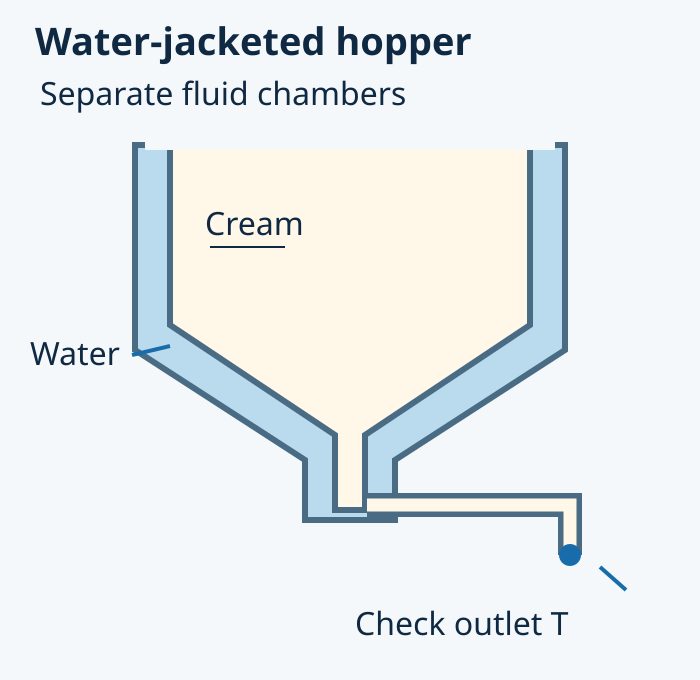
A double-wall water-heated hopper transfers heat through its inner wall; the heating water remains outside the product chamber. It is a temperature-control option, not permission to raise a cosmetic formula to an arbitrary filling temperature. Obtain the permitted product-temperature range and holding time from the formulation team first. Specify where product temperature will be measured, how the jacket is controlled and what happens during a pause or restart.
Check the entire route from the hopper to the outlet. A warm hopper does not establish the temperature of cream waiting in an unheated hose, valve or nozzle. Record these locations during the proposed assessment, particularly after an interruption. Insulation, a heated transfer path or a different layout may be worth reviewing if the product leaves its approved window before discharge. A low-speed agitator is another configuration to assess against the formula; it is not proof of acceptable shear or emulsion stability.
Apply a formulation-based rule of thumb: if product temperature T at a measured location falls below the approved lower bound T_min, or rises above T_max, resolve the thermal path before accepting output data at that condition. The formulator sets those bounds. A controller setpoint is a control input, while the product reading is the evidence that the required condition reached the filling location. Use the paste filling family overview to frame the feed and metering discussion without assuming a standard hopper size or heater rating.
Calculate outlet velocity and compare losses over one period
Use mean outlet velocity to explain why a bore change affects discharge, while keeping the pressure and cream rheology review separate. For a circular open bore, A = πd²/4 and u = Q/A. In a hypothetical comparison with Q = 5 mL/s = 5,000 mm³/s, a 6 mm bore gives u = 5,000/(π × 6²/4) = 177 mm/s; a 10 mm bore gives 64 mm/s. These are geometric averages for an unobstructed bore, not recommended settings or a prediction of foam, pressure or stringing. A plug and its annular opening need their own flow-area drawing.
Compare product loss and changeover time over the same planned production period. Product giveaway mass M = N × Δm/1,000, where N is accepted packs and Δm is average excess grams per pack. With assumed inputs of 100,000 accepted packs and 0.4 g excess, M = 100,000 × 0.4/1,000 = 40 kg. Log rejected product separately so it is not counted again as giveaway. Use the filling accuracy and speed guide to set the measurement basis before assigning value to either loss.
For the same hypothetical month, changeover hours H = C × t/60. At 20 changes and 30 minutes per change, H = 20 × 30/60 = 10 hours. Enter your measured drain, cleaning, reassembly and restart times instead of adopting these assumed values. Compare quotes using the same production schedule and product valuation, with separate rows for giveaway, rejected packaging, unrecovered cream, cleaning labor, heater electricity and replacement contact parts. Obtain energy consumption from measurement or supplier documentation; do not infer it from the presence of a jacket.
Agree a sample record that includes the next operation
Ask for a product-and-packaging sample assessment with a written scope before shipping material. Match the supplied formula, approved temperature, dose and pack to the proposed arrangement. Include the intended pause and refill condition so the record covers more than continuous dosing. Agree the sampling period and acceptable fill results with your team. Any temperature or nozzle change should have its own labelled record, rather than disappearing inside a single average.
Observe the handoff after filling: pack movement, sealing or closing, and the inspection point used to count good output. A clean nozzle event can still leave a contaminated sachet seal or jar rim during withdrawal. Review the filling line handoffs when setting the sequence and equipment boundary. Record how the product path drains and which contact parts need removal between fragrances or colors, then have the quality team define the release procedure for the next formula.
ISO 22716:2007 addresses quality practices for cosmetic production, control, storage and shipment. Its public scope supports reviewing filling within the wider manufacturing process; it does not supply a lotion filling temperature or certify a machine configuration. Keep component access, cleaning procedure and batch records in the project review. This guide uses the public scope, rather than claiming access to or compliance with the full standard.
- Record formula lot, viscosity method, product temperature and time since preparation.
- Keep pack drawing, target dose/unit and nozzle/cutoff description with each run.
- Label individual fill measurements and startup, steady-run, pause and refill observations.
- Inspect the seal area or rim after withdrawal and again at the closing operation.
- Record drain and changeover steps, then identify any condition requiring another trial.
Method, sources and the next configuration discussion
This guide combines published rheology methods, documented nozzle and hopper arrangements, and an original buyer assessment sequence. The engineering mechanisms describe configuration choices; the actual formula, pack and proposed component drawings determine their applicability. Arithmetic examples use stated hypothetical inputs. No model capacity, viscosity limit, heater specification or performance guarantee follows from them. Updated October 19, 2026.
Use the What to send us table to prepare the formula condition, pack drawing, cutoff observation, thermal window and production schedule. Send those details through the WhatsApp inquiry button to discuss the filling project and whether a sample review is appropriate. State which measurements are still missing. Confirm assessment availability, sample quantity, timing and charges before sending material. The discussion should finish with a defined product-and-pack combination and a list of configuration questions to resolve.
Common questions
Can one filling setup run several lotions and fragrances?
Each formula and pack combination needs its own review of product-contact parts, cleaning and restart behavior. List the planned combinations and record which changes involve temperature, nozzle settings or tooling. Include fragrance and color clearance in the quality procedure.
What fluids and product viscosities can this machine handle?
The proposed configuration and actual formula determine the answer. Send the viscosity measurement conditions, dose, pack opening and supply arrangement. This guide specifies no universal viscosity range; use the sample assessment to check the intended lotion or cream condition.
Can a sachet filling machine also fill bottles or tubes?
Bottles, jars and tubes need separate handling and closing arrangements. A diving-nozzle example illustrates the motion, not a conversion kit for sachet equipment. State the primary pack in the project brief so the proposed supply, dosing and closing scope can be reviewed together.
What to send us
Swipe to compare all columns.
| Item | Why we need it | Example format |
|---|---|---|
| Formula and viscosity record | Review flow at the measured condition. | Formula/lot; method, temperature and elapsed time, or not measured |
| Package and fill amount | Check opening, nozzle travel and closing area. | Drawing with dimensions; sachet, pouch, bottle or jar; dose and unit |
| Cutoff observation | Separate drips, threads and transferred residue. | Close-up clip including the next pack movement |
| Approved thermal window | Review hopper and downstream temperature needs. | Formulator-approved bounds and holding time, or not established |
| Production and changeovers | Compare good output and losses over one period. | Accepted packs/month; formula changes; recorded cleaning time |
We reply within 24 hours.