
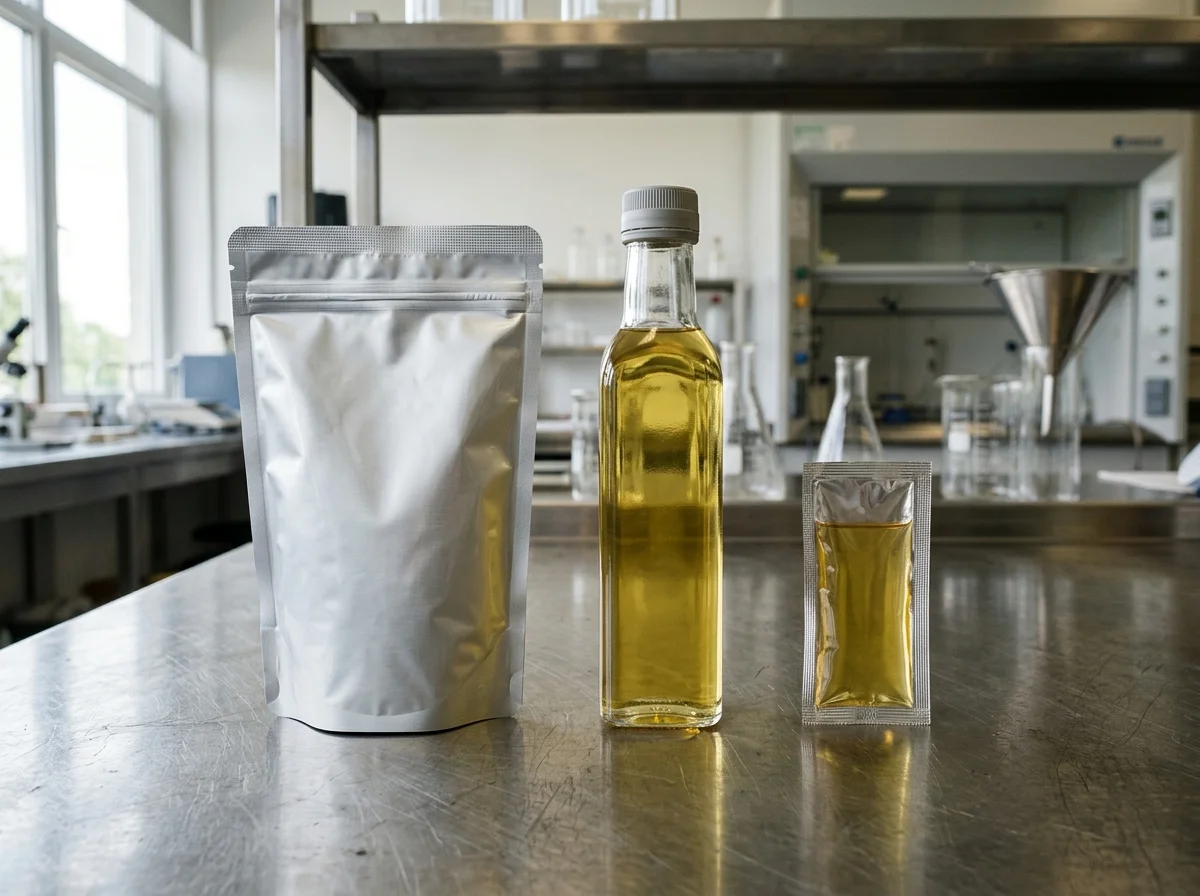
Quick Specs
Swipe to compare all columns.
| Input or item | Value or source to record | Why it matters |
|---|---|---|
| Pack route | Your drawing: bottle, premade pouch or film sachet | Defines handling and closure |
| Oil condition | Your product at filling temperature | Defines the condition the proposal must cover |
| Quantity basis | Your target in g or mL; density method if converting | Makes proposed accuracy comparable |
| Cutoff requirement | Observation at outlet and closure area | A correct dose still needs a clean pack |
| Accepted output | Good closed packs per operating period | Includes handling and rejects, not only dosing cycles |
Choose the pack before the dosing principle
Comparing an oil bottle filler with a pouch filler produces quotations for different jobs. Choose a filling machine for edible oil by fixing the pack format first, then the oil condition, quantity basis, cutoff and accepted output. A bottle, a supplied pouch and a sachet formed from film need different handling and closing sequences even when they contain the same oil.
Use this checklist to prepare a comparable project brief and a record for a sample assessment. It is based on public technical descriptions, not our equipment tests. The liquid filling machines on this site cover premade pouches and film-formed sachets; bottle filling is explained as a separate route and does not establish bottle-line supply. Begin with your launch package, and list possible future formats separately so they do not quietly become promised capabilities.
Record the handling and closure route
A pack drawing should describe both the opening that receives the oil and the closure that follows it. For a bottle, record neck geometry, container material, stability and the intended cap or other closure. For a premade pouch, record the supplied bag dimensions, gussets and opening features. A spouted pouch needs its own handling and closure review; it is not automatically interchangeable with an open-top bag.
For sachets, keep the finished pack drawing with the film specification and intended seal layout. The machine must form the pack as well as deliver the portion. Ask the packaging supplier which film structure is intended for the particular oil and storage conditions, and keep that answer with the samples. A filling-machine quotation alone does not establish package barrier performance or shelf life.
The table separates the routes without ranking them. Write the actual package revision in your brief, including the material and dimensional units. If a supplier proposes another format, ask for a revised scope rather than treating the new pack as a minor adjustment. Our liquid premade-pouch process page explains the bag presentation, opening, filling and sealing sequence.
| Format | Handling to define | Closure to confirm |
|---|---|---|
| Bottle or rigid container | Container drawing; neck; support and positioning | Cap, liner or other specified closure |
| Premade pouch | Supplied bag; magazine presentation; opening and support | Seal area and material; spout closure if applicable |
| Film-formed sachet | Roll specification; formation; print registration | Seal layout and packaging supplier settings |
Describe the oil as it reaches the filler
Record the oil identity, filling temperature and any visible sediment or inclusions using the product that will enter production. Keep infused or unfiltered recipes on separate rows from a clear filtered oil. Do not replace those observations with a generic viscosity label or assume that a trial with another cooking oil answers the same question. If viscosity or density has not been measured, write Unknown and agree how the missing input will be obtained.
Describe the upstream supply too: where the oil is held, how it reaches the filler, and what happens during replenishment or a pause. Ask whether the proposed dosing arrangement relies on a particular supply level, pressure or temperature. Those are configuration questions for the supplier, not settings that can be inferred from an oil name. If heating is proposed, have your product team define the permitted conditions before accepting it as part of the equipment scope.
Send samples that represent the intended recipe and packaging revision. Agree sample quantities and handling before shipping. The sample assessment page describes the scope available on this site; it does not promise a production run, a shelf-life study or validation of every oil formulation.
Compare what sets the dose, with the units attached
Net-weight and volumetric filling answer different measurement questions. Public manufacturer descriptions explain net-weight filling as using a load cell to control the amount by weight. A volumetric piston description instead draws product into a cylinder and dispenses a defined volume through a valve. These descriptions establish the measurement principle, not an accuracy ranking for your oil, pack size or production conditions.
A proposal that says only pump filling is incomplete for comparison. Ask for the pump type, what sets the portion, and how the outlet stops delivering product. Record the answer beside the quoted fill target. Do not treat a servo drive, an anti-drip label or an automatic control panel as the measurement principle. For the wider technology comparison, use the existing piston vs pump guide rather than choosing a technology from the word oil alone.
When checking a volume declaration by weighing, keep density and reference temperature with the result. OIML R 87:2016, Annex A.2.6.1, discusses this conversion and the need for tare determination. A scale reading in grams is not a direct reading in millilitres. Agree the applicable quantity-control method for the destination market separately; an international recommendation is not proof that a particular machine or package complies with local requirements.
| Proposed approach | Question to resolve | Do not infer |
|---|---|---|
| Net-weight control | How are the empty pack and its support accounted for? | That every flexible-pack handling system includes weighing |
| Volumetric piston | Which cylinder, valve and operating range cover this oil and dose? | That a volume setting establishes net mass |
| Named pump or flow-based arrangement | What measurement or control variable ends the dose? | That all pump systems use the same metering method |
Check cutoff at the outlet and the closing area
Assess cutoff by observing the oil after the main flow ends, including a pause and restart. Public oil-filler literature lists suck-back on one weigh-filling configuration, but that is a feature of the described system. It is not evidence that every edible-oil filler has it or that it will keep your package clean. Ask which cutoff arrangement is actually included in the proposal, and what the sample assessment will show.
For an open-top pouch or sachet, observe the area that must seal as well as the amount delivered. For a bottle, observe the neck and the area used by the intended closure. Record where any residue appears, whether it follows a normal fill or a restart, and which operating conditions were used. Do not count an externally clean package as a passing seal test; the closure needs its own agreed assessment.
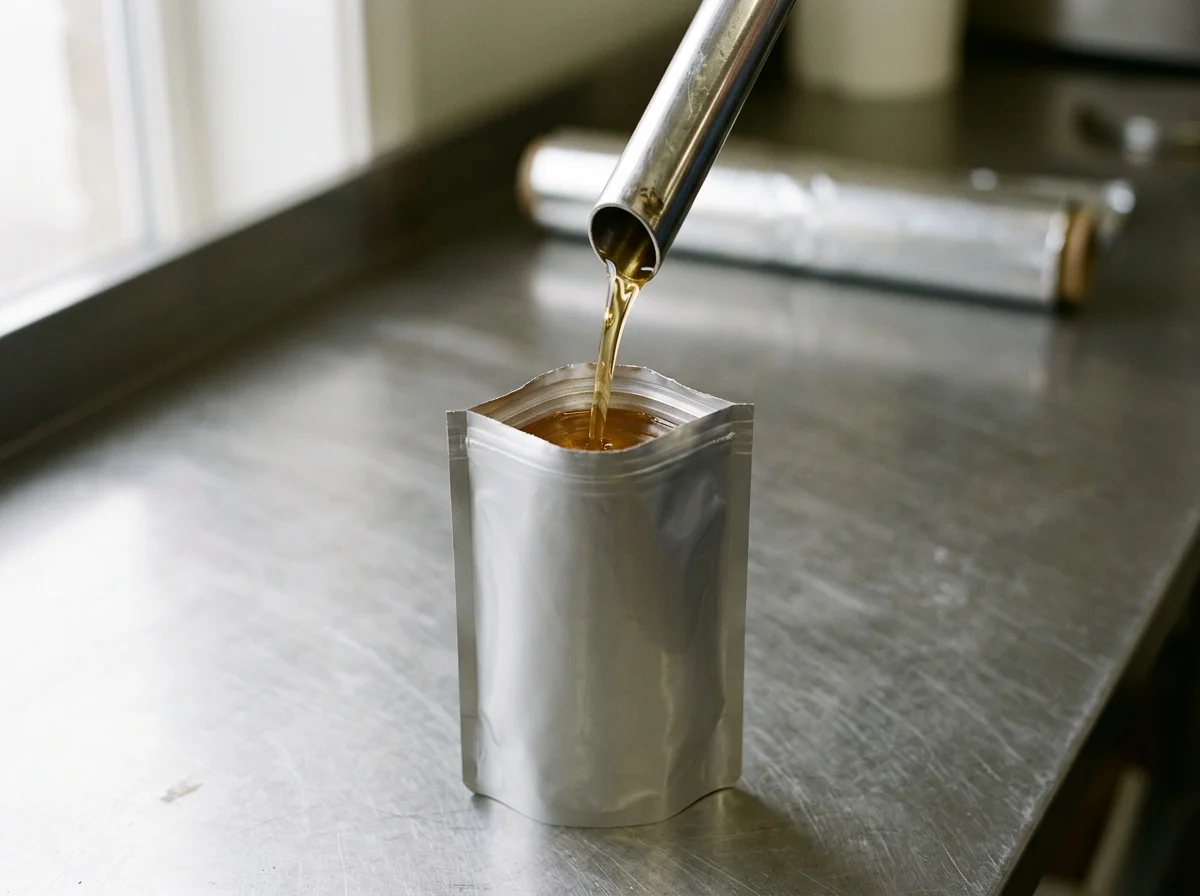
Keep a short video of the outlet and package together if the trial permits it. A close view of the nozzle alone cannot show how the oil lands in the pack, and a photograph of a finished pack cannot establish repeatability. The outlet, pack support and filling position should be visible in the proposed arrangement before you agree what the trial needs to demonstrate.
Include cleaning, changeover and the work around filling
Review cleaning against the actual product-contact path. Ask for the fitted tank or hopper, metering parts, valves, hoses, connections and outlet, then record how each is drained, accessed and reassembled. A stainless frame does not describe the contact materials, seal compatibility or cleaning procedure. Have the supplier identify those details and your plant team review them against the oil and the intended cleaning process.
For several oils or infused recipes, list the changeover sequence and the first-pack checks after restart. Keep packaging changes separate from product changes: moving a guide, replacing an outlet and cleaning a product path are different tasks. Mark any proposed change parts explicitly so they appear in the commercial scope. Do not assume that a quick recipe selection on a screen completes the physical changeover.
For a small operation, compare the whole operating period before deciding how much automation to buy. Include presenting empty packs, replenishing oil, closing, checking and removing finished packs. Record the accepted closed packs and the labour assigned under the same conditions for each proposal. A dosing-cycle figure by itself does not tell you how much saleable output the operation will produce. The manual and semi-automatic guide covers that broader decision.
Use the blank pack-format checklist during sample review
Download the blank CSV and use a separate row for each oil and pack combination. It is a record template, not a calculator or an acceptance standard. Before a trial, enter the package revision, oil condition, target quantity and unit, and the agreed measurement and closure checks. Leave unknown inputs blank rather than copying a value from a catalogue for a different configuration.
During the review, record tare and gross readings where relevant, the density method if converting units, and observations at cutoff and closure. Add the run condition so that a normal fill, a refill and a restart can be distinguished later. Agree the sample count and acceptance limits with the responsible parties before assessing the result; this blank record does not supply legal tolerances or machine performance limits.
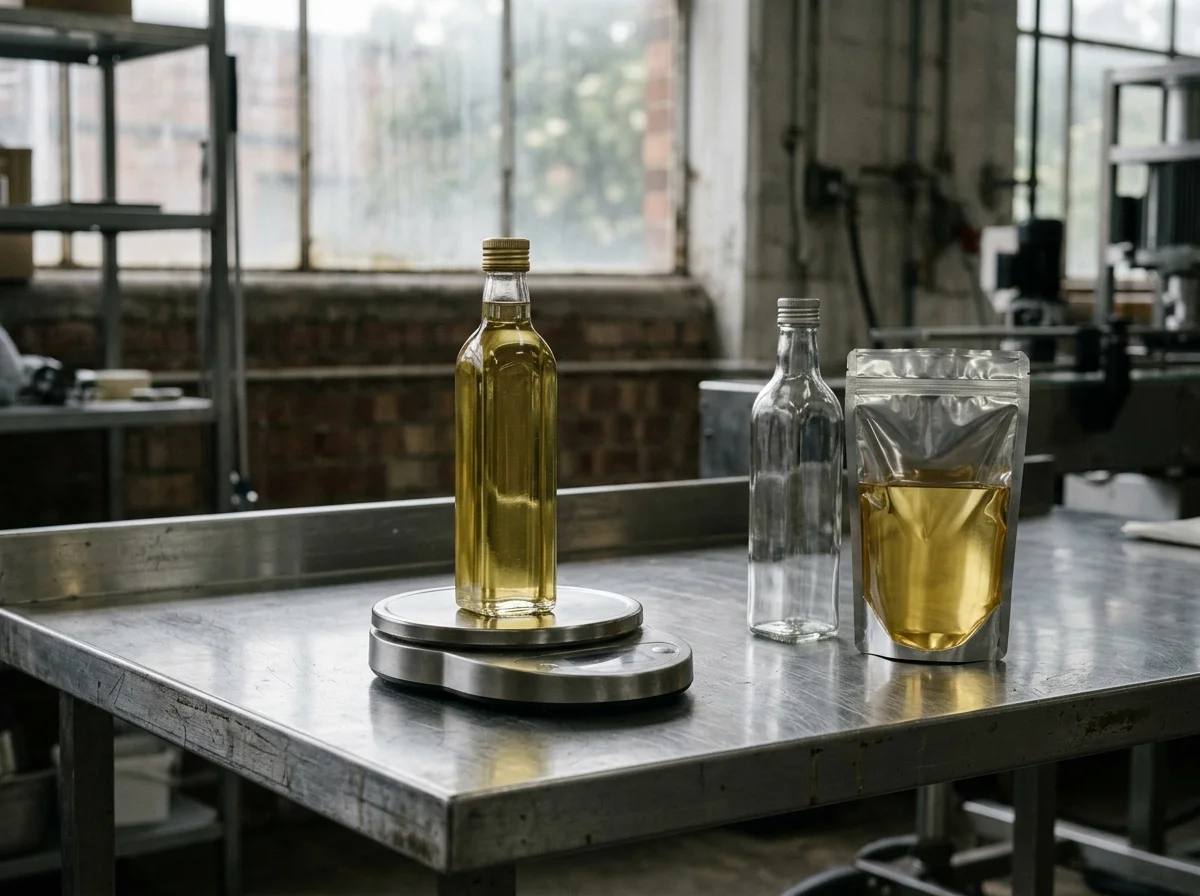
Keep a passing dose with a failed closure visible as a failed pack in your production record. Likewise, record good-pack output over the agreed observation period, with stops and rejects included. This connects the equipment discussion to the complete pack you intend to sell. The image below shows weighing objects only; it provides no measured quantity or test result.
What to send us for a pouch or sachet project
For a flexible-pack project, send the inputs below so we can discuss the proposed product and packaging route and the scope of sample assessment. Keep bottle requirements identified separately. There is no need to guess undecided dimensions or operating values: label them provisional and say who will confirm them. The same inputs should stay attached to any later equipment proposal.
| Item | Why we need it | Example format |
|---|---|---|
| Oil and filling condition | Review product supply and dosing questions | Recipe description; temperature with units; sediment observations |
| Pack format and revision | Review handling and closure route | Dimensioned drawing and supplied bag or film specification |
| Fill target and unit | Discuss the quantity-check basis | Target in g or mL; density method if needed |
| Accepted output and work sequence | Define the complete operating task | Good packs per stated period; staffing and stops |
| Cutoff and cleaning observations | Identify what sample assessment should examine | Short video or notes; proposed changeover sequence |
Method and sources — updated October 2026
This checklist combines the site’s published flexible-pack process pages with manufacturer descriptions of net-weight, volumetric and oil-filling arrangements accessed on 15 October 2026. Those descriptions explain principles and proposed features; they are not our tests and do not establish our supply scope. Manufacturer identities, retrieved pages and claim locations are retained in the editorial evidence record. No supplier speed, accuracy, price or certification claim has been transferred to this guide.
The quantity-check discussion uses the linked OIML R 87:2016 recommendation, specifically Annex A.2.6.1 and its tare and density context. The pack-route matrix, blank record and review sequence are editorial tools for preparing questions. Package suitability, cleaning procedures, closure acceptance, applicable local quantity rules and the final equipment configuration still require their own project-specific confirmation.
Common questions
Can I compare edible-oil filling accuracy in grams and millilitres directly?
No. Keep the target unit with each result. A weight-based check of a volume declaration needs the relevant density and reference temperature, together with the tare method. OIML R 87 discusses that measurement context; agree the applicable market requirements separately.
Does an anti-drip option establish that an oil pouch will seal correctly?
No. Identify the fitted cutoff arrangement and observe the closure area with the actual oil and packaging. A clean-looking outlet or an accurate dose does not establish closure performance.
Does this guide confirm bottle-filling equipment supply?
No. Bottle filling is included to distinguish its pack route. The published liquid equipment scope on this site covers premade pouches and film-formed sachets; discuss a flexible-pack project using its own samples and drawing.