
Published by LINEVO PACK · Published:
The short answer: viscosity first, then volume, then daily output
Choose the filling principle first, by how the liquid flows at filling temperature: thin liquids go to gravity or overflow fillers, small high-value doses of thin liquids to a peristaltic pump, and thick or particle-carrying products to a piston. Then choose the tier from your own timed fill cycle. Our rule of thumb: if filling fits comfortably inside one operator's day, a manual hand-lever piston or a tabletop semi-automatic filler is enough; past that, look at more heads or an automatic line. For a thin liquid the practical start is usually a semi-automatic tabletop unit, because the hand-lever fillers in the public pages we compared are pistons, while the gravity, overflow and peristaltic fillers are powered.
This is a selection comparison compiled from public manufacturer descriptions of each filler type, not a report of our own tests, and it gives no prices or machine ratings. Our own equipment examples on this site are pouch, sachet and dosing-cap fillers; bottle handling and capping are a separate scope. By the end you'll have one principle and one tier on your shortlist, a stopwatch method to check the tier, and the details to send with an inquiry.
- The filling principle has to suit the liquid before the level of automation matters.
- Manual and semi-automatic fillers both need an operator to place every bottle; the difference is who powers and times the dose.
- None of the public sources we compared gives a bottles-per-day point for upgrading, so the tier rule here is ours: time your own cycle and do the arithmetic.
- Hand capping and labeling can limit output before the filler does, so time them too.
What does each tier actually automate?
The three labels describe how much of one bottle's cycle the machine takes over, not how accurate it is. On a manual filler the operator supplies the motion, usually by pulling a hand lever or turning a crank on a piston filler. Some hand-lever piston fillers need no electricity or compressed air at all, and some draw product straight from a bulk container through an intake hose instead of a hopper. A semi-automatic filler meters and dispenses the dose by itself once the operator presses a foot pedal or button, but the operator still sets each bottle under the nozzle and takes it away. A fully automatic system moves the bottles too, usually on a conveyor with several fill heads, and is often linked to capping, labeling and reject stations.
Two public sources we compared, an equipment maker's tier overview and a supplier's FAQ, draw the same three lines. Entry-level manual equipment has the lowest startup cost and suits short runs or tight floor space, but it's less flexible and puts the most labor into every container. Semi-automatic equipment is the middle ground for a growing business, and the equipment maker describes its semi-automatic range as upgradable as needs expand. Fully automatic lines hand placing, filling, capping and labeling to machinery; they cut labor per bottle at high volumes but need a large upfront investment.
| Question | Manual | Semi-automatic | Automatic |
|---|---|---|---|
| Who places and removes each bottle | Operator | Operator | Conveyor or indexing system |
| What powers and starts the dose | Operator's hand on a lever or crank | Pedal or button, then a pneumatic, electric or pump drive | Machine control, often several heads at once |
| What sets the dose | Piston stroke | Piston stroke, fill timer, pump rotations or overflow level | The same principles, run by the line control |
| Capping and labeling | Separate, usually by hand | Separate stations; operator moves the bottles | Often linked into the same line |
| Main limit | Labor per bottle | Operator handling time per bottle | Upfront cost, and enough volume to use it |
Which filling principle suits your liquid?
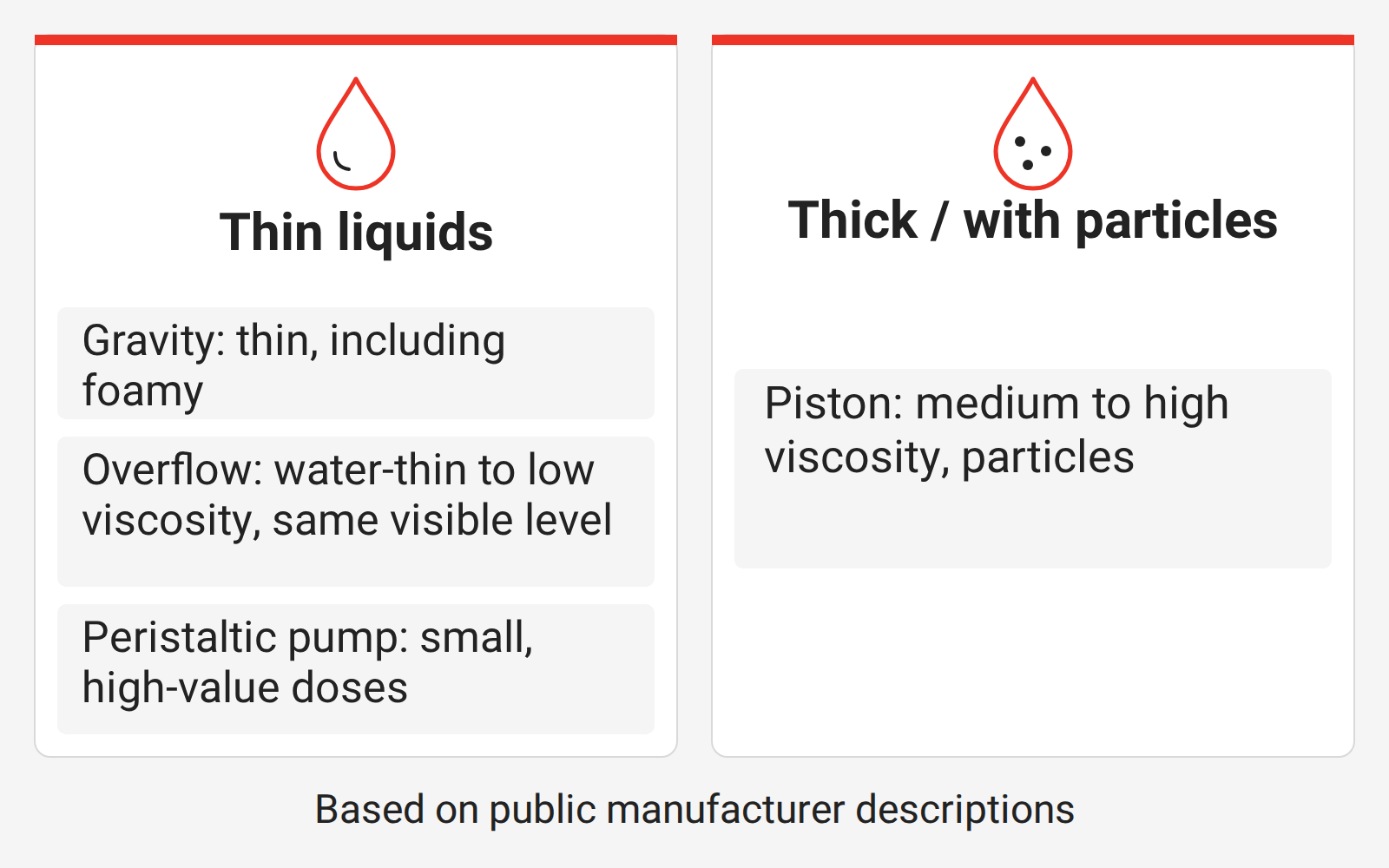
Thin liquids suit gravity or overflow fillers, small high-value doses of thin liquids suit a peristaltic pump, and thick or particle-carrying products suit a piston, whether the machine is manual, semi-automatic or automatic. Judge the liquid at the temperature you'll fill it. Gravity fillers keep a tank above the nozzles and let the liquid run down for a set time or to a set level. Manufacturers recommend them for water, juice, thin sauces and essential oils, and one maker names thin, foamy products as their best fit; thicker or chunky liquids may clog the nozzles or give uneven fill levels. A pressure-assisted version handles slightly thicker liquids.
Overflow fillers are built for water-thin to low-viscosity liquids and fill every bottle to the same visible level, which is why makers suggest them for clear bottles that must show a consistent line. In our reading the trade-off is that a level isn't a volume: if your bottles vary inside, the contents can vary with them, so check contents as well. Piston fillers draw product into a cylinder and push it out, and the stroke length sets the volume. Makers recommend them for medium to high viscosity products such as honey, syrups, lotions, sauces and products with particles. They also note more involved cleaning and changeovers, speeds below some high-throughput systems, and that very thin liquids may need extra flow-control parts.
Peristaltic pump fillers press on the outside of a flexible tube, so the product only touches the inside of the tubing, and the dose is set by counting pump rotations. Makers describe the fluid path as disposable, which simplifies cleanup and avoids cross contamination between products. They aim these fillers at small, high-value fills of thin liquids such as fragrances, essential oils and reagents. One maker says flow rate depends on drive speed, tube size and how thick the product is, so in our reading a thick product or a large bottle means a long wait per fill.
| Principle | What sets the dose | Liquids it suits | Where it struggles | Tiers named in the pages we compared |
|---|---|---|---|---|
| Gravity (timed) | Fill time, with the tank above the nozzles | Thin liquids, including foamy ones: water, juice, thin sauces, oils | Thick or chunky products | Tabletop semi-automatic and fully automatic |
| Overflow | A set level in the bottle | Water-thin to low-viscosity liquids, often in clear bottles | Thick products; equal contents when bottles vary (our reading) | Semi-automatic and fully automatic |
| Piston | Cylinder stroke length | Medium to high viscosity products, including particles | Very thin liquids without flow control; frequent product changes | Manual hand lever, semi-automatic and fully automatic |
| Peristaltic pump | Pump rotations | Small, high-value doses of thin liquids | Thick products and large fills (our reading) | Tabletop semi-automatic, with extra pump heads available |
How does the fill volume per bottle change the choice?
Volume decides whether one stroke, one timed dose or one counted dose covers a bottle, and how long each bottle holds the filler. On a hand-lever piston filler, a bottle larger than one stroke takes several strokes; one maker of these fillers describes larger bottles exactly that way. If most of your range fits in one stroke, a hand-lever or semi-automatic piston stays simple. If your largest bottle of a thick product needs several strokes, ask the maker whether a larger cylinder or volume range is available.
Large bottles of a thin liquid are where timed gravity fillers fit, and one maker describes its gravity fillers for containers from very small bottles up to multi-gallon sizes. At the small end, peristaltic fillers are described for small, high-value doses of thin liquids, with the dose counted by pump rotations and a disposable fluid path. With overflow, check that your bottles are consistent enough inside that the same level means the same contents.
If you run several bottle sizes, list them all before you compare machines. Ask what changes between sizes, such as the stroke or timer setting, the nozzle and the bottle guides, and who makes the change. Ask before you buy rather than after the first new product arrives.
How many bottles can one operator fill in a day?
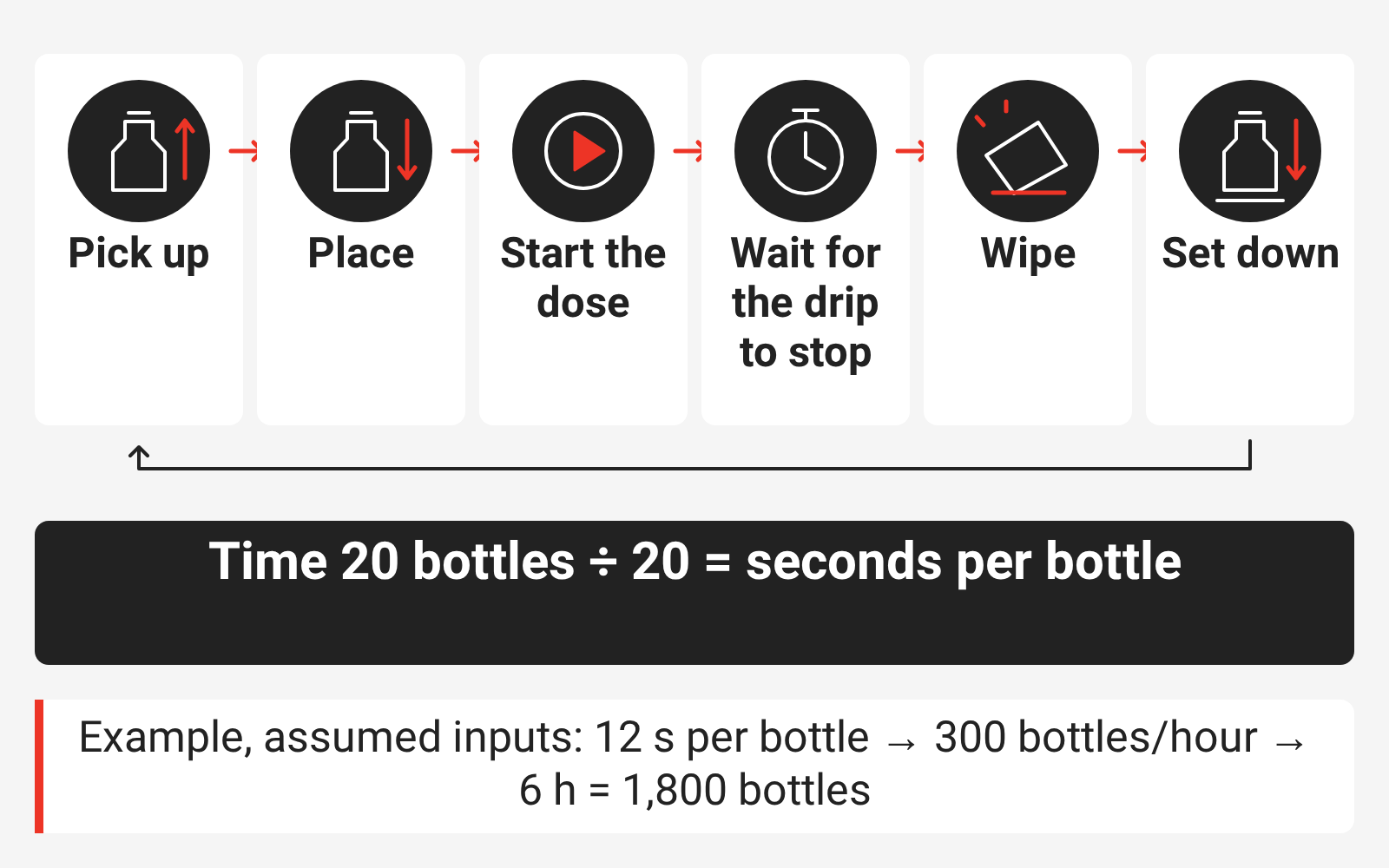
One operator fills 3,600 divided by your seconds per bottle each hour, multiplied by the hours actually spent filling. None of the public descriptions we compared gives a bottles-per-day point for leaving manual filling, so you need your own seconds per bottle. Fill 20 bottles in a row with the real product and the real bottle, and time everything a bottle needs at the filler: picking it up, placing it, starting the dose, waiting for the drip to stop, wiping it and setting it down. Divide the total by 20, and repeat the timing later in the shift in case the pace drops.
Here's a worked example with assumed inputs, not a measured rate for any machine. At an assumed 12 seconds per bottle, one operator fills 300 bottles an hour; with an assumed six productive hours of filling a day, that's 1,800 bottles. If you need 3,000 bottles a day, that's 10 hours of filling, about 1.7 of those operator days, before anyone caps or labels a bottle. Our rule of thumb, not an industry threshold: when the answer is well under one operator day, manual or tabletop semi-automatic filling is enough; when it runs past one day and keeps growing, more heads or an automatic line becomes the real question.
Count accepted bottles, not attempts. Bottles you top up, re-weigh or throw away come out of the total, and our accuracy and output guide explains how to measure net contents and accepted output so two setups can be compared fairly. If you set the dose by volume but your label states a weight, settle that conversion before you judge any filler.
A three-step decision tree
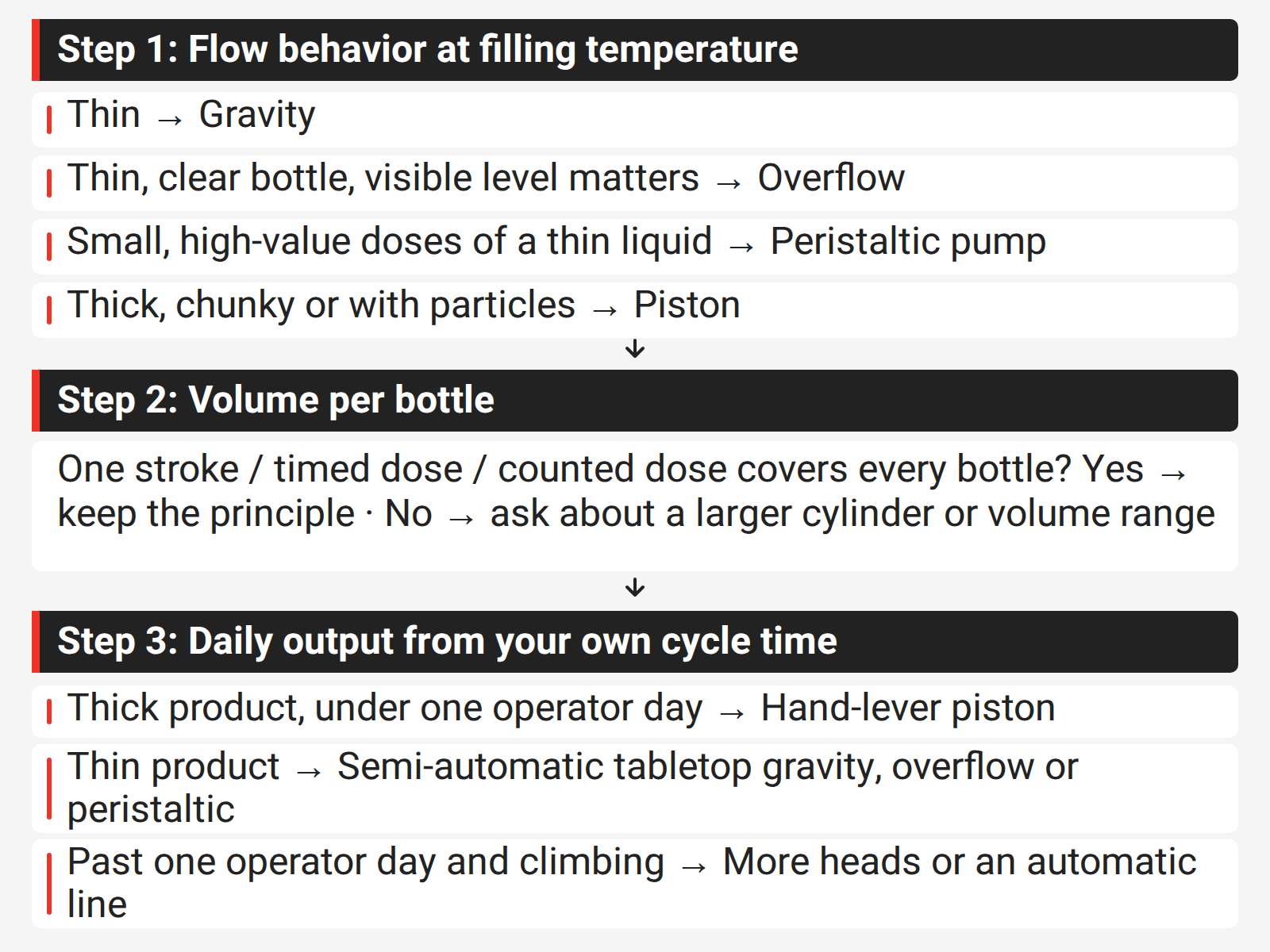
Run the steps in this order, because each one narrows the next; the steps and cut-offs are our editorial judgment, built on the manufacturer descriptions above. Step one is flow behavior at filling temperature. Thin liquids point to gravity, or to overflow if the bottle is clear and the visible level matters; foamy thin liquids are the case gravity filler makers name. Small, high-value doses of a thin liquid point to a peristaltic pump. Thick, chunky or particle-carrying products point to a piston.
Step two is volume per bottle. If one stroke, one timed dose or one counted dose covers every bottle in your range, keep the principle from step one; if your largest bottle needs several strokes, ask about a larger cylinder or volume range. Step three is daily output from your own cycle time. For a thick product comfortably under one operator day, a hand-lever piston is enough; move to a semi-automatic piston when the lever work runs for hours or results vary between operators. For a thin product, start with a semi-automatic tabletop gravity, overflow or peristaltic unit. Past one operator day and climbing, look at more heads or an automatic line, especially if capping and labeling must keep up too. If nothing fits cleanly, for example a product whose thickness changes a lot across your filling temperatures, run a trial with your product on the candidate machine before buying.
Signs it's time to upgrade, and when to wait
Upgrade when the filler is the reason you can't ship, not because a bigger machine exists. The signs listed at the end of this section are our own checklist; when several show up together, the current tier has usually run out.
Wait when the problem sits somewhere else. If bottles queue at capping, a semi-automatic capper or labeler may raise output more than a new filler would. If you run many products in short batches, a piston filler's cleaning time or a peristaltic filler's disposable tubing may matter more than speed. And if a new product hasn't been tried on any filler, trial that product before buying for it, because a machine that handles one recipe well says little about the next.
When you do upgrade, ask whether the next machine can grow. One equipment maker describes its semi-automatic range as upgradable as needs expand, and a peristaltic filler maker sells extra pump heads for more channels. Keeping the principle that already suits your product makes the step smaller.
- Filling takes more than one operator's day, and your cycle-time sums say it will keep growing
- Fill results differ between operators, or drift late in a shift
- Refilling a hopper or swapping containers interrupts the run often enough to show in the count
- A new product thickens, foams or carries particles your current principle can't handle
- Clear bottles need the same visible level and hand topping-up has become routine
- Bottles queue at hand capping or labeling while the filler waits
Mistakes that make a first filler the wrong one
A common mistake, in our view, is choosing by listing price and tier label before checking the product. A gravity filler bought for a thick sauce may clog or give uneven fill levels. An overflow filler gives a neat line in a clear bottle, but not necessarily the same contents if the bottles vary. A piston filler handles thick products well, but plan for its cleaning and changeover time if you switch products every day.
Two more checks are easy to miss. Product-contact parts, including tubing, manifolds and pumps, have to suit your formulation chemically; one timed-filler maker says fill temperature and abrasiveness decide which seal and tube materials are needed, and that each product may need its own nozzle trials. And a volume setting isn't a weight check.
For the general buying steps, from describing the product to defining the scope, read How to Choose a Filling Machine.
What to send us for a scope check
If you'd like us to look at your project, send the details below. The team checks them against the pouch, sachet and dosing-cap equipment shown on this site and tells you whether the project falls within that range or needs a separate bottle handling and capping scope. This is a scope check, not a bottle filling trial. Rough early answers are fine; say which details are fixed and which are still open.
Send them through the Request a Quote page. If you're comparing what drives cost rather than machine types, the filling machine price guide covers what changes a quotation; it lists factors, not prices.
- Product name and how it pours at filling temperature: thin, foamy, thick, or carrying particles, plus anything in the formulation that could affect tubing and seals
- Bottle type and material, whether it's clear, and the range of fill volumes
- How many products and bottle sizes you run, and how often you switch
- Bottles needed per day now and in a year, plus your measured seconds per bottle if you have it
- Whether you need capping and labeling, and how they're done today
Method and sources
We compiled this guide on 7 October 2026 from public product pages, buying guides and FAQs published by manufacturers and suppliers of gravity, overflow, piston and peristaltic fillers, read on 6 and 7 October 2026, together with the measurement method in our own accuracy guide. We used their descriptions of how each principle works, what it suits and where it struggles, and left out their performance figures, prices and model names. Those descriptions are the manufacturers' statements, not our tests. The tier rule of thumb, the decision steps and the checklists are our editorial judgment built on them, and the cycle-time example uses assumed inputs. The guide doesn't cover glass-specific handling, food safety rules or full line layout. Last updated 7 October 2026.
Common questions
How much is a hand filling machine?
We don't quote prices here, because the figure depends on the filling principle, the product-contact materials, the number of heads and what comes with it, such as hoppers, nozzles or a bottle fixture. Manual units carry the lowest upfront cost and the most labor per bottle. Compare quotations against the same product, bottle and output, not listing prices.
Is a manual bottle filler accurate enough for retail products?
It can be, if the principle suits the liquid and you check it on real bottles: weigh or measure a run of filled bottles from different operators and different points in the shift against what your label states. Treat any accuracy figure as conditional on product, dose and measuring method; the accuracy and speed guide on this site explains how to set up that check.
Can one semi-automatic filler handle both thin and thick liquids?
Sometimes, within limits. Piston fillers cover medium to thick products but may need flow-control parts for very thin liquids, while gravity and overflow fillers suit thin liquids and struggle with thick ones. If your range spans both, trial the thinnest and thickest product on the same machine, or plan for two principles.
Do I need a semi-automatic filler before going fully automatic?
No. Pick the tier your daily output and labor support. A semi-automatic step makes sense when growth is uncertain or capping and labeling are still done by hand; going straight to automatic makes sense when volume is already high and the whole line has to keep pace.
Updated: