
Quick Specs
Swipe to compare all columns.
| Recipe condition | Record before comparison | Confirmation needed |
|---|---|---|
| Smooth | Filling temperature; holding history; target and unit | Feed, dosing and cutoff under those conditions |
| Chunky | The same inputs plus measured piece size and concentration | Complete product path and acceptable piece condition |
| Either recipe | Pack drawing; closure; pause/refill observations | Accepted closed packs and cleaning access |
Why should smooth and chunky recipes have separate trial records?
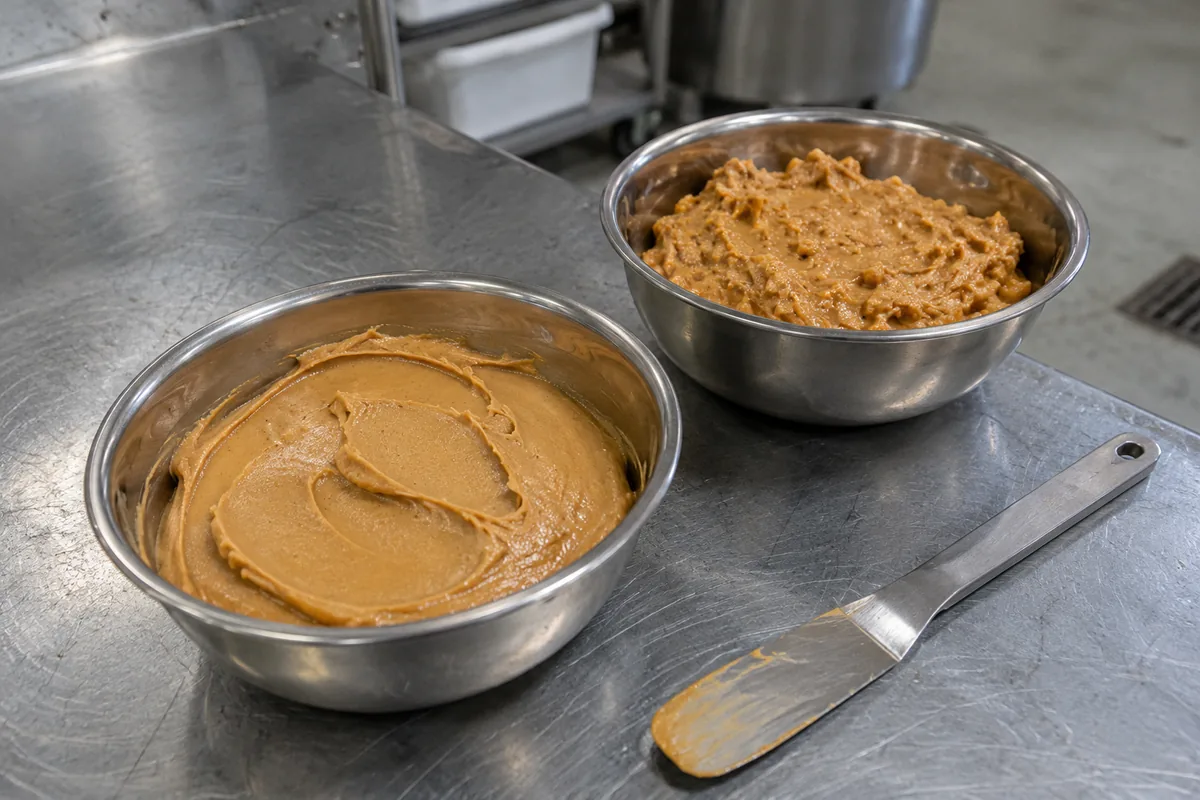
A smooth-product demonstration can waste a trial if the chunky recipe’s passage checks are left unanswered. Choose a filling machine for peanut butter by checking the actual recipe, its condition at the inlet, the complete product path and the final package together. Keep smooth and chunky peanut butter on separate trial records.
This guide turns those inputs into a fillable sample brief. It is compiled from public technical descriptions and our proposed assessment questions, not an equipment test. The paste filling machines page defines the flexible-pack scope available on this site. Jar examples here explain package observations; they do not establish that a jar-filling line is offered. For chunky recipes, obtain a written compatibility answer for the proposed contact parts before treating a smooth-product demonstration as relevant.
What should the product record say before the sample is shipped?
Record the recipe revision, batch identity and condition at the normal filling point. Include the temperature with its unit and where it was measured, elapsed holding time, transfer method and any visible oil layer or change in consistency. If viscosity is available, attach the measurement method and temperature; otherwise leave it Unknown. A product name or the word thick cannot replace those observations.
A public peanut-processing bulletin describes how formulation, processing and cooling affect peanut butter, including oil separation and the role of stabilizers. That supports recording product history; it does not supply a filling temperature for your recipe. Let the product team set permitted handling conditions. Do not copy a processing temperature from another formulation into a filler specification.
Keep the smooth and chunky samples identifiable throughout preparation and transport. For the chunky sample, record a measured description of the largest pieces observed, the measuring method and the piece concentration if known. Add close photographs and state whether broken pieces are acceptable in the finished pack. If no measurement is available, say so rather than estimating a particle limit from a photograph. Agree sample quantity, packaging and handling using the sample assessment process before sending food.
Where must chunky peanut butter pass without an unresolved restriction?
Follow the proposed route from the supply vessel to the package. Ask the supplier to identify the transfer connection, any hose or pump, dosing inlet, valve, chamber and outlet actually included. Request the permitted particle size, concentration and product condition for that installed combination. A nozzle opening alone does not answer what happens at the inlet or moving valve.
Public piston-filler documentation lists particulate-product valves separately from other outlet and heating options. It shows why the valve arrangement belongs in the configuration review, but establishes no universal peanut-piece clearance. Record the proposed part references and written limitations. Ask how the supplier will assess passage, blockage and piece damage with your chunky sample. Do not convert a bore diameter into an allowable particle threshold using an assumed safety ratio.
For a smooth recipe, start by checking repeatable feed, portion delivery and the end of the deposit under the recorded conditions. For a chunky recipe, add the full-path and piece-condition checks before comparing output. If a pump-fed arrangement is proposed, name the pump and how the portion is controlled. The piston vs pump guide covers the general principles; the additional job here is to keep each recipe tied to its own trial record.
| Review point | Smooth recipe | Extra question for chunky |
|---|---|---|
| Supply and transfer | Record feed method and product condition | Which included restrictions contact the pieces? |
| Dosing valve and chamber | Confirm how the portion is set | What piece size and concentration are permitted? |
| Outlet and cutoff | Observe the end of the deposit | Are pieces trapped or damaged during closing? |
| Written result | Identify the installed parts and trial conditions | Keep compatibility limits with the same recipe record |
Does the hopper need heating or agitation?
Keep heating and agitation as decisions to justify from the recipe record. If the sample develops a visible oil layer or changes consistency during holding, record when that happens and the conditions. Ask what the proposed hopper arrangement is intended to control, how it will be monitored and which product limits it must respect. An attachment name does not establish that the recipe remains suitable throughout production.
Manufacturer documentation describes heating as an option that can reduce viscosity and mixing as a way to maintain temperature uniformity in that arrangement. These are reasons to ask a question, not instructions to heat every peanut butter. Before a trial, agree the permitted product-temperature range with your product team and document the actual settings used. For chunky material, include acceptable piece condition in the review of any agitation.
Assess the complete supply sequence, including replenishment and the proposed holding period. Keep observations made before adjustment separate from those made afterward. If an adjustment changes the product condition, identify the changed condition in the record instead of combining all readings as one result. Product stability after packaging requires its own assessment; a hopper mixer does not prove shelf life.
What must the trial show at the package opening?
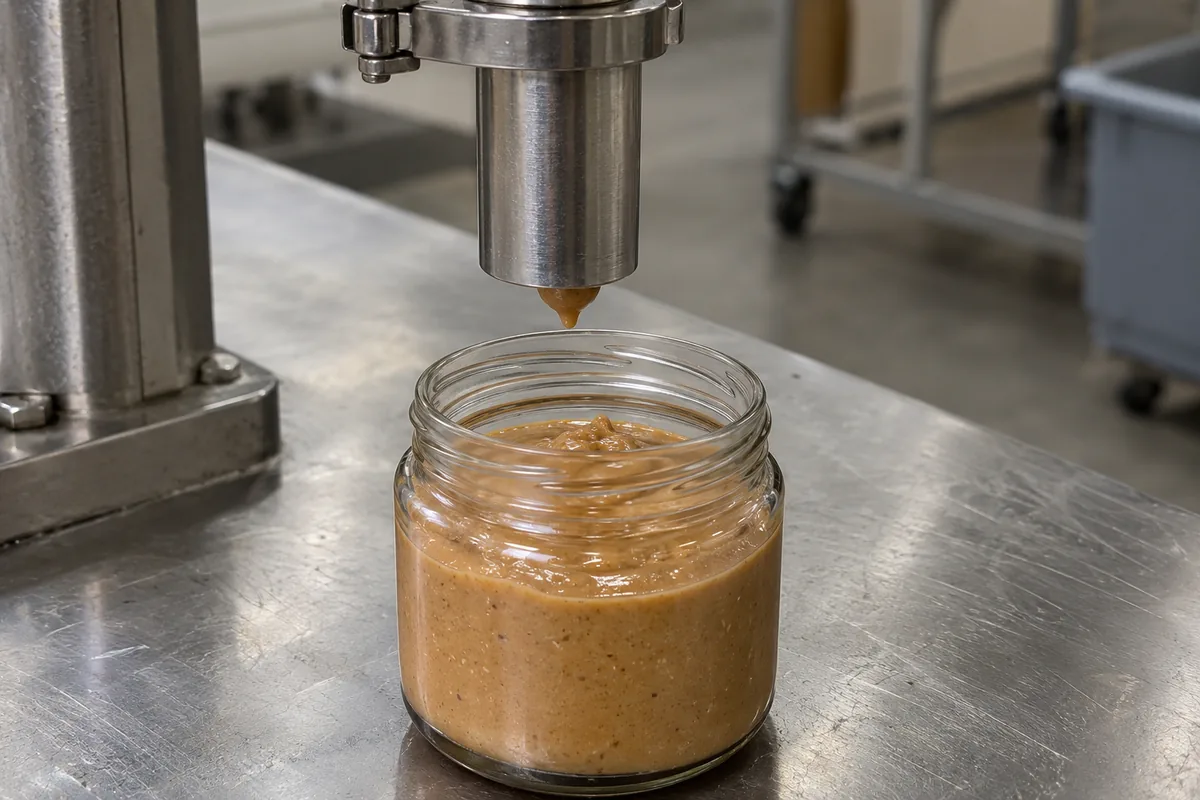
Observe both the portion and the area that will be closed. Record the container or pouch drawing revision, opening dimensions and the specified closure. Watch the end of the deposit for a hanging tail, a late drop or paste on the rim or seal area. Note where it lands and whether the pack can proceed through its intended closing operation under the agreed acceptance criteria.
Keep jar, premade-pouch and film-sachet observations separate. A jar has a rim and closure arrangement to inspect; a flexible pack has an opening and seal area that must stay suitable for its specified closing process. A public peanut-butter packaging description treats filling, capping and conveying as separate equipment functions. A successful deposit therefore does not settle the whole packaging task. Our sauce-sachet process page explains the flexible-pack sequence in more detail.
Use the actual packaging samples wherever an assessment has been agreed. Photograph the opening after cutoff and retain both acceptable and rejected examples with their sequence or time reference. If a different jar, pouch or film is substituted, identify it. The image below helps locate the outlet and jar rim; it supplies no evidence of a tested dose, selected nozzle or accepted closure.
How should pauses, refills and output be recorded?
Agree an observation sequence that includes the operating events relevant to your process. Keep startup, steady running, a planned pause, restart and replenishment identifiable in the log. Record the conditions and any adjustments at each event. Collect portion results by sequence so a satisfactory overall average cannot hide a change following a restart. This is a proposed trial structure; the supplier and buyer still need to agree its duration and acceptance limits.
Write the target amount and unit before measuring. For mass checks, record the weighing and tare method alongside individual results. Do not silently treat grams as millilitres. Count acceptable closed packs at a defined point over a stated period, and keep rejects and stops visible. The filling accuracy and production speed guide explains those measurement distinctions without supplying a performance promise for peanut butter.
A manual filling machine for peanut butter still needs these product-path and cutoff checks. Manual or semi-automatic operation also needs an agreed account of who presents the pack, triggers the dose, removes it and closes it. Record the working sequence when discussing required output. A motorized dosing unit alone does not define an automatic packaging line, and a short continuous demonstration does not describe all the work in a production period.
Which contact parts need access during cleaning?
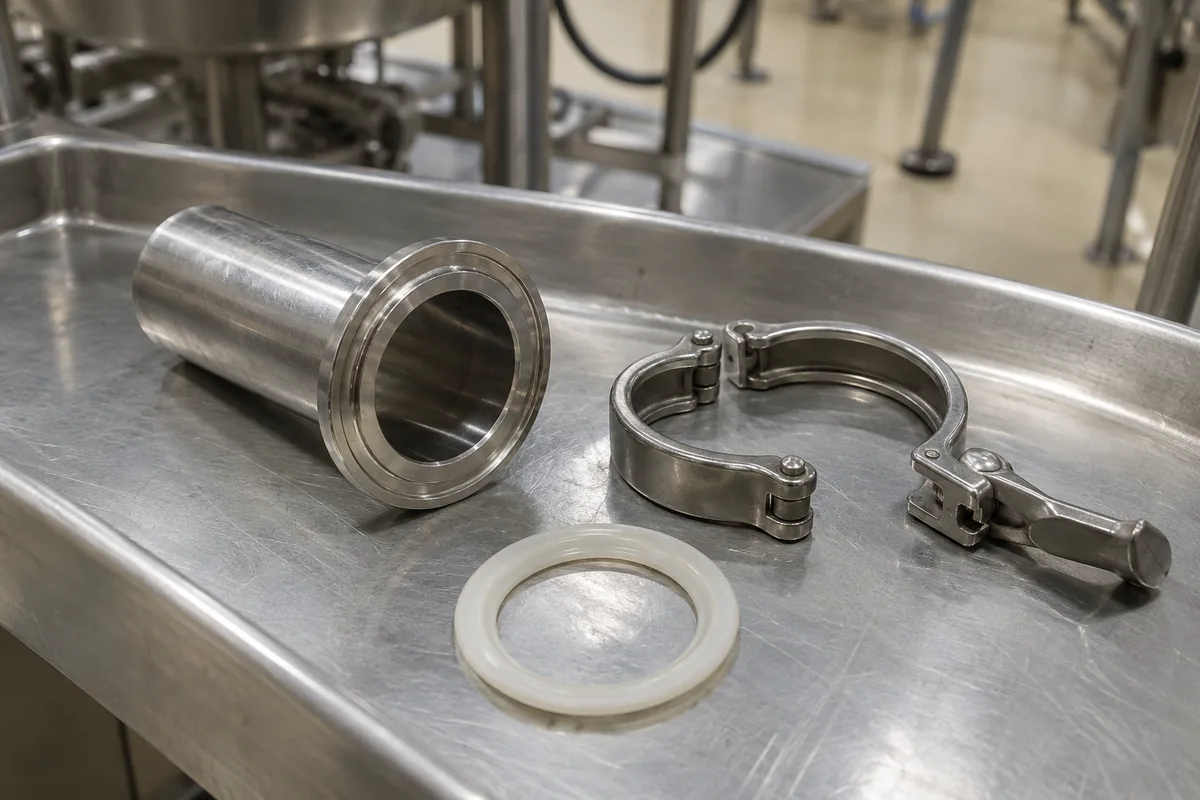
Ask for the cleaning and disassembly instructions for the proposed contact path. List the hopper outlet, transfer connections, dosing parts, valve seats, seals and nozzle that are actually included. Identify how each is accessed, inspected, cleaned and reassembled. Ask which tasks need isolation, tools or replacement seals, and let the responsible food-safety team determine the cleaning and release criteria.
FDA’s January 2025 draft guidance for low-moisture ready-to-eat foods distinguishes removal of residue from sanitizing treatments. It also cautions that cleaning alone, including material flushing, has not been shown to mitigate pathogen contamination on food-contact surfaces. The document is draft, nonbinding guidance, not a cleaning recipe or equipment approval. A visibly clean nozzle and a product purge do not establish pathogen control.
For shared equipment, include the next product’s allergen profile in the changeover review and ask how cleaning effectiveness will be assessed. Leave detergent selection, moisture control, sanitizing conditions and release decisions with the qualified site team and equipment instructions. Record unresolved access or reassembly questions before equipment selection. The separated outlet, gasket and clamp below illustrate the contact details to discuss; they are not a validated cleaning procedure.
Fill in a separate brief for each recipe
Use the blank CSV below as a working record, with a separate row for each recipe and package combination. Duplicate rows when the product condition or pack revision changes. The fields mirror the checks in this guide: actual filling condition, measured particle description, target and pack, valve and outlet compatibility, pause or refill behavior, cutoff, closure observations and contact-part access.
Enter Unknown where a measurement or supplier answer is missing. In the written-confirmation field, identify the unresolved question and the document or trial result needed to close it. Keep supporting drawings, sample identifiers, photographs and raw readings with the completed file. The blank download contains no machine ratings or test results and does not itself establish approval.
Discuss the completed record against the proposed configuration before comparing quotations. A useful proposal should distinguish included equipment, required utilities, packaging assumptions, agreed trial work and open items. If chunky-product passage, package closure or cleaning access remains unresolved, retain that question explicitly in the scope instead of treating a general peanut-butter application claim as the answer.
| Field group | Your entry | Evidence to attach |
|---|---|---|
| Recipe and actual condition | Unknown / enter your measurement | Recipe revision; temperature and handling record |
| Particle description | Unknown / enter your measurement | Method; piece photographs; concentration if known |
| Target and package | Unknown / enter your requirement | Target unit; drawing and closure revision |
| Path, cutoff and restart | Unknown / record observations | Installed parts; event log and pack photographs |
| Cleaning and confirmation | Unknown / identify open questions | Instructions; contact-part list; written supplier answer |
Method, sources and limits
This guide combines public equipment descriptions with a proposed buyer record; it contains no measured peanut-butter filling results. Sources beside the relevant sections support the product-condition, configuration and sanitation distinctions. Historical processing context is not a recommended operating recipe. Supplier-specific performance figures have been excluded because they do not establish capability for your recipe and package.
The images visualize texture, outlet and contact-part details; they do not document a customer installation, supplied model or acceptance trial. The CSV is an empty working template. Particle limits, allowable product temperature, accepted output, contact-material suitability and cleaning effectiveness remain questions for the actual unit and process. Updated 16 October 2026 after reviewing the cited public sources.
Common questions
Can a smooth peanut butter trial cover a chunky recipe?
It leaves the particle-passage and piece-condition questions open. Keep a separate chunky record with measured piece information, the proposed contact path and written compatibility limits. Use the full-path section above to identify the missing checks.
Should the blank brief contain estimated particle limits?
No. Enter observed or measured product information with its method. Keep the allowed size and concentration as supplier-confirmation items for the installed combination of transfer, dosing, valve and outlet parts.
Does this guide confirm jar-filling equipment availability?
No. Jar examples explain rim and closure observations. This site’s paste family page defines its flexible-pack scope; any different container route needs a separate scope review.