
Portion sauces into film-formed sachets
A sauce sachet filling and sealing machine combines product dosing with packaging made from film. The sequence coordinates film transport, sachet formation, sauce delivery, seal completion and cutting. Ketchup and similar pumpable condiments are useful starting applications. The product path and packaging tooling need to be reviewed against the actual recipe and the intended portion.
Begin with the finished sachet drawing, film specification and product description. Identify the seal format instead of treating every small flexible pack as the same construction. This page describes a sachet equipment family; it does not assign one model, lane count or output to every recipe. Those details should follow the product-and-pack review and appear in the written equipment specification.
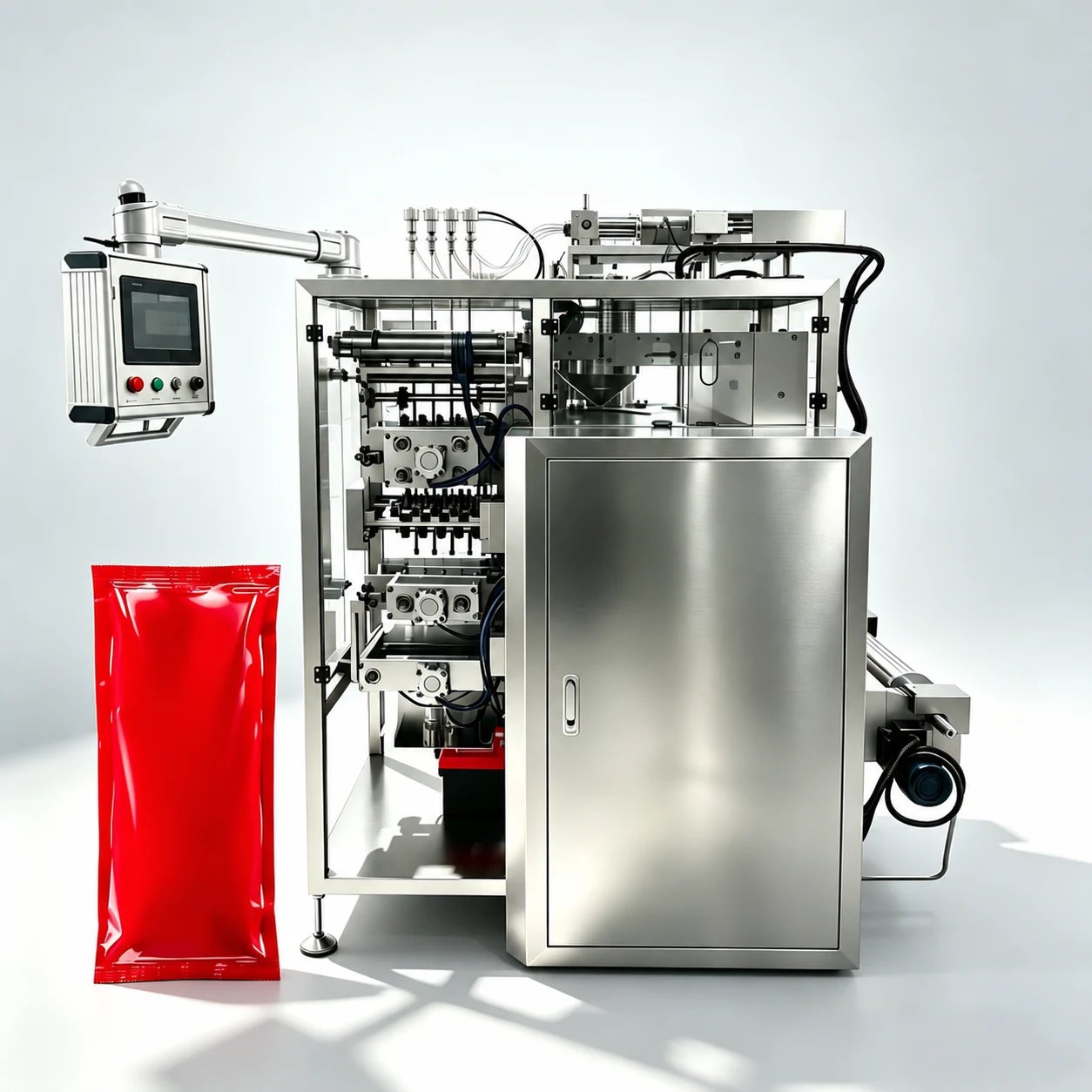
Supply the sauce under representative conditions
The hopper and transfer arrangement deliver product to the metering unit. Explain how sauce reaches that hopper, the normal filling temperature and the time it may remain there. Describe separation, settling or any change in consistency during a pause. Those observations help define whether a supply option should be included and what it is expected to achieve.
Where heating or agitation is proposed, discuss the purpose and permitted product conditions. The illustration of a hopper and connecting hoses provides a useful view of this part of the process, but the final contact path needs confirmation. Include refill and drainage tasks in the review. A dosing assessment is more informative when the sauce supply resembles the arrangement planned for routine production.
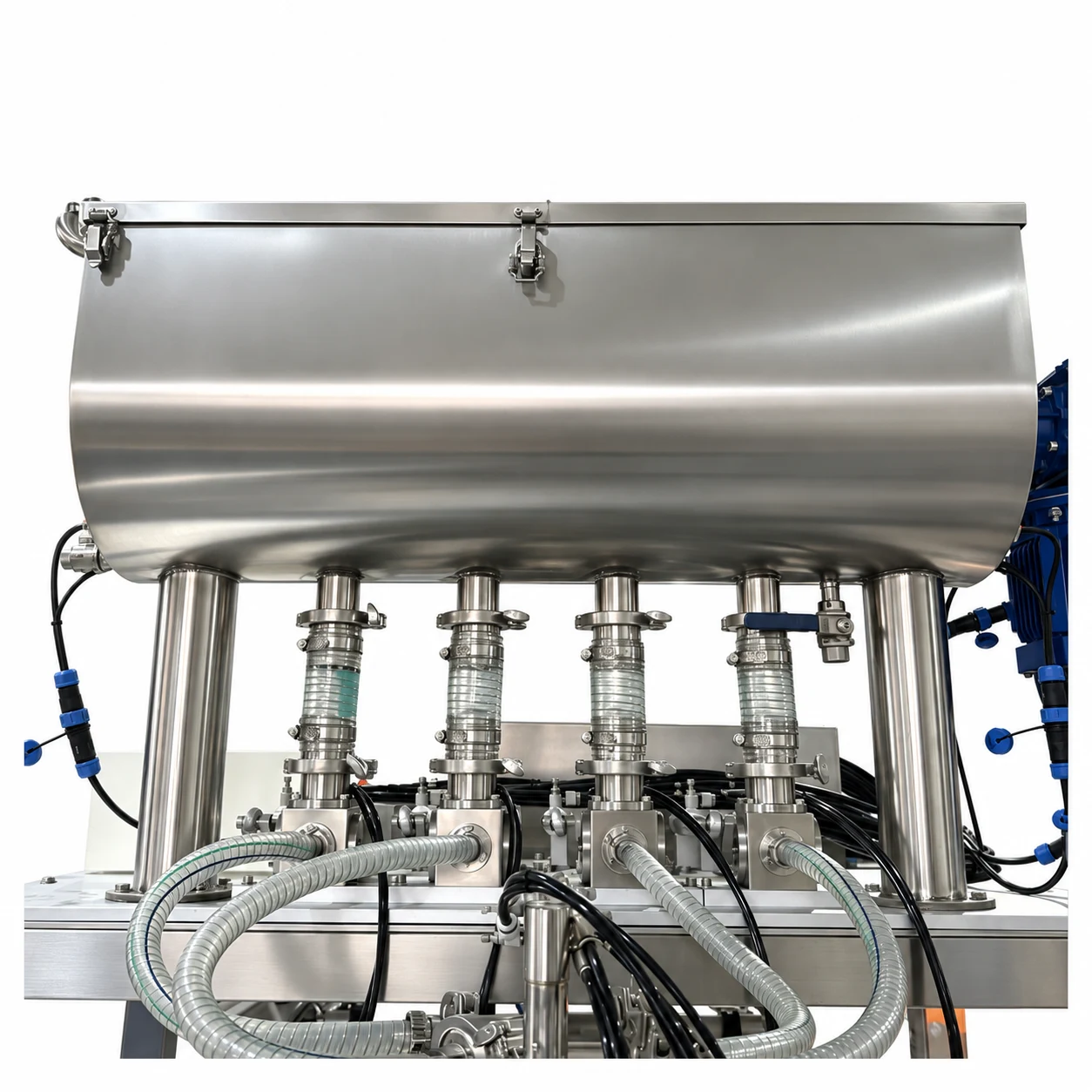
Review the piston, valve and nozzle together
A piston metering arrangement is one route described for this sauce equipment family. Its operation needs to be considered together with the valve and filling outlet. Discuss the portion range, adjustment method and the product-contact parts included in the offered configuration. Where the sales portion is specified by weight, agree a measurement procedure for the finished output.
Observe cutoff behavior during sample filling. A portion may have the intended quantity while still leaving a tail or residue near the sachet opening. Ask how nozzle position and timing are reviewed against that behavior. If the sauce contains pieces, include their dimensions and acceptable condition after filling. The full path must be assessed with the recipe, rather than selecting an outlet from viscosity alone.
Specify the film and the four-side package
A four-side-seal sachet is closed by seals along all four edges, so the seal layout, the portion and the finished dimensions must fit within one defined perimeter. Provide a drawing showing the usable product space, artwork and opening feature. Include film structure and print-repeat information from the intended packaging supplier. If another seal format is requested, state it as a separate tooling requirement rather than assuming it is covered by the same arrangement.
Review how the film is presented, aligned and cut in the offered configuration. During a trial, check print position, overall dimensions and the appearance of the seal regions. A small change in pack layout can have consequences for tooling or setup, so keep the drawing revision attached to the equipment discussion. The proposal should identify the actual formats that have been included.
Keep sauce delivery clear of the closing region
Product delivery and package closure need a coordinated sequence. Observe the position of the nozzle and the condition of the film as the dose finishes. Record splashes, trailing product or pieces close to the sealing area. These observations help define the next adjustment or tooling question, and they should be considered alongside quantity measurements.
Agree the finished-sachet checks before the run. Depending on the project, these can include external cleanliness, seal appearance, cut position and a defined handling or leak check. Use the intended sauce and film whenever possible. A visually neat sample is useful, but it should not be presented as proof that a different formulation or packaging material will behave identically under production conditions.
Make recipe and portion changes practical
List the sauces and portions planned for the machine, including the product that will run most often. Describe differences in flow, particles, color and residue. Ask which dosing or contact parts change between those recipes. Include the corresponding sachet drawings so the review can distinguish a product adjustment from a packaging-format change.
Discuss access to the hopper, valve, metering components and outlet for cleaning and inspection. State the site's intended cleaning procedure and utilities. A complete changeover plan includes clearing product and film, reassembly and checking the first acceptable sachets. Identify the parts and settings that need documentation so the production team can return to the reviewed configuration after cleaning or maintenance.
Define output, coding and collection requirements
Decide whether the proposed machine ends at sachet discharge or includes coding, inspection and collection. Share the next operation and any requirement for pack orientation or grouping. If multiple lanes are proposed, ask how total output is counted and how samples remain traceable to the relevant lane. Keep optional functions visible in the quotation rather than assuming they are present.
Describe performance with the product, portion, film, layout and run conditions attached. Include replenishment and relevant stops in the production discussion. A useful assessment records acceptable finished sachets and the reasons for any rejected output. This provides a clearer basis for comparing configurations than a maximum speed that does not identify the actual recipe or packaging used.
Prepare the materials for a focused assessment
Send the complete sauce description, filling temperature, portion and unit, sachet drawing, film information and output requirement. Include the maximum particle size and concentration if the recipe contains pieces. Explain any cutoff, dripping or sealing problem observed with the current process. These inputs help the team define an assessment with a specific question and representative materials.
The next review can then follow the full path from hopper to finished sachet. Record quantity, product condition and packaging observations together. Confirm the selected dosing parts, seal format, tooling, controls and included options in the proposal. The goal is a configuration description that production staff can evaluate against their recipe and packaging, with the remaining questions clearly identified before an equipment decision.
| Review item | Information to confirm |
|---|---|
| Recipe | Temperature, consistency, separation and particles |
| Portion | Target amount and agreed quantity measurement |
| Sachet | Seal format, finished dimensions and usable fill space |
| Film | Structure, print repeat, code and opening features |
| Supply path | Hopper, transfer, valve and outlet configuration |
| Checks | Cutoff, seal-area condition and finished-pack evaluation |
Common questions
What is a sauce sachet filling machine?
A sauce sachet filling machine forms small packs from roll film, doses a measured sauce portion into each one, then seals and cuts them. The reference format on this page is a four-side-seal sachet, and piston metering is one dosing route discussed. Hopper supply, valve and nozzle behavior, film and seal layout are reviewed together for your recipe.
Can a sachet machine make formats other than four-side seal?
Four-side seal is the reference format on this page; other seal formats need to be specified and confirmed as a separate tooling requirement. Send the drawing with film layout, print repeat and opening feature. Even a small change to sachet width or seal layout can affect forming and sealing parts, so keep the drawing revision attached to the quotation.
How do you stop sauce dripping onto the sachet seal?
By reviewing cutoff behavior, not only the portion weight. Observe the end of each dose, because trailing sauce or splashes near the opening can affect the seal even when the quantity is correct. Nozzle position, timing and valve arrangement can then be reviewed and rechecked with the actual sauce and film under agreed conditions.
Updated: