
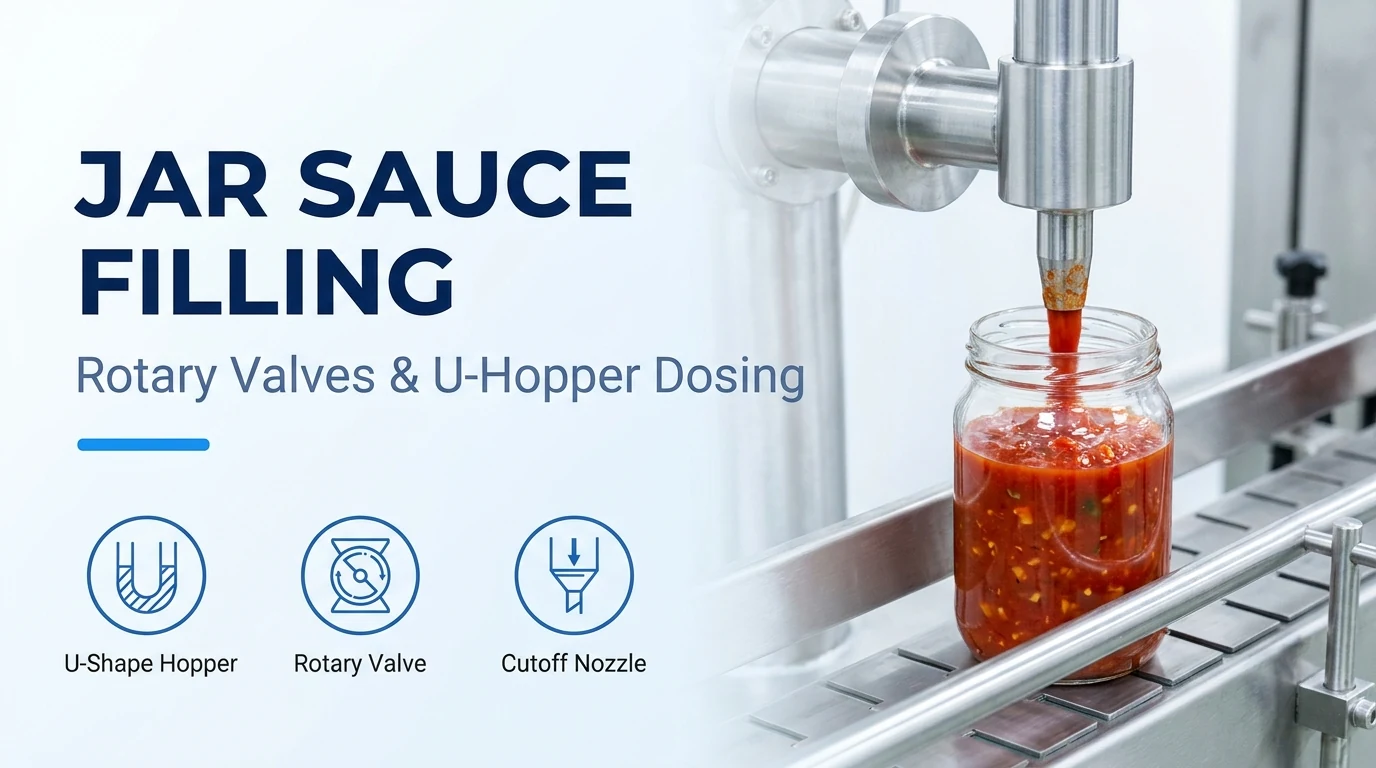
At a glance
Swipe to compare all columns.
| Review area | Bring to the discussion | Decision to record |
|---|---|---|
| Particulate dimensions and valve passage | Max cube size (up to 0.75–2 in.), solid fraction, and chunk friability | Three-way quarter-turn rotary valve or chunky butterfly valve vs check valve |
| Hopper conditioning and thermal window | Fill temperature (180–200 °F HFH vs ambient), equilibrium pH (≤4.6), and settling rate | U-shaped horizontal hopper with spiral ribbon mixer and optional heated jacket |
| Nozzle cutoff and jar rim geometry | Wide-mouth jar neck ID, plastisol lug cap vacuum check, and headspace target | Rotary/horizontal/plug-spout/ball cutoff nozzle and ISO 3310-1 / No. 8 sieve check |
Three-Way Rotary Valves vs. Check Valves in a Jar Filling Machine
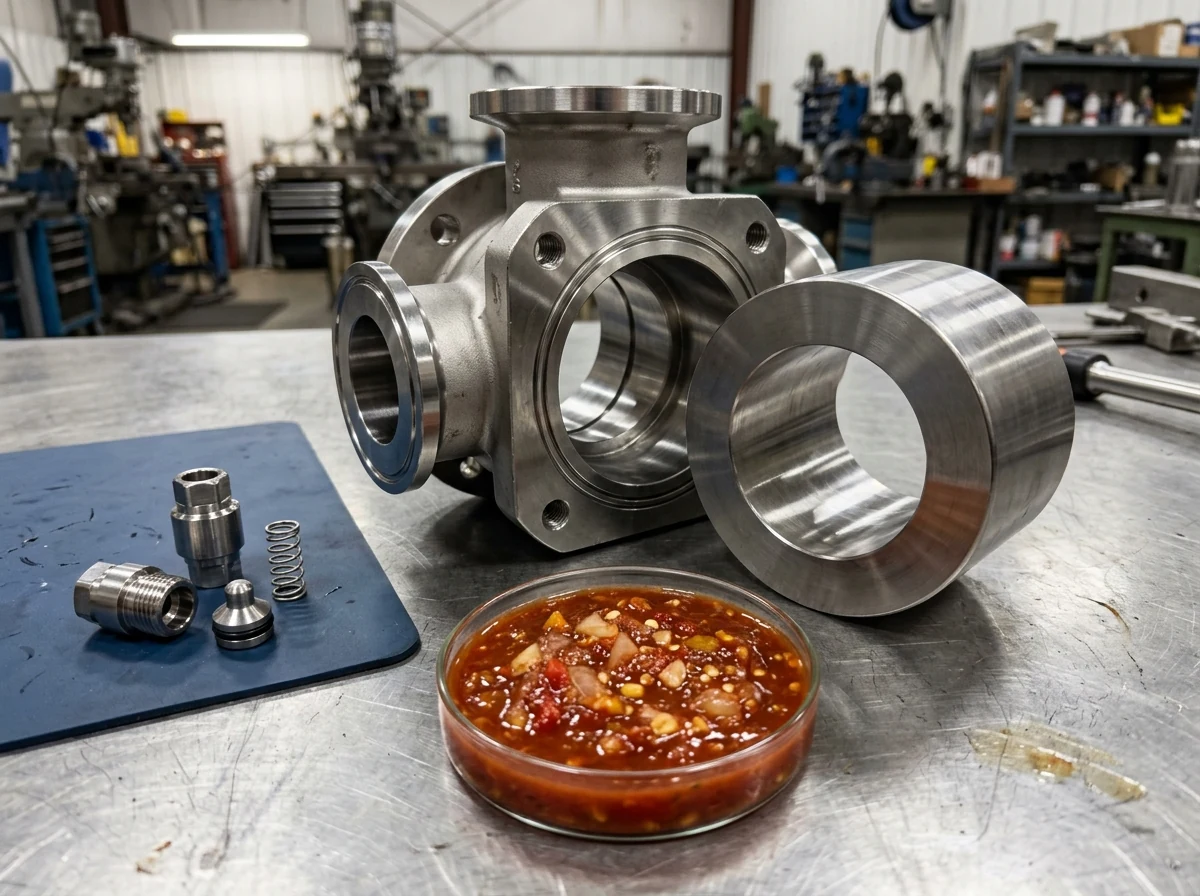
On piston fillers for food products with particulates (such as jellies and jams with fruit chunks, chunky cottage cheese, salsa, and salad dressings), with most of those particulate foods, the piston filling machine will use a three-way rotary valve with a hollowed-out portion to move product from the hopper to the cylinder, then rotates so the piston forces product through the nozzles into containers. Spring-loaded check valves on piston fillers only allow one-way flow and suit low-viscosity solutions without particulates, because viscous products can cause them to close erratically and solids can prevent leak-tight closure between discharges. Quarter-turn rotary valves on piston fillers rotate between charging and discharging positions to allow full flow with no restrictions. In piston vs pump filling comparisons, piston filling is a two-stroke volumetric method where cylinder geometry and stroke length set the volume, whereas pump fillers are identified by mechanism (gear, rotary lobe, screw, time-based, or peristaltic) and control variable (rotation, time, or valve), with thick and particle-containing recipes requiring joint review of the piston chamber, valve passages, and nozzle.
The Unifiller Systems Pro 1000i piston depositor has a 3-inch piston diameter and handles a maximum particulate size of 0.75 inch cubes with a 14-gallon hopper capacity. The Unifiller Systems Pro 1000i piston depositor has a deposit range from 0.5 ounces minimum to 32 ounces maximum and an output of up to 140 cycles per minute. The Unifiller Systems Pro 1000i is pneumatically operated with air requirements of 4 CFM at 80 PSI and approximate dimensions of 52 inches long by 26 inches wide by 68 inches high. Hinds-Bock SP-64 single-piston filler/depositors feature large port openings that permit filling chunky ingredients without crushing and are USDA and AG Canada/CFIA approved. The Hinds-Bock SP-64 depositor has a maximum deposit size of up to 64 ounces per piston, a 6.7-gallon hopper (12 inches diameter by 15 inches depth), and a 2.25-inch flanged discharge diameter. The Hinds-Bock SP-64 has paddle agitation and requires 80 PSI air, a 0.5 HP motor, and 120 V / 60 Hz / single-phase power, with dimensions of 54 inches length, 27 inches width, and 77 inches height.
Volumetric Technologies piston fillers (1500, 2000, 3000, Incline 3000 Series, and Bench Top) are rated for accuracy up to +/- 0.25 of 1%, fill volumes from 1/4oz to 5 gallons, speeds up to 90 cycles per minute, and particulate sizes up to 2 inches. Volumetric Technologies piston fillers use product contact surfaces constructed from 316L stainless steel and FDA/USDA approved materials, with a solid-state PLC in a UL-listed control panel. Volumetric Technologies benchtop piston fillers are typically around $6k while larger fillers range from $16k to over $100k, with a 1-year parts and labor warranty and lead times of 2-6 weeks for smaller projects and up to 6 months for larger projects. For paste filling machines, we engineer and assemble our systems at our LINEVO PACK facility in Foshan, Guangdong, China (WhatsApp +86 153 3888 8949), reviewing the inlet, valve, and outlet together and asking inquiries to include the recipe and temperature, particle details, cutoff video, fill target and unit, sachet or film details, and acceptable output.
U-Shaped Stirring Hoppers, Spiral Mixers, and Viscosity Conditioning
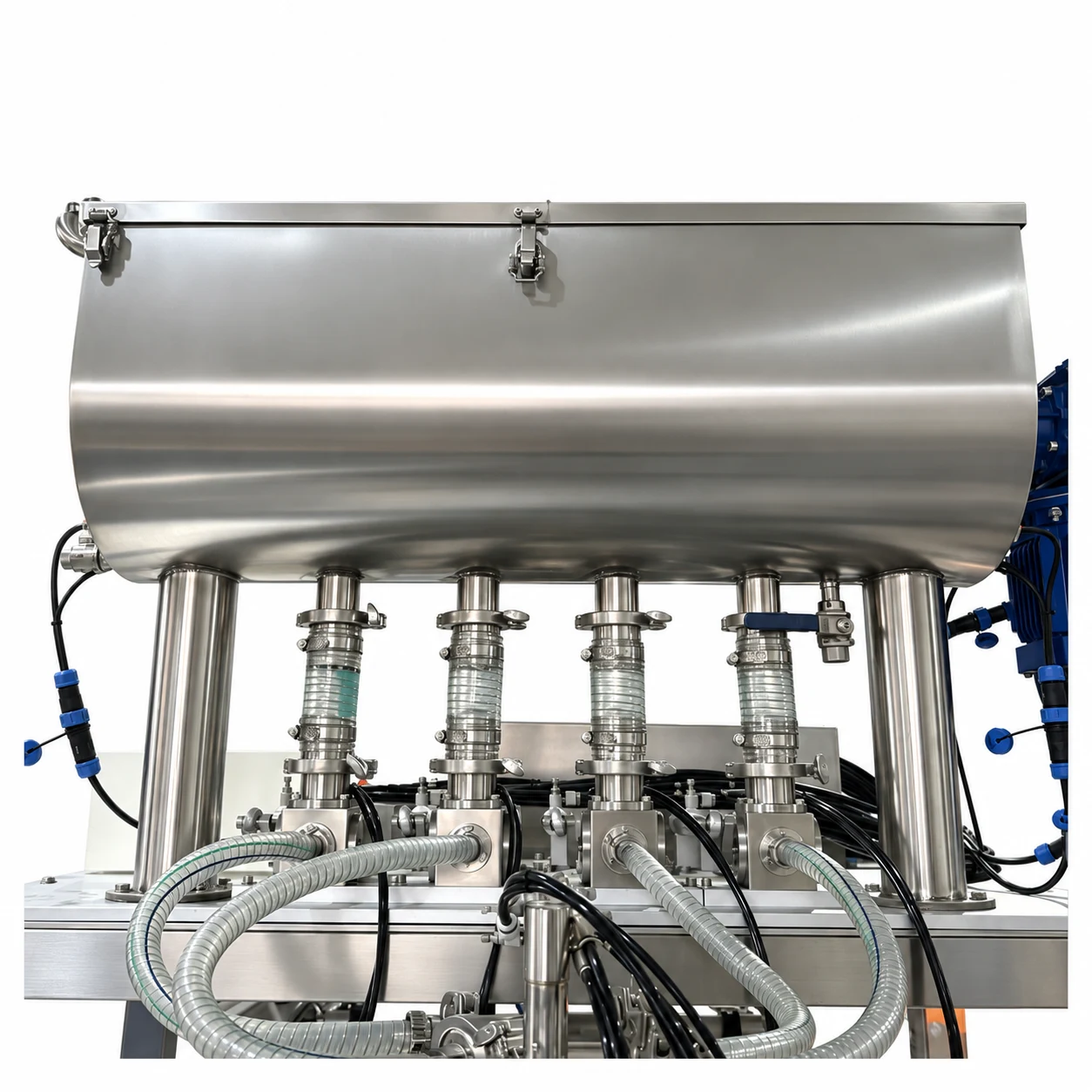
On the Liquid Packaging Solutions viscosity chart, Water at 70°F is 1 to 5 cP, Karo Corn Syrup or Honey is 2,000 to 3,000 cP, Blackstrap Molasses is 5,000 to 10,000 cP, Hershey Chocolate Syrup is 10,000 to 25,000 cP, Heinz Ketchup or French's Mustard is 50,000 to 70,000 cP, and Tomato Paste or Peanut Butter is 150,000 to 200,000 cP. The HHZ Packaging HP-F100PH semi-automatic piston sauce filling machine with stirrer uses a U-shaped stirring hopper to keep chili sauce, beef sauce and chunky condiments evenly mixed and prevent particle settling and separation. The HHZ Packaging HP-F100PH runs on 220V/50HZ (110V/60HZ) power and 0.4-0.9 Mpa air pressure, achieves ≤±0.5% filling accuracy at 1-25 bottles per minute, and uses food-grade stainless steel contact parts. In ZONESUN semi-automatic sauce jar filling machines, the rotary valve is customized to the material particle size, and a U-shape hopper with an internal spiral mixer is used because particulates in liquid tend to fall to the bottom and go hard, requiring the spiral mixer to scrape and lift particles from the bottom. ZONESUN automatic jar filling machines can be customized with 2, 4, 6, 8, 10, or 12 filling nozzles and integrated with automatic capping, labeling, and bottle turntable machines.
The Accutek AVF12 Automatic Volumetric Piston Filling Machine dispenses via 12 fill heads using sanitary stainless steel cylinders in 1 oz, 8 oz, 16 oz, 32 oz, 64 oz, or 128 oz dose models (29.57 mL, 236.59 mL, 473.18 mL, 946.53 mL, 1.89 L, 3.79 L). The Accutek AVF12 has an output of up to 120 CPM, a viscosity range of 1-20,000 cps, air requirements of 100 PSI / 3 CFM, 120 VAC single phase 60 Hz power (220 or 240 VAC available), dimensions of 120 inches (304.8 cm) by 56 inches (142.2 cm) by 96 inches (243.8 cm), and weight of ~1200 lbs (545 kg). Accutek AVF12 options include chunky product butterfly valves for sanitary products with particulates, honeycomb nozzles for products that string or drip, extended-length nozzles for bottom-up filling to reduce foam, and an optional heat package where a heater reduces viscosity and a mixer keeps tank temperature uniform. Cleveland Equipment SGP hopper-fed piston fillers are built with 316 stainless steel, rated at ±1% accuracy on liquids and ±2% on creams, require 5 CFM at 90 PSI compressed air with a recommended 30-gallon compressor, and carry a 1-year warranty. Cleveland Equipment single-head SGP fillers come in five cylinder sizes (SGP-60 at 10–60 ml, SGP-120 at 30–120 ml, SGP-250 at 45–250 ml, SGP-500 at 75–500 ml, and SGP-1000 at 100–1,000 ml) with a 3-gallon standard hopper, while the SGP-5000 fills 550–5,000 ml (18.5 oz to 1.3 gallons) at up to 30 cycles per minute with a 22-gallon hopper, and the SGP-1000-D and SGP-5000-D dual-head models ship with a 26-gallon hopper. In our sauce filling applications and sample testing trials, water can demonstrate movement but cannot establish sauce cutoff or particle handling, and changeover schedules must count draining, cleaning, drying, and restart checks rather than treating a quick-release fitting as a cleaning result on its own.
Anti-Drip Cutoff Nozzles and Jar Rim Protection for Chunky Sauces
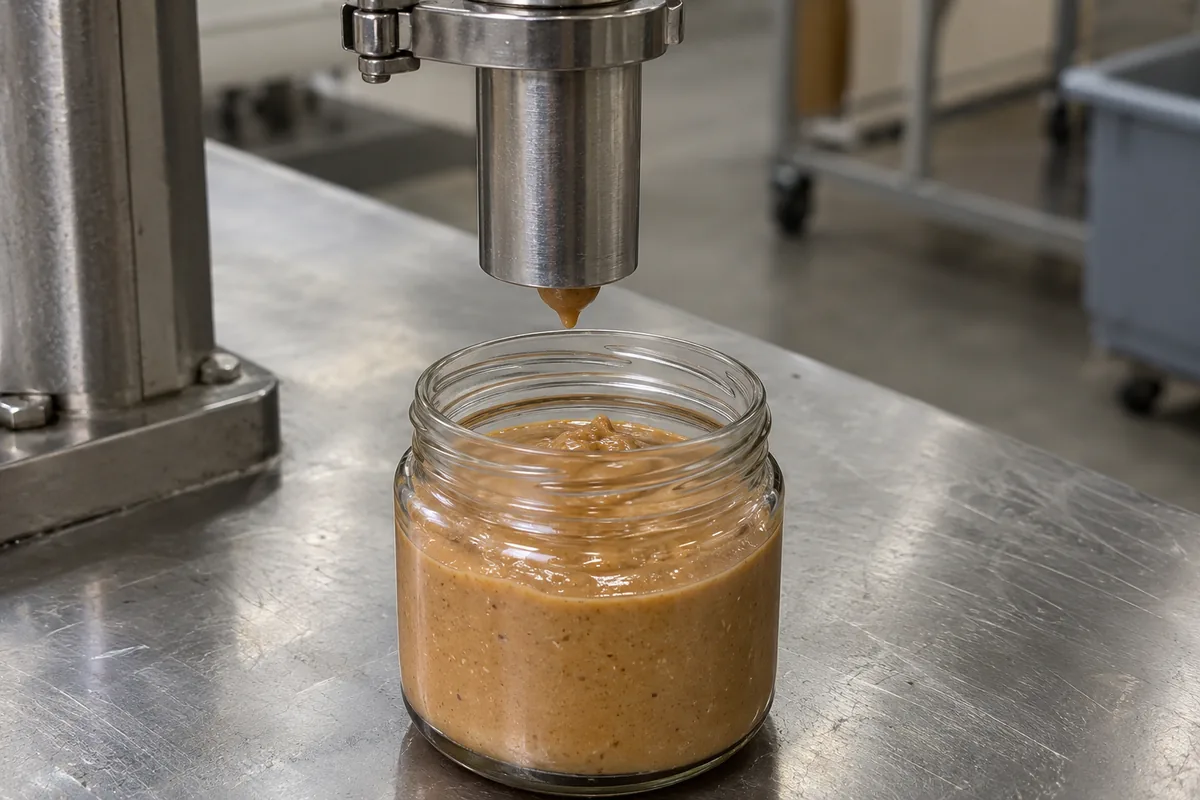
Volumetric Technologies Beveled Seat Nozzles are bottom shut-off, no-drip nozzles for thin liquids or thick creams in 0.25-inch to 1.9-inch opening sizes, while Inverted Cone Nozzles for liquids, creams, homogeneous sauces, and sticky products come in 0.375-inch to 4-inch sizes. Volumetric Technologies Rotary Cutoff Nozzles for thick products with or without particulates come in 1-inch to 3-inch sizes and are recommended for products that build up such as fudge, soup bases, or high-sugar and high-salt products. Volumetric Technologies Plug Spout Nozzles are offered in 2- and 3-position models from 0.375 inches up to 3 inches, with Ertalyte or Waukesha alloy spool valves, shear edge models, angled inlets to reduce shear, and air-shot-thru piston models. Volumetric Technologies Horizontal Cutoff Nozzles for thick, slurry-type products with or without particulates are available in 1-inch through 3-inch sizes.
The Jores Technologies Model E-FP-1000-DB High Viscosity Tabletop Paste Piston Filler (1000ml, $3,608.00) features a ball valve nozzle that prevents large particulates from getting trapped at the dispensing head, with 316 SS contact parts and a 304 SS shell. Replacement parts for the Jores Technologies E-FP-1000 Series include a 13.5mm Non-Drip Tip (P-B77-5-HO, $9.99), FKM 75 O-rings in 7mm CS x 57mm ID (P-B25-HO, $20.35), 3.5mm CS x 41mm ID (P-P76-HO, $12.00), and 3.5mm CS x 34.5mm ID (P-J106-HO, $12.00), and a High Temperature Piston (P-P204-HO, $534.75). As noted in our smooth vs chunky peanut butter filling guide, engineers do not convert a bore diameter into an allowable particle threshold using an assumed safety ratio, and jar, premade-pouch, and film-sachet observations stay separate because a jar has a rim and closure to inspect whereas a flexible pack has a seal area that must stay suitable for its specified closing process.
Hot-Fill-Hold Thermal Controls, Headspace, and Acidified Food Compliance
Under 21 CFR 114.3(b) and (d), acidified foods are low-acid foods to which acid(s) or acid food(s) are added with water activity (aw) above 0.85 and finished equilibrium pH of 4.6 or below, whereas low-acid foods have finished equilibrium pH above 4.6 and water activity above 0.85 (excluding tomatoes and tomato products with finished equilibrium pH below 4.7). Under 21 CFR 114.80(a)(1)-(2), acidified foods shall be manufactured, processed, and packaged so a finished equilibrium pH of 4.6 or lower is achieved within the scheduled process time and maintained, and if finished equilibrium pH is above 4.0, measurement shall be by a potentiometric method. Under 21 CFR 114.90(a)(6)(i), for food mixtures of liquid and solid components differing in acidity, pH sample preparation drains container contents for 2 minutes on a US standard No 8 sieve inclined at 17 to 20 degrees, records liquid and solid weights separately, and blends aliquots in the original container ratio at 25 °C to determine equilibrated pH. Under 21 CFR 114.90(a)(6)(ii)-(iii), when preparing marinated oil products for pH testing at 25 °C, no more than 20 milliliters of distilled water should be added per 100 grams of product, and when blending semisolid products to a paste at 25 °C, 10 to 20 milliliters of distilled water may be added per 100 grams of product. Under 21 CFR 150.160(d)(1) and (5), fruit preserves and jams require not less than 47 parts by weight of Group I fruit ingredient (or 45 parts in all other cases) to each 55 parts by weight of saccharine ingredient, and finished soluble-solids content is not less than 65 percent by refractometer under AOAC 13th Edition (1980) section 22.024.
Under 21 CFR 113.40(c)(10) for pressure processing in steam in continuous agitating retorts under Part 113, when minimum container headspace, product consistency (measured on product from the filler before processing), minimum closing machine vacuum, maximum fill-in or drained weight, minimum net weight, and percent solids are specified in the scheduled process, measurements and recordings should be made at intervals not to exceed 15 minutes. Under 21 CFR 113.60(a)(2), for glass containers with vacuum closures, capper efficiency must be checked by a measurement of the cold water vacuum before actual filling operations, and the results shall be recorded. Under 21 CFR 113.81(c) and 113.83, container filling, mechanically or by hand, shall be controlled to ensure scheduled process filling requirements are met, including critical factors such as minimum headspace, consistency, maximum fill-in or drained weight, and water activity (aw). In the hot-fill-hold (HFH) process for shelf-stable acidified foods (equilibrium pH < 4.6 and water activity > 0.85, such as sauces, beverages, and salsas), products are typically heated to 180–200 °F, held for 2–5 minutes in the container, and inverted to sterilize the headspace; however, HFH is sometimes not suitable for very thick products or those with large particulates if the product cannot flow to contact all container surfaces and fill the headspace when inverted. For acid and acidified foods (pH less than 4.6) processed by Hot-Fill-Hold above 180°F (82°C), unlike low-acid foods needing 240° to 250°F under pressure, hot product is filled into pre-cleaned and sanitized containers, capped with plastisol-lined metal caps, inverted and held; the vacuum seal forms as the product cools. Published minimum Hot-Fill-Hold temperature and time combinations for acidified foods are 140°F for 12.7 min, 141°F for 11.3 min, 161°F for 1.1 min, and 180°F for 0.1 min at equilibrium pH 4.1 or below (2010), versus 141°F for 77.8 min, 142°F for 67.7 min, 179°F for 0.4 min, and 180°F for 0.4 min at equilibrium pH 4.1 to 4.6 (2014).
Drained-Weight Sieve Verification and Prepackage Metrology
Under OIML R 87:2016 Clauses 3.2 and 3.3, average actual quantity in prepackages shall be at least equal to nominal quantity (Qnom), a homogeneous group shall contain no more than 2.5 % of packages with T1 errors, and no prepackage shall have a T2 error. Under OIML R 87:2016 Table 1, the tolerable deficiency (T) for prepackages by nominal quantity (Qnom) in g or mL is 9 % for 0 to 50 g/mL, 4.5 g/mL for 50 to 100 g/mL, 4.5 % for 100 to 200 g/mL, 9 g/mL for 200 to 300 g/mL, 3 % for 300 to 500 g/mL, 15 g/mL for 500 to 1,000 g/mL, and 1.5 % for 1,000 to 10,000 g/mL (rounded up to the next 0.1 g or mL for Qnom ≤ 1,000 g or mL).
Under OIML R 87:2016 Clause 4.1.3, expanded uncertainties (at k=2 confidence) for measuring instruments and test methods shall not exceed 0.2 T, including uncertainty from packing material variations and density fluctuations caused by differing amounts of solids in the liquid or temperature changes. Under OIML R 87:2016 Annex C (C.2.1 and C.3.3–C.3.7) when verifying drained quantity of solid product in a liquid medium, the method stores samples for 12 hours at 20 °C to 24 °C and drains product on a flat ISO 3310-1 sieve with a 2.5 mm square mesh and 1.0 mm wire thickness (whose diameter should be 20 cm for containers of 850 mL or less and 30 cm for containers exceeding 850 mL) tilted at 17° to 20° for a 2-minute drain time.
Sources
- Liquid Packaging Solutions and Packaging Digest — Piston Filling Machines for Food Products, Three-Way Rotary Valves, and Common Liquid Viscosity Reference
- Volumetric Technologies — Precision Piston Fillers, Depositors, and Dispensing Nozzle Engineering Specifications
- Unifiller Systems and Hinds-Bock Corporation — Single-Piston Particulate Depositor Specifications
- Accutek Packaging Equipment and Cleveland Equipment — Automatic Volumetric Piston Fillers and Pneumatic Hopper-Fed Piston Series
- Jores Technologies, HHZ Packaging, and ZONESUN Technology — Ball-Valve Tabletop Paste Fillers and U-Shape Stirring Hopper Sauce Jar Fillers
- US Food and Drug Administration — Code of Federal Regulations for Low-Acid, Acidified, and Fruit Preserve Foods
- University of Georgia Cooperative Extension and Kansas State University Research and Extension — Hot-Fill-Hold Process Controls for Acid and Acidified Foods
- International Organization of Legal Metrology — Quantity of Product in Prepackages and Drained-Weight Sieve Methodology
- Our LINEVO Engineering Library — Paste Filling, Sauce Application, Piston vs Pump, and Chunky Trial Engineering Guides
Common questions
Why do jar filling machines use a three-way rotary valve instead of a spring-loaded check valve for chunky sauces?
Spring-loaded check valves rely on one-way spring tension that closes erratically in viscous carriers and traps solid cubes on the valve seat, causing drips and dose drift. A quarter-turn, three-way rotary valve uses an unobstructed hollow core that aligns with the hopper on the intake stroke and rotates to the discharge nozzle on the dispensing stroke, passing fruit chunks, salsa dices, or dressing particulates (up to 0.75–2 inches depending on cylinder and port diameter) without crushing.
How does a U-shaped stirring hopper or spiral mixer prevent solid-to-liquid ratio drift in a sauce filling machine?
In two-phase sauces such as chili oil, beef sauce, or chunky salsa, dense solids settle to the bottom of a static cone hopper and compact while oil or brine floats, causing early jars to receive mostly solids and later jars to receive mostly liquid. A horizontal U-shaped hopper equipped with an internal spiral ribbon mixer continuously scrapes and lifts settled particulates across the rotary-valve inlets, and can be paired with a heated jacket to keep carrier viscosity and temperature uniform.
Which dispensing nozzle styles prevent dripping and stringing onto wide-mouth glass jar sealing rims?
To keep plastisol-lug jar rims free of sauce strings or trapped chunks, engineers select positive cutoff nozzles matched to particle size: rotary or horizontal cutoff nozzles (1–3 inch openings) for thick slurries, fudge, or soup bases; 2- or 3-position plug-spout nozzles (0.375–3 inches with shear-edge or Ertalyte/Waukesha alloy spools and optional air-shot blow-off); or full-port ball-valve nozzles (such as on the Jores E-FP-1000-DB) that shear cleanly without pinching large particulates.
What federal acidified-food and Hot-Fill-Hold controls apply when filling chunky sauces into glass jars?
Under 21 CFR Part 114 (§ 114.80), shelf-stable acidified sauces (aw > 0.85) must reach and maintain a finished equilibrium pH of ≤ 4.6 (measured potentiometrically above pH 4.0). Hot-Fill-Hold lines typically fill pre-cleaned jars at 180–200 °F (above 82 °C), apply plastisol-lined metal caps, and invert jars for 2–5 minutes to sterilize the closure and headspace—provided the sauce is fluid enough to contact all headspace surfaces when inverted; for vacuum-capped glass jars under 21 CFR § 113.60(a)(2), cold-water capper vacuum must also be verified and logged before filling.
How are prepackage net weight and drained particulate weight verified using standard sieve methods?
OIML R 87:2016 requires lot average quantity to meet or exceed Qnom with expanded test uncertainty ≤ 0.2 T, and Annex C verifies drained solids after 12 hours at 20–24 °C by draining for 2 minutes on anISO 3310-1 square-mesh sieve (2.5 mm openings, 1.0 mm wire, 20 cm diameter for ≤850 mL or 30 cm for >850 mL) tilted at 17°–20°. Similarly, 21 CFR § 114.90(a)(6)(i) drains heterogeneous liquid-solid foods for 2 minutes on an inclined (17°–20°) U.S. No. 8 sieve before re-blending proportional aliquots at 25 °C for equilibrium pH testing.
What to send us
Swipe to compare all columns.
| Item | Why we need it | Example format |
|---|---|---|
| Sauce recipe and filling temperature | Determine carrier viscosity, thermal jacket requirements, and hot-fill-hold flow behavior in the container. | Recipe description, equilibrium acidity category, and normal filling temperature range |
| Particulate dimensions and solid fraction | Size the rotary valve port, piston cylinder bore, and hopper agitation to prevent crushing or bridging. | Largest cube or piece size, particulate concentration, and settling tendency |
| Jar drawing, neck finish, and closure | Keep the jar sealing rim clean during cutoff and verify minimum headspace for vacuum capping. | Wide-mouth jar drawing, neck opening diameter, plastisol lug cap spec, and target fill level |
| Fill target, unit, and acceptable output | Align volumetric cylinder swept volume, nozzle count, and drained-weight quality checks. | Nominal fill target in grams or milliliters, drained-solid target, and accepted jars per minute |
We reply within 24 hours.