
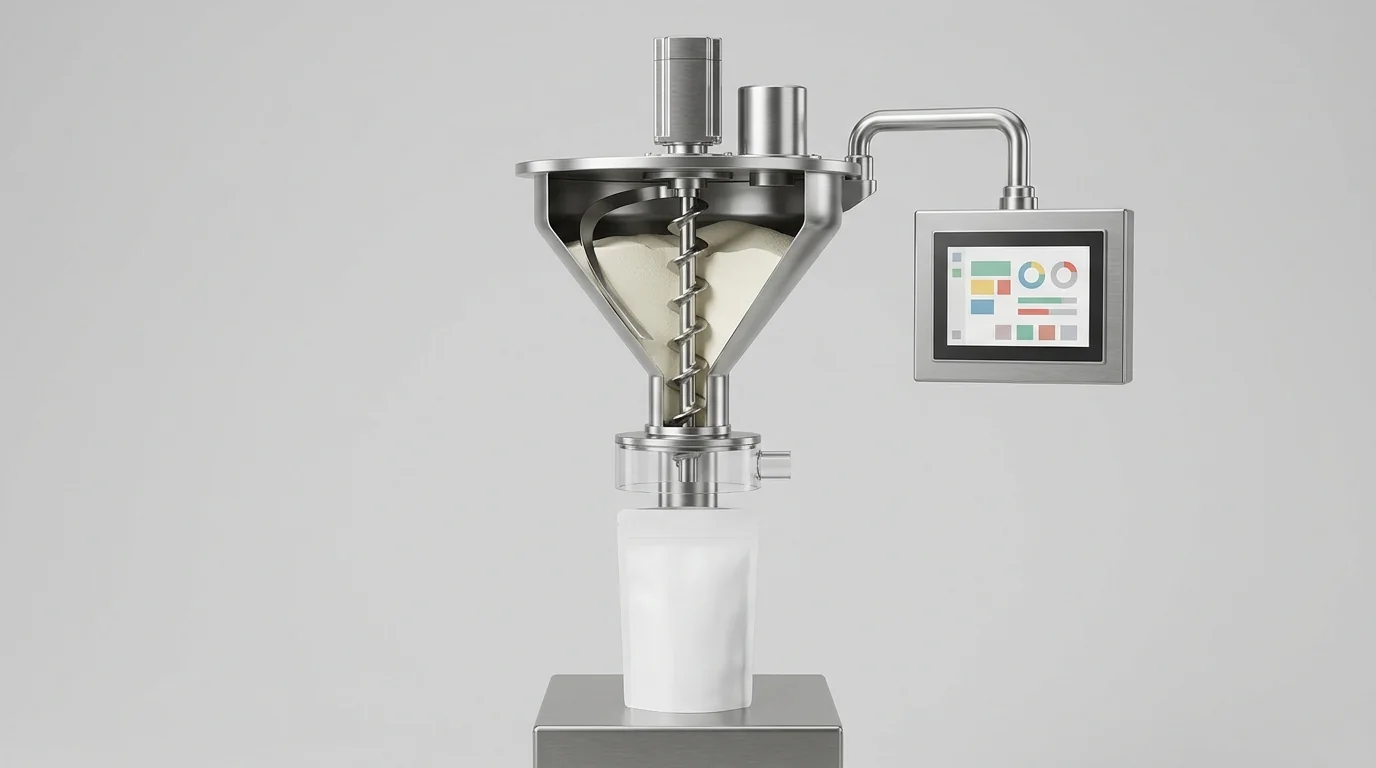
At a glance
Swipe to compare all columns.
| Station decision | Powder or package input | Auger-filler configuration |
|---|---|---|
| Metering principle | Target volume vs finished package weight | Helical screw rotating partly in a hopper and partly in a tube; shaft rotations set volume while bulk density sets pack weight unless paired with a weight scale |
| Cohesive powder feed | Sticky or fine blends prone to bridging or ratholing | Steep cone or wedge hopper slopes with hopper agitators, vibrators, or an independent side-knife and mid-stirrer mixer drive hub |
| Free-flow cut-off | Granules or seeds running on between cycles | Positive cut-off tooling at the discharge tube outlet, including spinner nozzles or screen nozzles |
| Hopper and automation tier | Single container vs multi-lane or form-fill-seal output | Cone hopper for 1 auger on 1 head (foot-pedal semi-automatic or inline) vs wedge hopper across multiple augers on vertical stick-pack or pouch lines |
What Is an Auger Filling Machine?
An auger filling machine is a volumetric powder dosing system that rotates a helical screw blade, called flighting, positioned partly inside a supply hopper and partly inside a filling tube to meter dry powders, granules, pellets, or seeds by shaft rotation count while pairing hopper agitation or nozzle cut-off tooling with blend flow.
In food and bulk powder processing, screw mechanisms convey and meter bulk solids using a tube containing either a spiral blade coiled around a driven shaft or a shaftless spiral driven at one end and free at the other. Without load-cell weight feedback, auger dosing is volumetric: the screw delivers a set volume on each cycle, and finished package weight follows from the powder's bulk density unless an integrated weight scale regulates the target mass. Auger fill heads operate as standalone stations or mount directly onto Vertical Form Fill Seal machines, pre-made stand-up pouch machines, and automated packaging cells. On our powder filling machines overview, published packaging routes cover film stick packs and specialized dosing caps, whereas rigid bottle, jar, or bag projects require a separate container-handling and closing review. To evaluate screw dosing alongside cavity-based metering on the same batch, see our auger vs volumetric cup filling guide.
How Does an Auger Filler Work on Each Cycle?
An auger filler works as a variable-rate volumetric feeder by turning a helical screw beneath a supply hopper for a controlled number or duration of shaft rotations, transferring powder volume proportional to shaft rotation rate into each positioned container before the package closes and moves downstream.
Auger dosing into formed packages is sequential rather than continuous: the packaging machine forms or indexes an open container under the filling tube, the auger rotates to dispense the programmed charge, and the filled package is sealed or transferred out. On modern servo-driven designs such as Accutek's AF Series, brushless direct-drive servomotors, motion control electronics, and a PLC-based touchscreen control system regulate shaft rotation accuracy across stored recipes. Because screw displacement is volumetric when run without weight feedback, package weights can drift even when machine settings have not changed if a powder blend aerates or compacts during a batch. Engineers quantify blend compressibility with the Carr Index, calculated from tapped bulk density in kg/m3 and loose bulk density in kg/m3 by dividing their difference by tapped bulk density and multiplying by 100. Fluctuating powder height above the screw flights also shifts head pressure and net weight, so automated stations fit an ultrasonic supply level sensor inside the supply hopper that lets the programmable logic controller regulate refills from the bulk hopper.
Which Powders Suit an Auger Filler Machine?
Cohesive fine powders and free-flowing granules both run on an auger filler when tooling matches blend flow: cohesive or sticky powders need steep hopper slopes and active hopper agitation to maintain flight feed, whereas free-flowing granules require positive cut-off nozzles that stop product from running between cycles.
Pre-selection trials check three powder behaviors before freezing auger tooling: bridging or ratholing inside the hopper, product continuing to run after the screw stops, and bulk-density swings from aeration or settling. In sticky or cohesive powders, bridging occurs when powder forms a self-supporting arch over the screw that starves the flights, while ratholing occurs when an agitator carves a vertical tunnel leaving stagnant powder packed against the hopper walls. Steep cone or wedge hopper walls paired with agitators or small vibrators collapse arches and tunnels; on Accutek's AF Series, a separate mixer drive hub rotates a side knife and mid stirrer independently of the auger drive shaft to prevent powder caking. Conversely, free-flowing granules and dry seeds flow through an open tube after rotation ends unless fitted with cut-off tooling such as a spinner nozzle or screen nozzle. Because dose consistency and stopping sharpness depend on the auger, drive, and blend condition per recipe, culinary lines running ground powders alongside coarse flakes review each ingredient separately in our spice filling changeover guide. Finely divided combustible powder suspended in air at the right concentration can also burn rapidly and become explosible, a hazard covering food powders such as candy, sugar, spice, starch, flour, and feed, alongside grain, plastics, pesticides, pharmaceuticals, dyes, coal, and metals.
| Powder flow class | Typical blend examples | Primary dosing failure mode | Hopper and nozzle tooling configuration |
|---|---|---|---|
| Cohesive or sticky fine powders | Flour, starch, fine spice powders, and cohesive dry blends | Bridging arch over the screw starving flights, or vertical ratholing with stagnant wall buildup | Steep cone or wedge hopper slopes plus independent side-knife and mid-stirrer agitation or small vibrators to keep flights fed |
| Free-flowing powders and granules | Granulated sugar, coarse spices, dry granules, pellets, and seeds | Product continuing to run out of the filling tube between auger rotation cycles | Positive discharge cut-off tooling at the tube outlet, such as a spinner nozzle or screen nozzle |
| Aerating or dusty combustible blends | Finely divided sugar, starch, flour, spice, or pharmaceutical powders | Bulk-density drift from aeration or settling, seal-area dust contamination, and airborne dust hazard | Ultrasonic supply hopper level control for steady refill head, plus a vacuum dust hood connected to a dust collector |
What Are the Main Auger Filling Machine Parts?
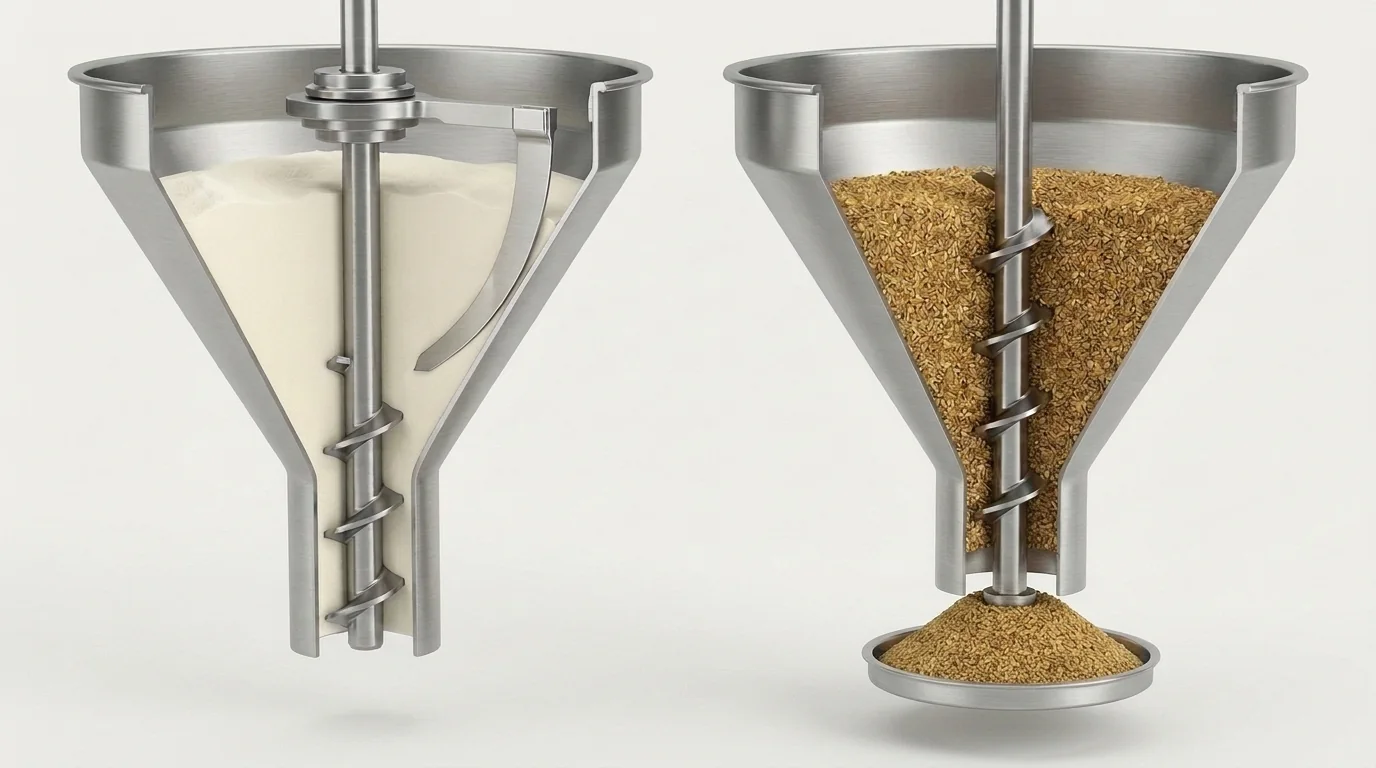
The main auger filling machine parts are the stainless supply hopper, supply level sensor, independent agitator drive hub with side knife and stirrer, helical auger screw, filling tube, discharge cut-off nozzle, direct-drive servomotor with touchscreen control, and vacuum dust hood around the filling outlet.
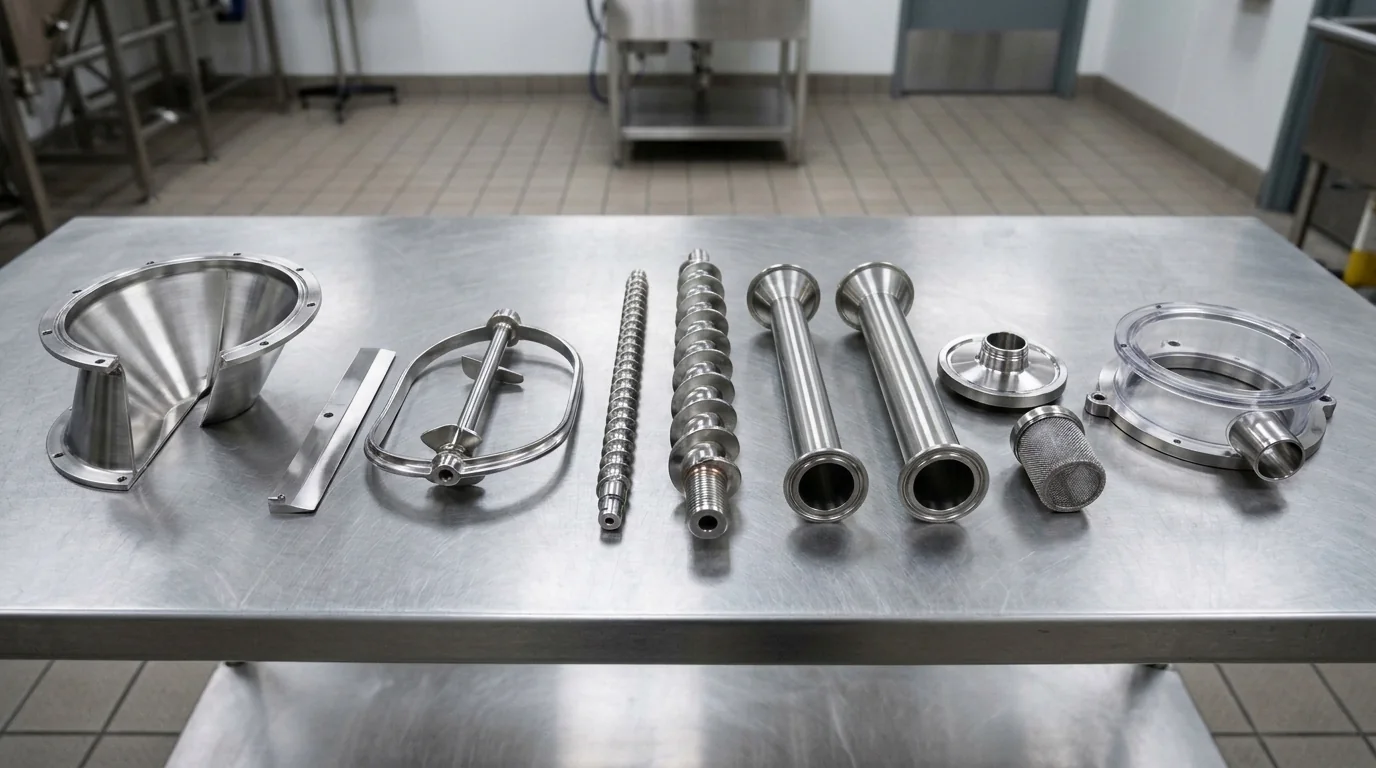
Hopper geometry follows head count: auger hoppers are typically cone-shaped when there is 1 auger for 1 filling head, and wedge-shaped when several augers span multiple filling heads across a multi-lane web. Falling powder generates airborne dust that can become trapped between the 2 sides of packaging film before the sealing jaws close, causing pack micro-leakages; pairing food-grade stainless contact parts with a vacuum hood connected to a dust collector pulls airborne particles away from the seal zone. For multi-spindle stick-pack extraction and lane checks, see our multi-lane powder dust and lane balance guide. Under federal sanitary equipment standards, food-contact surfaces must be corrosion-resistant when in contact with food, seams on food-contact surfaces must be smoothly bonded or maintained to minimize accumulation of food particles, dirt, and organic matter, and gravimetric, pneumatic, closed, and automated conveying systems must be built for clean and sanitary maintenance. During a recipe changeover, operators empty the hopper, remove the screw and filling tube, clean all product-contact surfaces, and inspect components for wear or buildup.
| Auger filler assembly | Mechanical role during dosing | Configuration and sanitary changeover check |
|---|---|---|
| Supply hopper and ultrasonic level sensor | Buffers powder above the screw while detecting product height so the controller regulates bulk-hopper refills | Cone hopper for 1 auger on 1 head vs wedge hopper across multiple heads; verify smooth, corrosion-resistant internal seams |
| Independent mixer drive hub and agitator | Rotates the side knife and mid stirrer independently of the auger shaft to prevent caking, bridging, and ratholing | Confirm agitator sweep along steep hopper walls and disassembly access to minimize particle buildup and allergen cross-contact |
| Helical auger screw and filling tube | Conveys and meters powder from the lower hopper through the tube in proportion to shaft rotations | Matched per recipe and target dose; remove screw and tube during changeover to clean and inspect for wear or buildup |
| Discharge cut-off tooling | Stops free-flowing granules, powders, or seeds from dribbling between intermittent auger cycles | Select spinner nozzle or screen nozzle based on granule run-on observation during sample trials |
| Direct-drive servomotor and PLC touchscreen | Controls shaft rotation count or duration and stores recipe parameters across runs | Pair with optional weight-scale feedback when bulk-density shifts require gravimetric trim |
| Vacuum dust hood and dust collector port | Captures airborne dust generated as powder drops into open pouches, stick packs, jars, or caps | Keeps powder out of heat-seal jaws to prevent micro-leakages and limits suspended combustible dust |
When Do You Choose a Semi-Automatic vs Automatic Auger Filler?
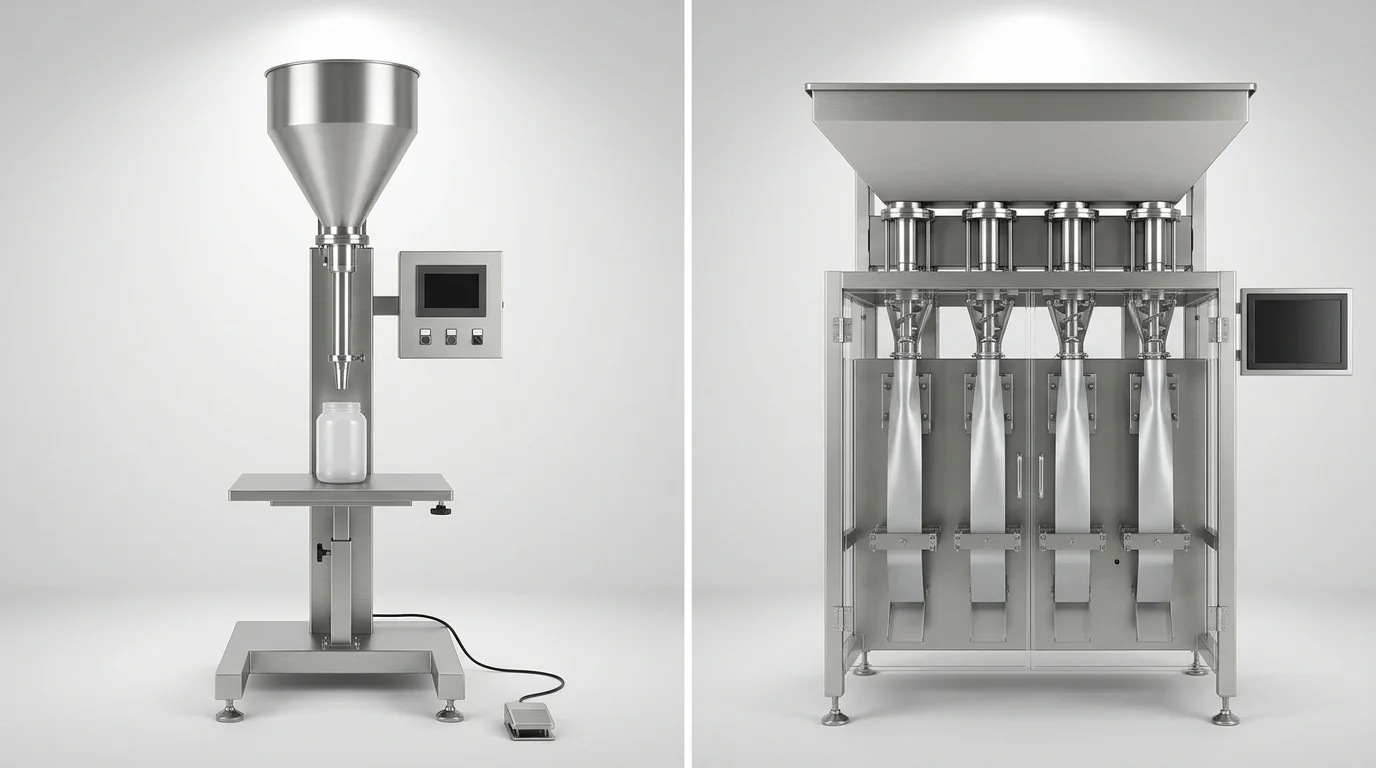
Choose a semi-automatic auger filler when an operator places empty bottles, bags, or vials by hand and triggers each cycle with a foot pedal across frequent changeovers, and choose an automatic auger system when conveyors or form-fill-seal heads run continuous output from 5 cpm to 100+ cpm.
Published OEM specifications illustrate how screw sizing and container handling divide across equipment tiers. On Accutek's AF Series, single-head auger filler specifications cover fill sizes from 0.001 lbs to 4.4 lbs (0.5 grams to 2 kg) at speeds up to 20 CPM for dry products, powders, granules, or seeds, emphasizing rapid cleanup and recipe changeover. At the micro-dosing end, specialized micro-doser auger fillers such as the nano-Filler and Micro-W Series meter powder doses down to 25 mg. When container throughput outgrows manual placement, automatic auger fillers index bottles or pouches into the fill position automatically at speeds ranging from 5 cpm to 100+ cpm, or mount auger fill heads directly onto Vertical Form Fill Seal machines, pre-made stand-up pouch machines, and automated packaging cells. Compare operator pacing and conveyor upgrades in our manual vs semi-automatic filling machines guide, and note whether your package is a film stick pack, dosing cap, bottle, jar, or bag when requesting a layout review.
| Equipment tier | Container handling and hopper layout | Published OEM reference range and typical role |
|---|---|---|
| Semi-automatic single-head auger filler | Cone hopper with 1 auger for 1 head; operator positions bottle, bag, or vial and presses a foot pedal | Published single-head series example (Accutek AF Series): 0.001 lbs to 4.4 lbs (0.5 grams to 2 kg) up to 20 CPM |
| Specialized micro-doser auger station | Fine-dose screw metering station for vials, small bags, or specialized dosing-cap cavities | Published micro-doser example (nano-Filler and Micro-W Series): powder doses down to 25 mg |
| Automatic indexing or integrated fill heads | Automatic bottle or pouch indexing conveyors, or wedge-hopper multi-lane and Vertical Form Fill Seal heads | Published automatic filler range: 5 cpm to 100+ cpm across indexed containers, stand-up pouches, and stick packs |
What Drives Auger Filling Machine Scope and Quotations?
Auger filling machine quotations shift with filling-head count, dedicated screw and tube tooling per recipe, free-flow spinner or screen cut-off attachments, hopper agitation, bulk loading with level sensors, dust extraction, and weight-scale feedback, so offers should be compared against identical blend, pack format, and fill-range inputs.
Two proposals rarely line up unless both suppliers quote against the same complete powder formulation, loose and tapped bulk density in kg/m3, target fill quantity, package drawing, spare screws and tubes for recipe changeovers, and sanitary cleanability requirements for closed or automated conveying modules. State upfront whether bulk loading feeders, ultrasonic hopper refill controls, dust collectors, and inline checkweighers or weight scales belong inside the machine supply boundary; see our filling machine price guide for how configuration scope moves an equipment quote. Use the downloadable checklist below to record blend flowability, density measurements, screw and cut-off tooling, and dust-control needs before shipping trial material.
| Checklist item | Blend and package data to record | Auger-filler module affected |
|---|---|---|
| Bulk density and compressibility | Loose bulk density and tapped bulk density in kg/m3 to calculate the Carr Index across handling conditions | Volumetric rotation setting vs optional weight-scale or checkweigher feedback loop |
| Hopper flow behavior | Tendency to form cohesive arches (bridging) or vertical tunnels (ratholing) when resting in a hopper | Steep cone or wedge hopper slope plus independent side-knife and mid-stirrer agitation or vibrators |
| Stopping and dribble check | Whether free-flowing granules, powders, or seeds continue running after screw rotation stops | Open discharge tube vs positive spinner nozzle or screen nozzle cut-off tooling |
| Target fill range and recipe list | Smallest and largest target weights across stick packs, dosing caps, pouches, jars, bottles, or bags | Number of dedicated auger screw and filling tube sets plus sanitary cleaning and inspection access |
| Refill and airborne dust control | Refill method, combustible food or industrial dust classification, and heat-seal jaw cleanliness | Bulk loading system with ultrasonic hopper level sensor, vacuum dust hood, and dust collector |
Common questions
What is an auger filling machine, and does it fill by volume or weight?
An auger filling machine rotates a vertical helical screw blade inside a hopper and filling tube to dispense dry powders, granules, or seeds. Without load-cell weight feedback, auger dosing is volumetric: the number or duration of shaft rotations sets the dispensed volume while finished package weight depends on powder bulk density, unless paired with a weight scale.
Why do cohesive powders bridge or rathole inside an auger hopper?
In sticky or cohesive powders, bridging happens when powder compacts into an arch above the screw that starves the flights, and ratholing happens when an agitator carves a narrow vertical channel while leaving stagnant powder packed along the walls. Steep hopper slopes combined with agitators, such as an independently driven side knife and mid stirrer, break arches and sweep the walls.
How do you stop free-flowing granules from dribbling out of an auger filler?
Free-flowing granules and seeds can keep running through an open tube after the auger shaft stops turning. Fitting positive cut-off tooling at the bottom of the filling tube, such as a spinner nozzle or a screen nozzle, stops product flow cleanly between intermittent dosing cycles.
When does an auger filler use a cone hopper instead of a wedge hopper?
Auger supply hoppers are typically cone-shaped when 1 auger feeds 1 filling head on a standalone semi-automatic or single-lane station, and wedge-shaped when several augers span multiple filling heads across a multi-lane packaging machine.
What steps are involved in an auger filling machine recipe changeover?
A standard auger recipe changeover involves emptying leftover powder from the hopper, removing the auger screw and filling tube, cleaning corrosion-resistant and smoothly seamed food-contact surfaces, and inspecting parts for wear or buildup before installing the screw and tube matched to the next product.