
Quick Specs
Swipe to compare all columns.
| Comparison input | Auger filler | Volumetric cup filler |
|---|---|---|
| Dose basis without weight feedback | Volume set by screw rotations | Volume of the cup or chamber |
| Common shortlist in manufacturer guides | Cohesive or bridging powders | Stable, free-flowing granules |
| Main feed question | Steady feed into the screw flights | Complete, even filling of each cup |
| End of the dose | Cut-off and product running on after the stop | Wiper level-off, then discharge |
| Changing the volume | Setting; some fills need another screw or tube | Cup depth or different cup inserts |
| Bulk-density change | Changes the pack mass; record it | Changes the pack mass; record it |
| Fair trial basis | Same batch, pack and target as the cup trial | Same batch, pack and target as the auger trial |
The short answer: without weight feedback, both dose by volume
Choosing a dosing method from a product name can leave you with drifting pack weights or powder in the seal area after installation. An auger filler and a volumetric cup filler both meter by volume when they run without weight feedback, so neither reads the mass of each portion. Public manufacturer guides commonly shortlist cups for stable, free-flowing granules and augers for cohesive powders. Treat that split as a starting point, then compare the candidates on your own batch, pack and target.
This page compares the two mechanisms using public manufacturer guides, not our own machine tests. It gives you a conditional matrix for deciding which method to trial and a blank record for keeping an auger trial and a cup trial comparable. The record contains field names only. It holds no example results, no pass limits and no promise that a particular configuration is available from this site.
Here, a volumetric cup filler means a machine that fills a cavity of set volume and empties it into the pack. Augers are also described as volumetric, so the two labels overlap. Fill-by-weight auger setups, checkweigher feedback and weighing-based dosing measure the mass instead and are not compared here; the powder filling machines page sets all three methods side by side.
How each mechanism meters a dose
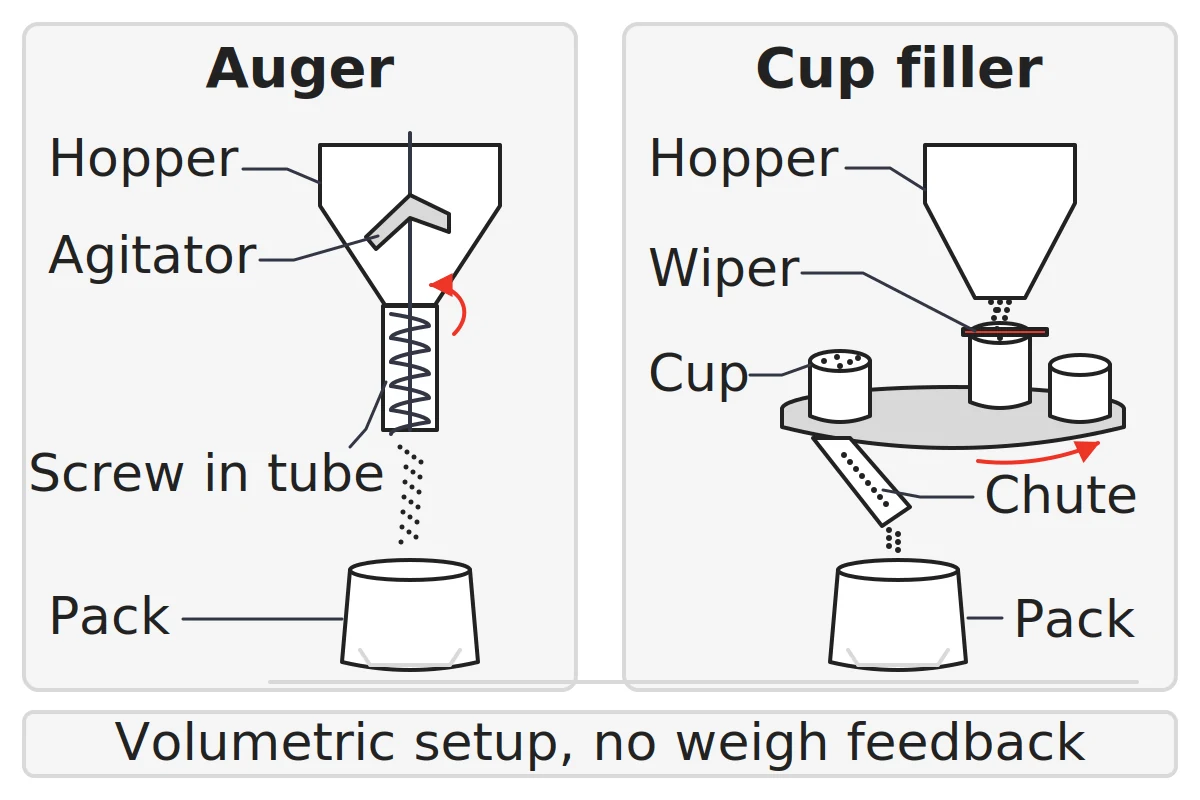
An auger filler turns a helical screw inside a tube below a hopper. Product moves down the flights and out of the tube into the pack, and the control sets the dose through the number or duration of rotations. An agitator in the hopper keeps powder moving toward the screw and helps prevent bridging. Some product can keep flowing after the screw stops, so the cut-off is tuned for the product. For free-flowing granules, one manufacturer guide describes extra tooling to stop material leaking between cycles.
A volumetric cup filler lets product fall under gravity from a hopper into cups of fixed or adjustable volume. In the rotary arrangement described in one manufacturer guide, a wiper removes the excess, and the filled cup moves over a discharge chute where the portion drops into the pack. Operators change the dose by adjusting cup depth or exchanging cup inserts, depending on the design.
The practical difference is where the dose gets its shape. An auger pushes material through a screw, so the feed into the flights and the stopping behavior matter most. A cup relies on gravity to fill a cavity completely and on a clean level-off, so how evenly the material settles into the cup matters most. In this volumetric setup neither mechanism weighs what reaches the pack, and any accuracy claim for either one depends on the material it was run with.
| Question | Auger filler | Volumetric cup filler |
|---|---|---|
| What sets the dose | Screw rotations or rotation time | Cup or chamber volume |
| How product reaches the doser | Agitated hopper feeds the screw flights | Gravity fill from the hopper into each cup |
| What ends the portion | Screw stop and cut-off behavior | Wiper level-off, then discharge over the chute |
| How the volume is changed | Control setting; some products or fill sizes need a different screw or tube | Cup depth adjustment or different cup inserts |
| What to observe in a trial | Feed into the flights, bridging, product running on after the stop | Complete, even cup filling and material left in the cups |
Read the material before choosing what to trial
Start with how the actual product behaves, not with its name. Two powders sold under the same description can flow differently, and a material that pours freely as a fresh sample may hang up in a hopper after it has absorbed moisture. Note whether it flows under gravity, clumps, bridges, dusts or breaks, and whether that changes with humidity, temperature or formulation. The manufacturer guides cited here treat these behaviors as the main inputs to the choice.
Particle size distribution, moisture, cohesion and static charge all affect flow. A wide spread of particle sizes can also separate in the hopper, with fines settling and larger particles rising, which changes what each portion contains even when its mass looks right. Fragile pieces raise a different question. A screw applies mechanical force to the product while a cup fills by gravity, so look at your particles after discharge from each route.
The matrix below turns those observations into trial directions. We built it as an editorial planning tool from the cited guides, and it does not pick a winner. If the product sits between categories, test both methods where both can be offered. If only one candidate can be tested, record the comparison as incomplete instead of treating a single result as a choice between methods.
| Observed condition | Candidate to investigate | What both trials must record | Still to confirm |
|---|---|---|---|
| Free-flowing, stable granules | Cup filler; an auger set up for granules if offered | Cup fill and level-off, flow after the screw stops, net mass per pack | Tooling that stops granules running between auger cycles |
| Cohesive or bridging powder | Auger with agitation; confirm whether a cup trial is meaningful | Hang-ups, bridging, uneven feed and when they appeared | Agitation and hopper arrangement for the actual powder |
| Flow changes with humidity, temperature or formulation | Both, under recorded conditions | Ambient conditions, batch age and storage with each run | Whether the supply setup can hold the material condition |
| Bulk density varies between batches | Both, on the same batches | Density method and units beside each pack's net mass | The verification routine and who adjusts the dose |
| Dusty discharge | Both; watch the discharge path | Visible product in the seal area, pack by pack | Containment and the agreed seal inspection |
| Fragile or mixed particles | Both; inspect the dosed product | Broken pieces or separation in discharged portions | Handling and feed design for the mix |
Why neither method is protected from bulk-density changes
Because both methods fill a volume, the mass in the pack follows the bulk density of the material at that moment. Manufacturer guides warn about this for cups and augers alike: the same volume does not always give the same weight. Aeration lowers density and can produce light packs, while compaction from head pressure or standing time pushes the other way. One auger guide states that density has to stay stable where product enters the screw.
Record the measurement method and units with every density value, and compare only results taken the same way. The cited guides list humidity, aeration, head pressure and agitation among the factors that change bulk density, so a figure from a fresh sample may not represent material that has sat in a hopper. If density shifts across batches, a volumetric method can still be workable once the buyer and supplier define the acceptable tolerance and a routine for checking packs and adjusting the dose.
This guide stays with the choice of mechanism. Whether a label states weight or volume is a separate decision. To measure net contents and accepted output in a way that lets two setups be compared, use our accuracy and production speed guide.
Set up a fair comparison on the same batch and pack
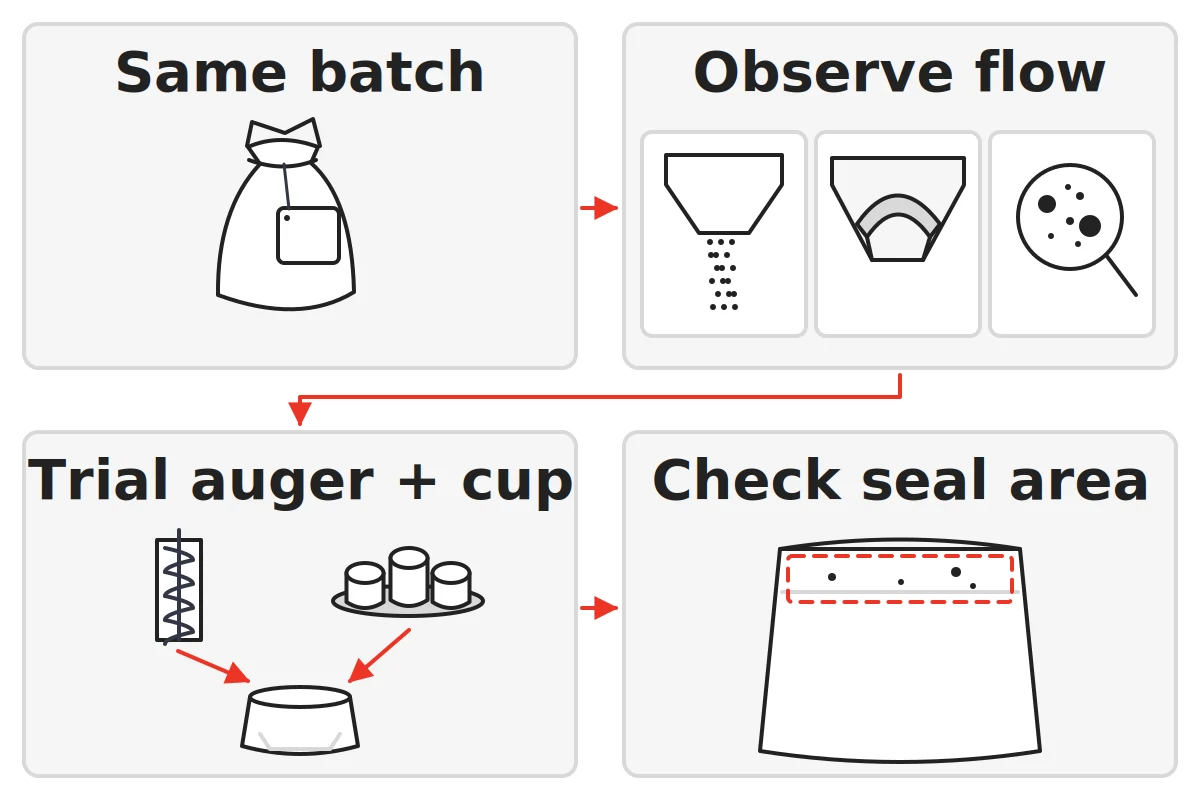
A comparison only helps when the conditions that should match actually match. Use the same product batch, the same package and the same target quantity for both candidates. Each machine needs its own tooling and settings, and those need not be identical; record them so every result traces back to a configuration. Include a difficult batch as well as a typical one, because manufacturer guidance on product testing recommends best-case and worst-case material.
Agree the acceptance criteria and sampling plan before the first pack is filled. Decide who weighs the packs, on which scale, how tare is established and how many samples make up a run. Limits written after the run tend to fit whatever numbers it produced. They belong to the buyer and supplier, and this page sets no sample size, tolerance or test duration.
Run at the speed you intend to use. A dosing setup that holds steady in a slow demonstration can drift at production speed, so ask for observations at your target output and note when the speed changed. Run long enough to catch intermittent problems such as occasional bridging. Our sample assessment page explains how to prepare material for review, and the general machine selection guide covers the product and pack brief that should come before any trial.
Record steady running, refills and restarts separately
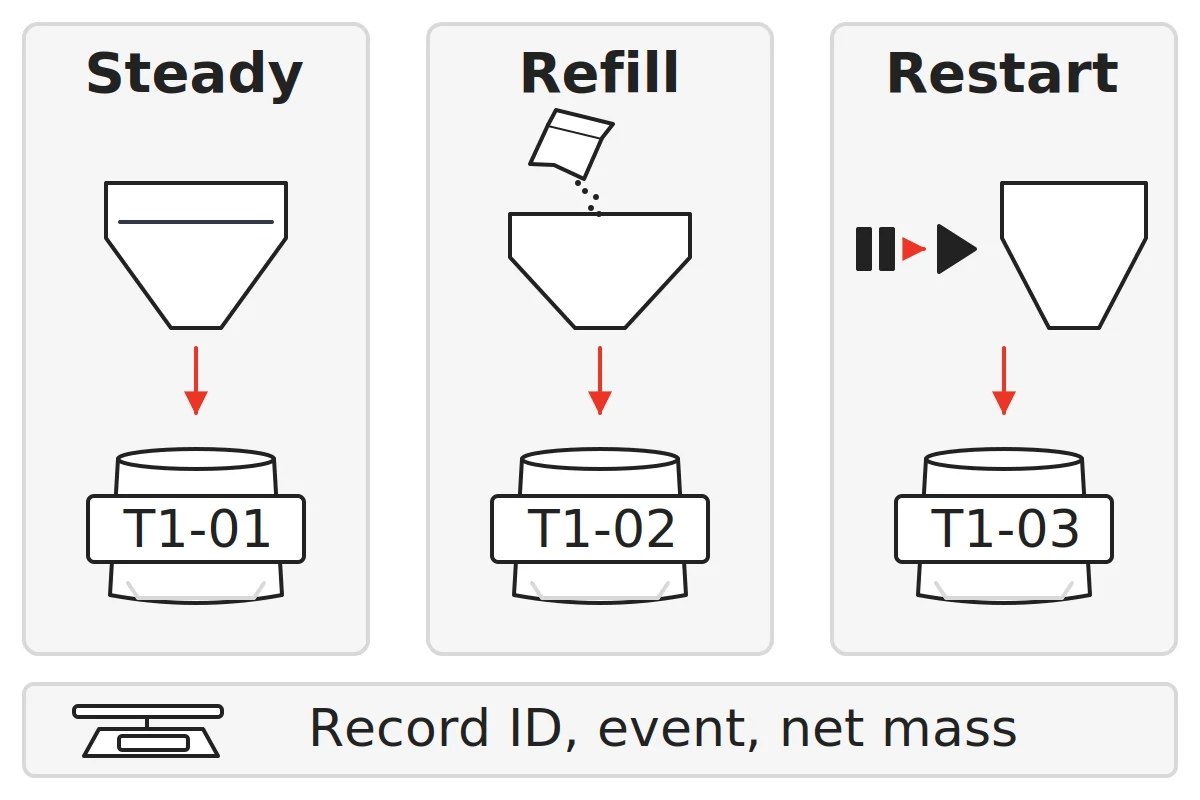
Manufacturer guidance links auger stability to refill routines, agitation settings and sampling frequency, and links drift at speed to changes in product flow and cut-off behavior. That makes the operating event part of the result. A pack filled just after the hopper was topped up may not represent steady running, and the same applies to the first portions after a stop.
Give every sampled pack an identifier and label the event it followed: steady running, refill, or restart after a pause. Record the first observed packs after each event without choosing the ones that look good. This event labelling is our editorial suggestion for keeping two trials comparable. The cited guides report no measured restart effect, and we make no claim that a restart will make packs heavier or lighter.
Write down what you saw as well as what the scale showed. Product that keeps running from the auger after it stops, powder hanging in the hopper, a cup that did not fill completely and material left behind in a cup are all worth noting beside the weight. An observation describes a symptom without identifying a faulty component, so pass it to the supplier as a question.
Check the discharge path and the seal area together
Dust from the discharge can reach the seal area, and manufacturer guidance warns that product in the seal zone can reduce seal integrity. Observe both candidates the same way: watch where powder goes as the portion leaves the doser, and note visible product in the seal area for each sampled pack. Do this for whichever method is on test rather than assuming one design keeps the seal clean.
A seal that looks clean has not been tested. Visual notes help you spot a pattern, but seal strength and leak checks need the inspection procedure agreed with your supplier and quality team. The equipment review and acceptance checks page lists the records to request before delivery.
Timing matters as well. The filler has to discharge only when the package is in position, or product can spill and packs can arrive empty. If several portions are dosed at once into stick packs, the multi-lane powder stick-pack machine page lists the lane-by-lane questions to raise.
Blank trial record: what each field is for
Use one row per sampled pack and keep the run context in a second record. Both blank files below open in any spreadsheet program; repeat the empty row of the per-pack record for each pack and condition. The table explains what each per-pack field is for.
Leave a field blank when the information is not available, and note the reason in the run context. Do not fill gaps with typical values or figures from another product. The record is a buyer's working document; it is neither a certified validation protocol nor a legal-metrology record.
The run-context record holds one row per run: trial ID, date, observer, product, batch, package format, package material and dimensions, target mass and units, agreed acceptance criteria, scale identification and verification, density measurement method, density units and the bulk density observation itself, product condition and environment, machine configuration and tooling, settings and agitation, hopper level or refill state, pause or restart context, run speed with units, the agreed sampling plan, product-handling observations and the follow-up owner.
The per-pack record repeats the density method and units so each row can be read on its own, while the measured density stays in the run context. Build the trial ID into every sample-pack ID, then join the two records through the batch and that ID so two trials never share a number.
| Field | What to record | Why it matters |
|---|---|---|
| Product or blend | Name, formulation reference and condition | Ties every result to one material |
| Batch | Batch or lot identifier | Lets both methods run on the same batch |
| Candidate method (auger or cup) | The configuration actually run | Separates the trials; it is not a recommendation |
| Bulk density method and units | How density was measured, with units | Density values compare only by the same method |
| Flow observation | Gravity flow, hang-ups, clumping, uneven discharge | Shows feed problems a weight alone hides |
| Restart or refill event | Steady running, refill or restart before the pack | Keeps event packs out of steady-run results |
| Sample pack ID | Unique ID that includes the trial ID | Links each row to its run context |
| Target mass | Agreed target with units | Reference for each measured result |
| Measured net mass | Net mass with units, by the agreed tare method | The result, kept apart from gross weight |
| Seal-area observation | Visible product in the seal zone | Flags packs for the agreed seal inspection |
| Supplier confirmation required | Open tooling, cut-off, cleaning or integration questions | Turns observations into questions with an owner |
Cleaning, changeover and tooling questions for the supplier
Changeover work differs between the two mechanisms. An auger changeover typically means emptying the hopper, removing the screw and tube, cleaning the product-contact surfaces and checking for wear or buildup before reassembly. Cup plates and cups are more exposed, which makes the contact surfaces easier to reach, while a large volume change may need different cup inserts. Ask how many screws, tubes or cup sets your products and fill range would need.
Settle these questions in writing instead of assuming numbers. Manufacturer guides publish changeover times and accuracy ranges for their own machines; we leave them out because their conditions do not transfer to your product. If cleaning between allergen-containing products or incompatible materials is required, ask for the disassembly sequence and how your team will verify that residue has been removed. Tooling and change parts are also a common reason two quotations differ, which the filling machine price guide explains.
- Which screw, tube or cup sets are proposed for each product and fill range?
- How does product behave after the screw stops, and how is the cut-off adjusted?
- Which parts touch the product, and how are they removed for cleaning?
- How is discharge timed to the package position?
- Which dust-control and seal-area checks are inside the proposed scope?
When this comparison does not apply
This guide compares an auger filler and a volumetric cup filler dosing dry powders or granules by volume. It does not compare fill-by-weight auger setups, checkweigher feedback loops or multihead weighers, which measure the mass instead of inferring it from a volume. If your target depends on measured mass at the filler, decide that question with your supplier before using this trial plan.
Liquids, pastes and products dosed by pumps or pistons are outside its scope, and so is the decision on whether a label declares weight or volume. It does not rank suppliers, set acceptance limits or confirm that a configuration is available from this site. Settle those points separately and use this comparison only for the dosing trial itself.
What to send for a scope review
Send the product description, the package format with a drawing, the target quantity with units and any trial records you already hold, including fields you could not complete. Add the conditions that changed flow during your own observations. We review these inputs against the stick-pack and dosing-cap routes shown on this site. An inquiry does not establish that a cup filler, a particular auger configuration or a trial is available for your project.
The Request a Quote page lists the details to include, or you can send the same information through the WhatsApp button on this page. If your dry food is weighed and bagged rather than dosed by volume, start from the granule weighing and bagging page; for powder portions sealed into caps, the matcha dosing-cap system page shows that route. Other guides in this series are on the filling equipment resources page.
Method and sources
Compiled from three public manufacturer guides reviewed in October 2026: a stick-pack filling-system comparison and an auger-versus-cup comparison, both published in September 2026, and an auger filler applications guide published in April 2026. They are linked beside the sections that use them. They are manufacturer descriptions, not independent tests, and citing them does not endorse a supplier.
The conditional matrix, the event labels and the blank trial record are our editorial tools. This page contains no sample values, accuracy figures, speeds, changeover times or prices, and none should be inferred from it. Your product trial, operating conditions and the configuration actually offered decide the result.
Common questions
Is an auger filler a volumetric filler?
Yes, when it runs without weight feedback. The screw delivers a volume set by its rotations, and the mass in the pack follows the bulk density of the powder. Some auger systems are paired with a scale or checkweigher feedback; that is a separately configured feature, so ask whether it is included rather than assuming it from the word auger.
How does a volumetric cup filler meter a dry product?
Product falls from a hopper into cups or chambers of set volume, the excess is leveled off and each cup empties into the pack. Depending on the design, the volume is changed by adjusting cup depth or exchanging cup inserts. Like an auger running without weight feedback, it does not read the mass of each portion.
What should I check before choosing an auger filler?
Check how your powder feeds into the screw: bridging or rat-holing in the hopper, product running on after the screw stops, and density changes from aeration or settling. Ask which screw, tube and agitation are proposed for your product and fill range, and how contact parts come out for cleaning. Then confirm the result on your own batch at the speed you intend to run.
When is a cup filler worth comparing with an auger filler?
When the product is a stable, free-flowing granule whose bulk density holds steady between batches. Manufacturer guides commonly shortlist cups for that kind of material. If the material bridges, clumps or changes with humidity, confirm whether a cup trial is meaningful before spending sample material on it.
Which filler should be tested for my powder?
The product name alone does not settle it. Use the observed flow, density stability, dust and fragility to choose the candidates, then trial them on the same batch, pack and target. If both methods could plausibly work, test both; if only one can be offered, record the comparison as incomplete.
Which powder-flow observations matter in a product trial?
Record whether the powder flows under gravity, bridges or rat-holes in the hopper, clumps, dusts at discharge or separates by particle size. Note humidity, temperature and storage condition with each observation, because some materials change behavior with them, and keep the notes beside each sampled pack's measured net mass.
What information is needed to compare quotations?
Compare quotations against the same product, pack format, target quantity, fill range, tooling list and included scope, such as feeding, dust control and checkweighing. This guide gives no prices. Differences in screws, tubes, cup sets and change parts are a common reason two offers do not line up.
What to send us
Swipe to compare all columns.
| Item | Why we need it | Example format |
|---|---|---|
| Product and storage condition | Review flow, density and dust questions for each method. | Product description, storage condition and a short discharge video |
| Batch and density record | Compare candidates on the same material. | Batch ID with density method and units |
| Pack format and target quantity | Review dosing and discharge into the pack. | Pack drawing, material and target with units |
| Existing trial records | Show what has already been observed. | Record rows with unknown fields left blank |
| Open supplier questions | Assign tooling, cut-off and cleaning questions. | List of unresolved items |
We reply within 24 hours.