
At a glance
Swipe to compare all columns.
| Quick-verdict dimension | Rotary filling machine summary |
|---|---|
| Operating principle | Continuous circular indexing around a central rotating carousel for hundreds of fills per minute on uniform bottles |
| Best-fit trigger | High-volume, single-format runs where continuous speed outweighs higher upfront capital and format-swap setup time |
| Accuracy driver | Product behavior and dosing method (volumetric, gravity, overflow pressure, or liquid-level) rather than rotary vs inline frame |
| Typical line sequence | Depalletising -> rotary turret (optional inert-gas headspace purge) -> capping, labeling, date stamping, and fill-height/metal inspection |
| Acceptance verification | NIST Handbook 133 (Ch. 2 gravimetric / Ch. 3 volumetric) with temperature-matched density conversion and accepted output tracked separately from gross cycles |
What Is a Rotary Filling Machine?
A rotary filling machine is an automated packaging filler that moves containers in a circular motion around a rotating carousel, indexing bottles continuously through filling stations at high speed. Operations choose rotary fillers for standardized, high-volume production runs with minimal container variation, whereas inline fillers suit multi-format lines with frequent changeovers.
Across packaging operations, filling machines handle dry, powdered, solid, liquid, gas, or viscous products. On large-scale bottling lines, liquid products include beverages as well as prepared foods such as sauces, syrups, marinades, oils, and vinegars. Rotary filling machines are commonly deployed for bottled water, juices, mass-market sauces, and over-the-counter pharmaceuticals, while inline filling machines remain the most popular automated layout for craft beverages, cosmetics, cleaning products, and specialty foods. To compare machine families across liquid, paste, powder, and granule routes, review our filling machines overview and our integrated filling lines guide.
How Does a Rotary Filling Machine Work?
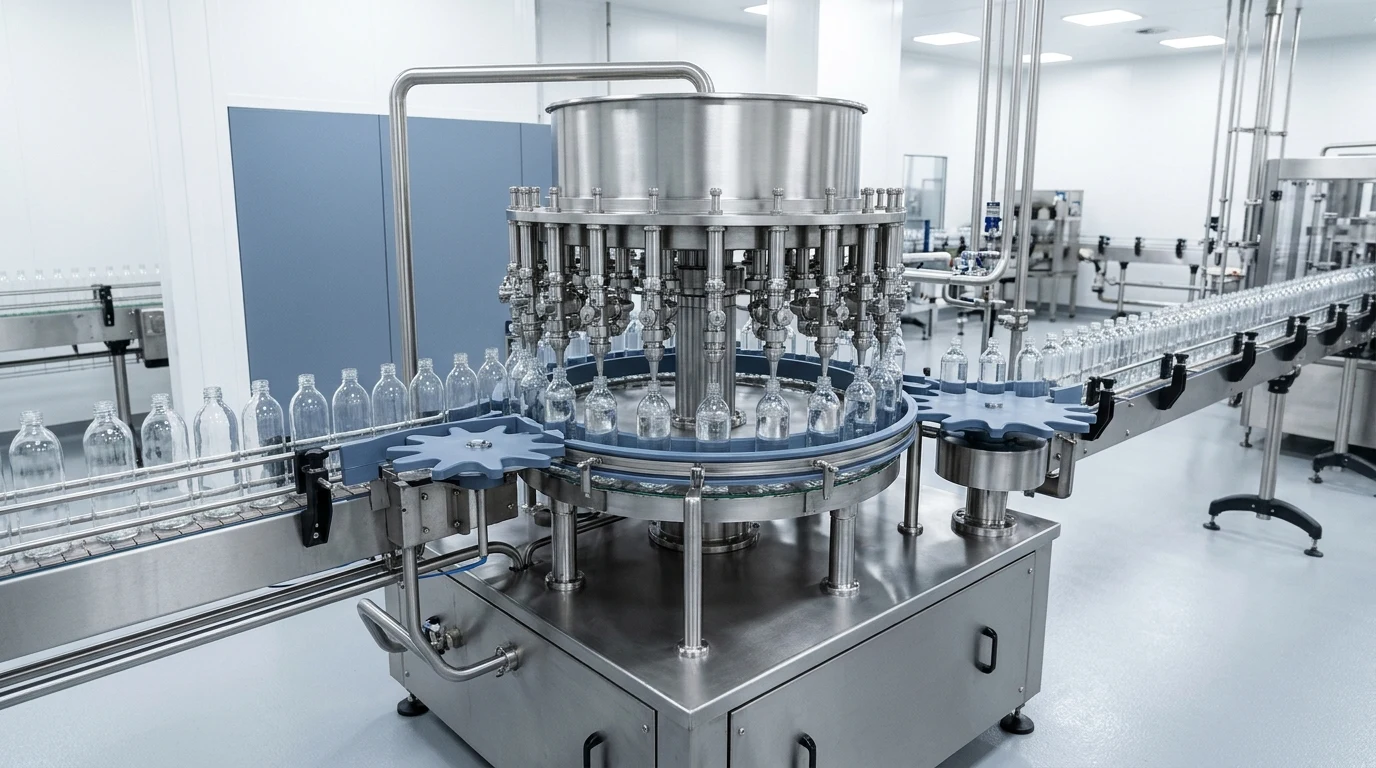
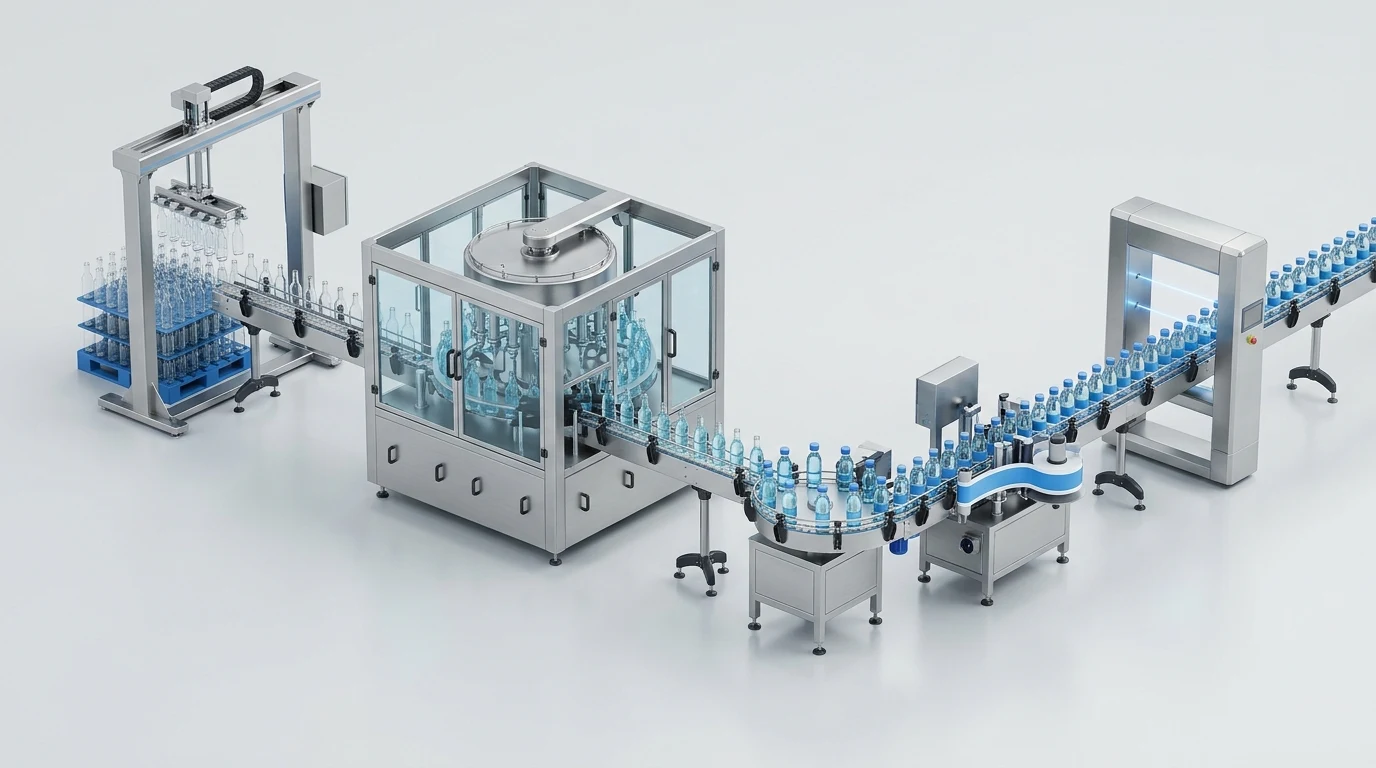
A rotary filling machine receives individual empty containers from upstream depalletising, indexes them in a circular motion around a rotating carousel to fill continuously at high speed, optionally purges headspace with inert gas, and transfers filled containers smoothly to downstream capping, labeling, date stamping, and inspection stations.
At the start of a bottling line, depalletising removes empty bottles from the original pallet packaging delivered by the container manufacturer so individual bottles can be handled automatically. Inside the rotary filler, bottles travel around the carousel while filling continuously; for oxygen-sensitive products, the filler can inject a small amount of inert gas such as carbon dioxide or nitrogen on top of the liquid to disperse oxygen and limit oxidation. Throughout high-speed transfer, packaging machinery must maintain positive control of the product so powders remain stable and liquids do not slosh out. Downstream of the rotary turret, bottling lines typically integrate capping operations, label application equipment, date stamps, and quality assurance verification equipment, including fill height detectors that reject under-filled or over-filled bottles as well as metal detectors.
Rotary vs Inline Filling Machine: How Do They Differ?
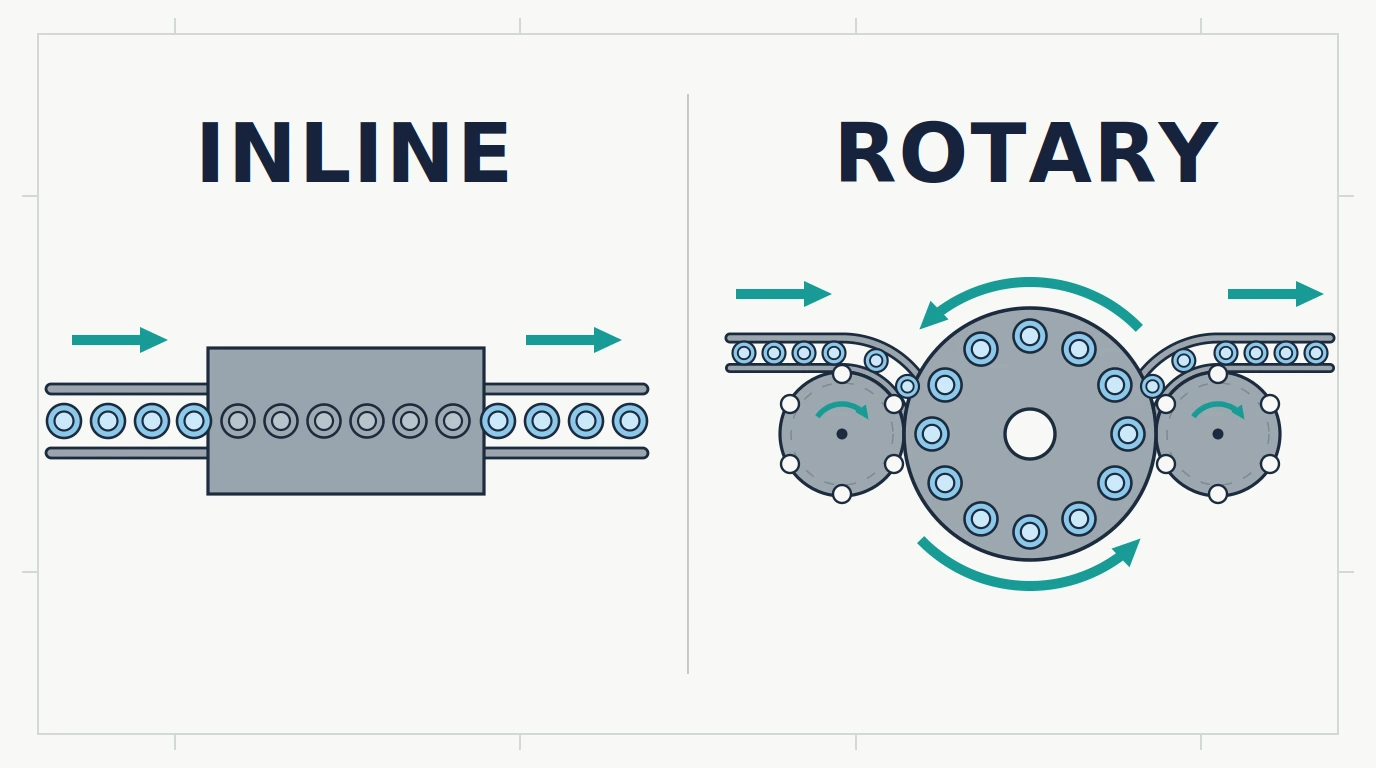
Rotary and inline filling machines differ primarily in container path, changeover speed, footprint, and maintenance complexity. Inline machines move containers in a straight line past sequential multi-nozzle heads (2, 4, 6, or 8+ nozzles) for fast multi-SKU changeovers, whereas rotary machines index bottles around a circular carousel for much faster continuous output.
Real production profiles illustrate why both automatic filling machines coexist. A high-volume beverage manufacturer bottling a single 16 oz format benefits from a rotary system capable of hundreds of fills per minute, where continuous circular motion maximizes throughput on a uniform bottle. By contrast, an operation producing multiple bottle sizes, such as a craft distillery, benefits from an inline filler that enables fast changeovers and accurate fill levels without the setup penalty of rotary format swaps. Progressing from manual work through a semi automatic filling machine to fully automated packaging lines helps control labor costs, improve quality consistency, and optimize throughput; compare early automation stages in our manual vs semi-automatic filling machines guide and coordinate downstream station pacing in our automated filling system speed balance guide.
| Comparison factor | Rotary filling machine | Inline filling machine |
|---|---|---|
| Container motion and nozzles | Circular indexing around a rotating carousel with continuous high-speed filling | Straight-line conveyor indexing sequentially under 2, 4, 6, or 8+ nozzles |
| Best-fit container and run mix | Standardized single format (such as a 16 oz beverage bottle) with short fill times and minimal variation | Multiple bottle shapes and sizes requiring frequent product or container changeovers |
| Typical industry applications | Bottled water, juices, mass-market sauces, and over-the-counter pharmaceuticals | Craft beverages, cosmetics, cleaning products, and specialty foods |
| Facility footprint and retrofit | Larger footprint and power requirements; often needs customized facility integration | Smaller straight-line footprint that retrofits easily into existing lines with minimal adjustments |
| Maintenance and troubleshooting | More moving parts and interdependent assemblies; longer maintenance downtime and skilled technician servicing | Simpler components, lower operating costs, and fast troubleshooting by in-house teams |
What Are the Main Rotary Filling Machine Components and Control Requirements?
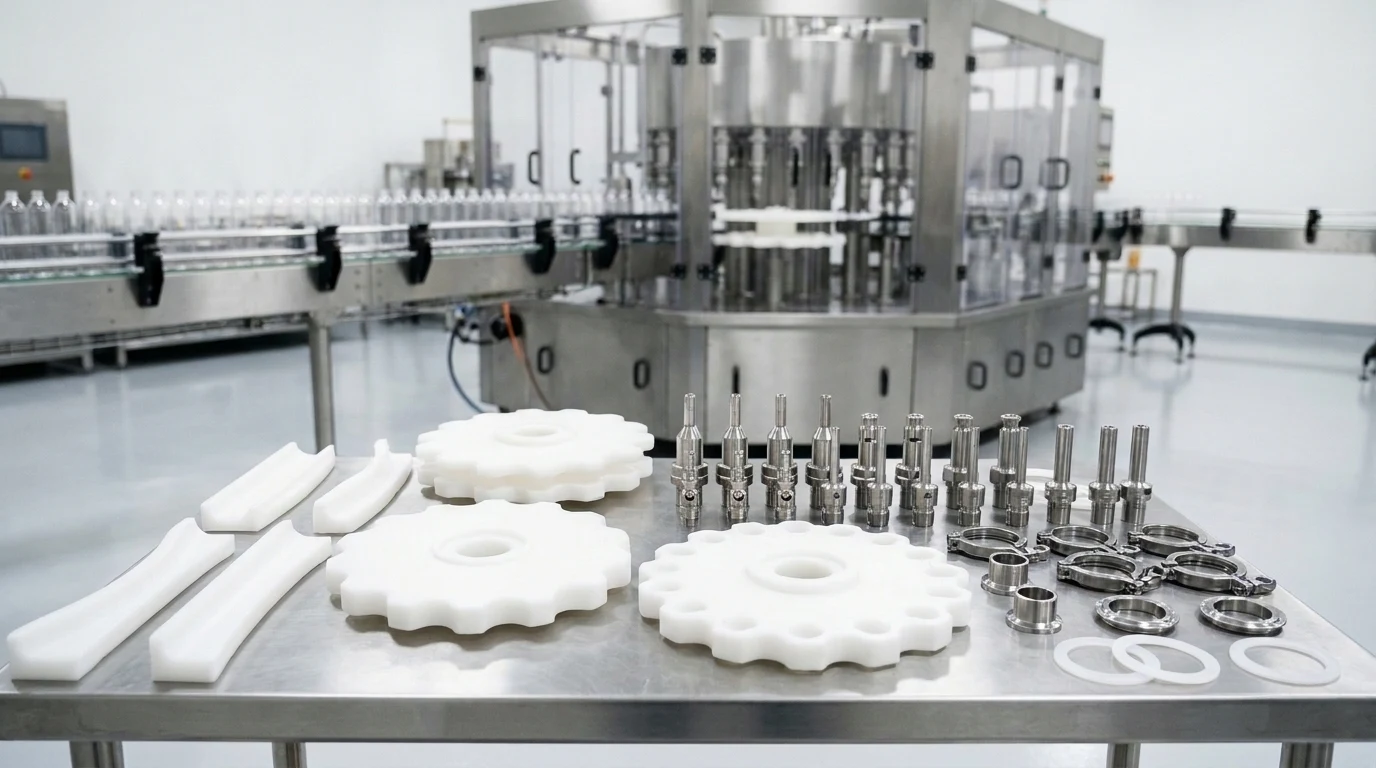
A rotary filling line combines the rotating carousel and dosing heads with programmable logic controllers, upstream depalletising, downstream capping and labeling, in-line quality inspection, and washdown-capable controls. Crucially, filling accuracy depends more on product type and fill method than on whether the machine layout is rotary or inline.
Dosing heads follow distinct metering principles depending on how the product is sold. Liquid level machines fill bottles so every bottle appears filled to the same visual line, whereas volumetric filling machines dispense the same liquid volume into each bottle. Among liquid dosing designs, overflow pressure fillers are the most popular machines with beverage makers, while gravity filling machines are the most cost-effective option; review both principles in our gravity vs overflow liquid filling machine comparison. At the control layer, packaging line automation increasingly relies on programmable logic controllers and robotics. Because large fully automatic packaging lines combine major equipment from different manufacturers with conveyors and ancillary machinery, system integration is a central engineering challenge, and industries that perform periodic high-pressure chemical washdowns place special demands on both the machinery and its control systems.
How Does Container Shape and Format Variety Affect Rotary Filling Machine Design?
Packaging operations are engineered either for variable package sizes and forms or for uniform packages with machinery adjusted between runs. Rotary filling machines are optimized for uniform, standardized containers with short fill times, so frequent container or product switches slow production and increase setup time compared with inline frames.
When a high-mix, small-batch bottling line installs a rotary filler without accounting for format variety, changeover downtime can erode the continuous-speed advantage of the rotating carousel. Inline systems handle frequent product or container switches faster because of their straightforward straight-line design and easy-to-adjust components. Before committing to a rotary turret, audit how many bottle formats share identical geometry, how long each production run lasts between switches, and whether container variety belongs on a flexible inline filler instead.
What Affects Rotary Filling Machine Ownership, Changeover, and Verification?
Evaluating a rotary filling machine goes beyond upfront capital investment to include floorspace, facility integration, changeover flexibility, maintainability, washdown demands, energy, labor, worker safety, outgoing quality, and return on investment. Acceptance testing must also separate repeating machine cycles from accepted net-contents output verified under NIST Handbook 133.
Because rotary fillers carry higher upfront investment, more moving parts, and interdependent assemblies, parts replacement and servicing require skilled technicians and can cause longer maintenance downtime than inline machines, which carry lower operating costs and simpler components for in-house teams. Rotary fillers also require a larger footprint and often need customized integration in older facilities because of their size and power needs, whereas inline fillers retrofit easily into existing lines. For compliance and acceptance testing, NIST Handbook 133 establishes procedures for checking the net contents of packaged goods, with Chapter 2 covering gravimetric test procedures for packages labeled by weight and Chapter 3 covering test procedures for packages labeled by volume. When a fill target is specified by volume but verified by mass, agree the density conversion at the product temperature rather than assuming one gram equals one milliliter; see our net weight vs volumetric filling guide. Likewise, track cycles per minute separately from packs per minute and confirm accepted output, which excludes rejected units so it never exceeds gross output; review acceptance metrics in our filling accuracy and speed guide.
| Evaluation factor | Data to document before selection | Engineering impact on rotary vs inline |
|---|---|---|
| Container standardization | Count of active bottle shapes, neck finishes, and fill-time requirements across SKUs | Uniform standardized containers favor rotary; frequent multi-format switches favor inline |
| Facility footprint and utilities | Available floorspace, power capacity, and existing conveyor integration points | Rotary often needs customized integration; inline retrofits into tighter spaces with minimal changes |
| Maintenance and washdown | In-house technician capability and periodic high-pressure chemical washdown schedule | Rotary interdependent parts require skilled servicing; controls must withstand chemical washdowns |
| Net-contents verification | NIST Handbook 133 Chapter 2 gravimetric or Chapter 3 volumetric protocol plus density at product temperature | Ensures volume-to-mass conversion accuracy rather than assuming one gram equals one milliliter |
| Output measurement | Repeating cycles per minute vs line packs per minute and rejected-unit counts | Separates gross cycle rate from accepted output that passes fill-height and quality checks |
Common questions
What is the main difference between a rotary filling machine and an inline filling machine?
An inline filling machine moves containers in a straight line and fills them sequentially at multiple nozzles (such as 2, 4, 6, or 8+ heads), whereas a rotary filling machine indexes containers in a circular motion around a rotating carousel to fill continuously at high speed.
Is a rotary filling machine more accurate than an inline filling machine?
No. Filling accuracy depends more on the product type and dosing method—such as liquid-level, volumetric, overflow pressure, or gravity filling—than on whether the machine frame is rotary or inline.
When should a facility choose a rotary filling machine over an inline filler?
Choose a rotary filling machine for high-volume, consistent production runs using standardized container formats with short fill times and minimal SKU variation, such as bottling a single 16 oz beverage format at hundreds of fills per minute.
Why do frequent format changeovers penalize a rotary filling machine?
Rotary filling machines are engineered for consistent runs with uniform containers; although they can accommodate product variety, frequent container or product switches slow production and increase setup time compared with straightforward, easy-to-adjust inline machines.
How should net contents and output be verified on a high-speed filling line?
Verify net contents using NIST Handbook 133 Chapter 2 gravimetric procedures for weight-labeled packages or Chapter 3 procedures for volume-labeled packages, confirm density conversion at product temperature when checking volume by mass, and track accepted packs per minute separately from gross cycles per minute.