
At a glance
Swipe to compare all columns.
| Review area | Bring to the discussion | Decision to record |
|---|---|---|
| Metering principle and shelf appearance | Net fluid volume target, bottle clarity, and mold capacity tolerance | Timed-flow gravity dosing vs return-to-tank overflow level control |
| Fluid rheology and surface foaming | Viscosity at fill temperature (≤200 cP vs ≤1,000 cP) and surfactant foaming | Overhead static head / pressure pot vs diving neck-seal recirculation loop |
| Chemical compatibility and package format | Acid, bleach, or sanitary food duty; rigid bottle vs flexible pouch drawing | 316L / PTFE / PP wetted path and rigid-bottle vs flexible-pack scope |
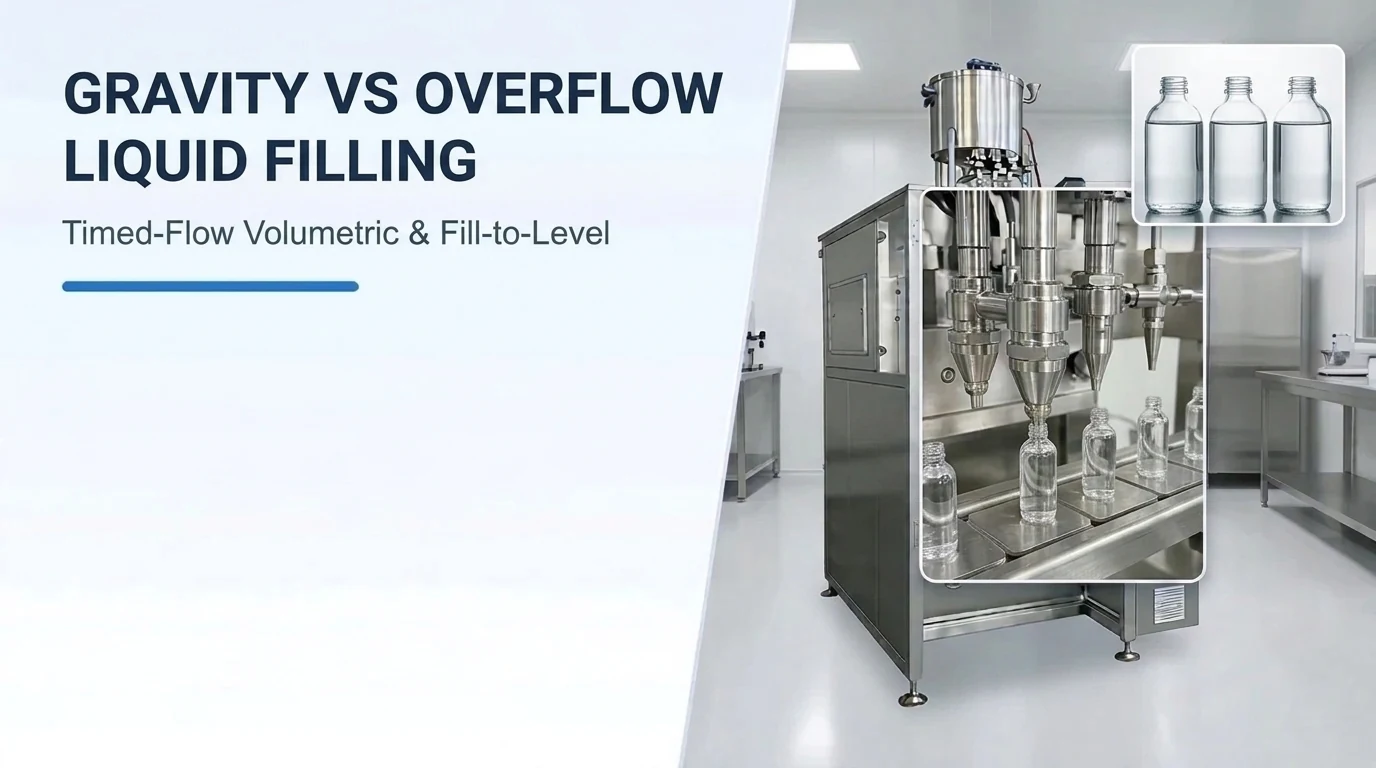
Time-Gravity Volumetric Dosing vs. Overflow Level Filling Principles
According to the PMMI ProSource Directory for Gravity Fillers (listing 51 companies), gravity fillers dispense typically water-thin or low-viscosity liquids from an upper chamber by dropping the product into a container. On Oden Machinery GRAV/TRONIC gravity fillers, precision electronics control fill volume based on timed flow from microliters to liters, and flow rate is varied by changing the elevation of the liquid reservoir above the filling nozzles. Oden Machinery GRAV/TRONIC gravity fillers support clean-in-place or steam-in-place, require minimal system volume, and use non-invasive cassette-load pinch valves or optional Oden Microdose filling valves. According to Oden Machinery, time-based gravity fillers ensure every bottle receives the same quantity of product despite discrepancies in the internal volume of containers, and are suited for thin-viscosity fluids where liquid recirculation in flow is not required. According to Makwell Machinery, gravity head pressure in an overhead filling bowl normally produces one psi or one to two feet of head, meaning gravity fillers require bigger stems and wider container necks to fill thick liquids quickly, and stable foam can rise up the vent tube into the bowl.
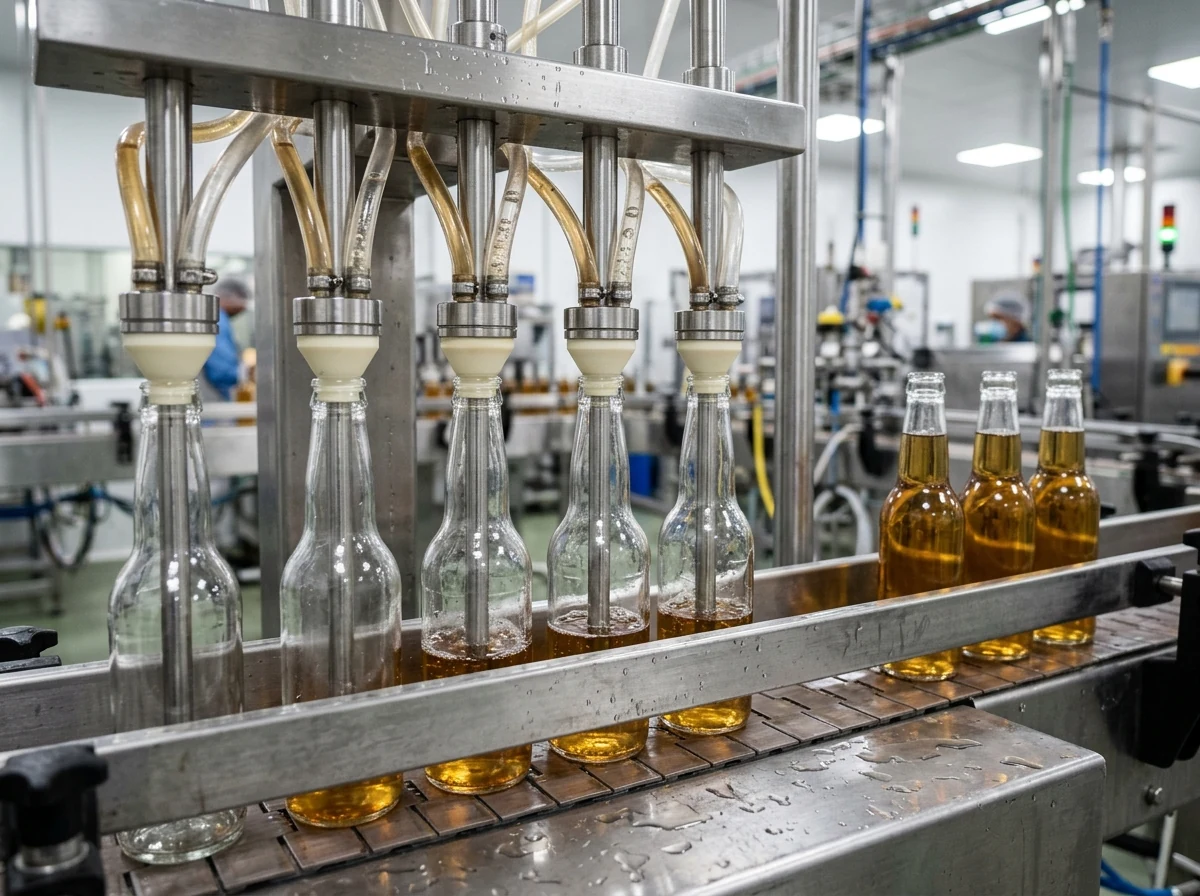
External pinch or peristaltic flow control valves use a single piece of tubing from pump to nozzle, eliminating valve cleaning and preventing leakage into or out of the fluid channel for high-purity or hazardous liquids. On Accutek Pinch Series timed-flow volumetric fillers, product delivery tubes run between a pinch bar and pinch plate with microprocessor-controlled timing to the nearest one hundredth of a second, and automatic models can fill up to twelve containers at the same time. On Accutek Pinch Series timed-flow fillers, product can be gravity-fed from an overhead surge tank without agitation, or pushed from a sealed two- or five-gallon pressure pot connected to an air hose; an all-pneumatic upgrade is available for filling flammable products. In an overflow filling machine, specialized nozzles descend into each bottle and form a seal at the opening; liquid flows continuously into the container until it reaches a predetermined height, and excess product is diverted through an overflow channel back into a central holding tank for recirculation. The Accutek Rotary Overflow Filler ROF-40 uses fill-to-level technology for free-flowing, non-carbonated liquids to produce visually appealing and consistent fill levels regardless of container shape or volume irregularities across rigid plastic, metal, and glass containers from ounces to gallons. In our liquid filling lineup, our liquid filling equipment focuses on flexible packaging—supplied premade pouches and film-formed sachets—while bottle-handling scope is confirmed separately. When we prepare piston and pump quotes, we compare them by what sets the dose—stroke, rotation, time, or valve—while keeping rigid-container handling and level control separate from our pouch or sachet equipment scope.
Net Quantity Regulations, Reference Temperatures, and Scale Verification
Under FTC 16 CFR § 500.7, the net quantity of contents statement shall be in terms of fluid measure if the commodity is liquid, or in terms of weight or mass if the commodity is solid, semi-solid, or viscous. Under FDA 21 CFR § 101.7(a), the net quantity statement on packaged food shall be in terms of fluid measure if the food is liquid, or in terms of weight if the food is solid, semisolid, or viscous. Under FDA 21 CFR § 101.7(b)(2), statements of fluid measure for packaged food shall be in terms of the U.S. gallon of 231 cubic inches and quart, pint, and fluid ounce subdivisions thereof. Under FDA 21 CFR § 101.7(b)(2)(ii) and (iii), fluid volume declarations for refrigerated foods are expressed at 40 °F (4 °C), while other foods express volume at 68 °F (20 °C). For liquid cosmetics in package form, statements of fluid measure shall be in terms of the U.S. gallon of 231 cubic inches and quart, pint, and fluid-ounce subdivisions thereof and shall express the volume at 68 °F (20 °C).
NIST Handbook 133 Checking the Net Contents of Packaged Goods (Current Edition - 2026) was adopted by the 109th National Conference on Weights and Measures (NCWM). In package net-contents checking, the average net quantity of contents of packages in a lot must at least equal the net quantity of contents declared on the label, while the Maximum Allowable Variation (MAV) is the limit of reasonable minus variation for an individual underfilled package. In Chapter 3 (Test Procedures – For Packages Labeled by Volume), the gravimetric procedure may be used to verify the net quantity of contents of packages labeled in volume when the density of the liquid product being tested does not vary excessively from one package to another. In the Chapter 3 Reference Temperature illustrative example, the volume of a liquid cleaning product might be 5 L (1.32 gal) at 20 °C (68 °F) and 5.12 L (1.35 gal) at 25 °C (77 °F), which represents a 2.2 % change in volume. In Table 3-1 (Reference Temperatures for Liquids), volume is determined at 4 °C (39.1 °F) for Malt (Beer), 15.56 °C (60 °F) for Distilled Spirits, 4 °C (40 °F) for Refrigerated food, and 20 °C (68 °F) for Other liquids and wine. For the Gravimetric Test Procedure for Non-Viscous Liquids, the scale division must be no larger than MAV/6 for the package size under test, and the smallest graduation on the scale must not exceed the weight value for MAV/6. In the scale suitability example for packages labeled 1 L (33.8 fl oz) with an MAV of 29 mL (1 fl oz) and liquid weight of 943 g (2.078 lb, density 0.943 g/mL), MAV/6 equals 4.557 g (0.010 lb), which a scale with 1 g (0.002 lb) increments satisfies.
In our dosing comparisons, volumetric filling dispenses a predetermined volume without measuring mass, whereas net-weight filling controls the dose by measured weight on a scale or load cells. In our accuracy evaluations, we define bias as how far the average fill sits from the target, whereas variation is how much individual fills scatter around their own average (illustrated with a 10.2 gram average against a 10.0 gram target). In Wolf Packing Machine's comparison, volumetric filler accuracy ranges from ±1-3% depending on product consistency and density stability, while gravimetric filler precision typically achieves ±0.1-0.5% of target weight with an initial capital investment 40-60% higher than volumetric alternatives, and volumetric systems reach 400 fills per minute on automated beverage lines.
Overflow Recirculation Hardware, Foam Control, and Viscosity Tiers
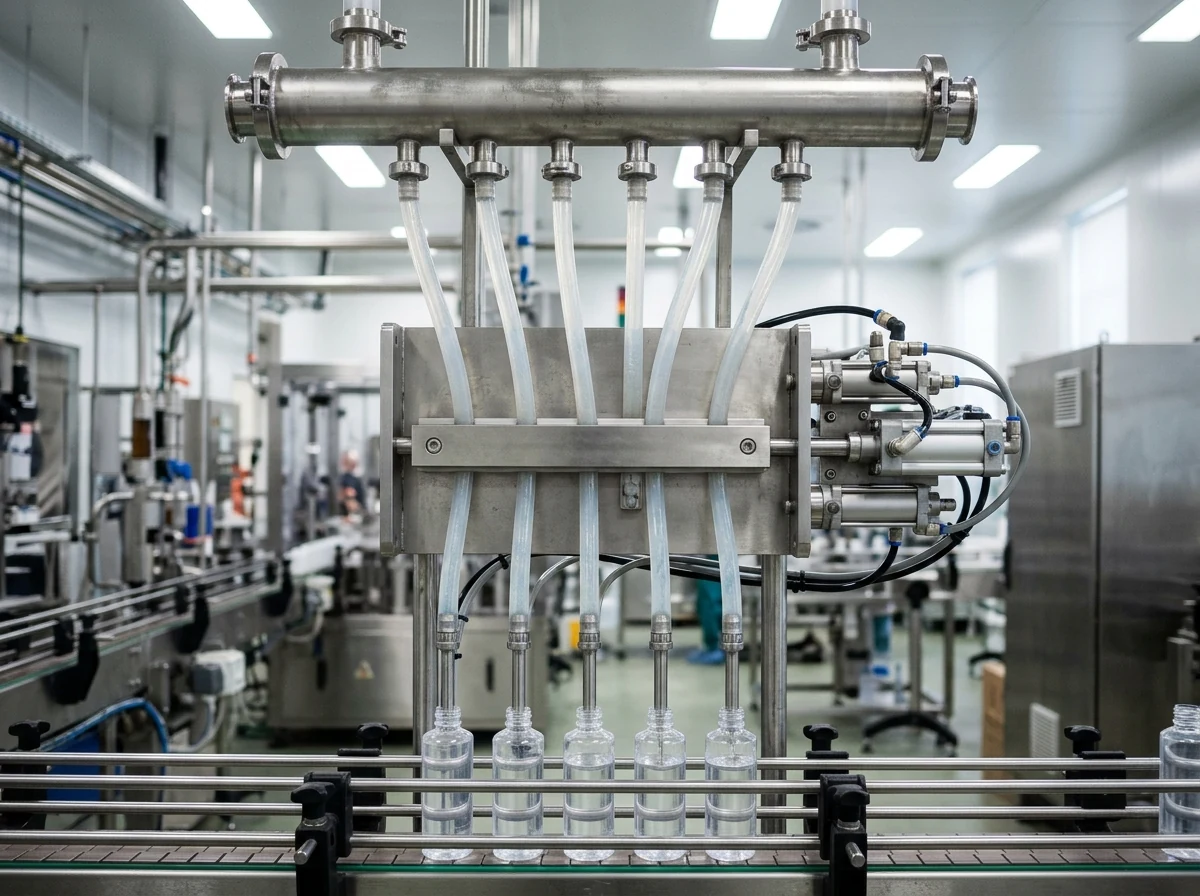
In our liquid filling systems, surfactant foam can make a bottle appear full before it holds the correct product quantity, and we use diving nozzles to fill closer to the liquid level and reduce splashing. The JPACKS JOF Automatic Liquid Bottle Overflow Filling Machine features a 304 stainless steel C-frame, a 20 Gallon stainless steel overflow tank, a 304 stainless steel feeding manifold (customizable in 316 or PTFE), Teflon and Viton contact parts, Expansion to 16 nozzles, fill range 50ml-5L, and viscosity limit ≤200 cps. The JPACKS JOF-8 Automatic Overflow Filling Machine includes an 80L stainless steel overflow tank, a 3000L per Hour 304 stainless steel centrifugal pump, a 250mm stroke air cylinder for nozzle movement, container height adjustment from 1 to 16 inches, nozzle stroke adjustment from 0 to 10 inches, and requires 15 Amps and 5 CFM @ 80 p.s.i.
In Tranfull Machinery's chemical filling guide, viscosity is measured in centipoise (cP) or millipascal-seconds (mPa·s), where water is 1 cP and honey is around 10,000 cP; gravity, overflow, and peristaltic fillers are matched to low-viscosity liquids, while 500 – 5,000 cP liquids use piston or gear pump fillers and 5,000 – 50,000 cP liquids use servo piston or rotary pumps. In Cleveland Equipment's liquid filler guide, SGP and SGY pneumatic piston fillers are built with 316 stainless steel, require 5 CFM at 90 PSI compressed air (with at least a 30-gallon air compressor), and are rated at ±1% accuracy on liquids, and the SGP is rated at ±2% on creams, whereas the CE-FIL-OF11 automatic pressure overflow filler is PLC-controlled for consistent fill levels in clear bottles. In the PMMI ProSource Directory, Acasi Inc. semi-automatic inline liquid filling machines operate at speeds up to 120 bottles per minute, while its rotary fillers operate faster than 300 bottles per minute. In the PMMI ProSource Directory, Aesus AESFILL AF-4 variable-speed bottom-up liquid filling systems run at up to 160 per min and fill container sizes starting from 3 ml. In PMMI ProSource's Liquid Filling in Focus overview, the Ronchi America LLC Exacta flow meter filler is engineered to dispense consistently at speeds of 300 bottles per minute.
Corrosive Chemical Time-Gravity vs. Anti-Corrosion Overflow Construction
Under § 211.65(a), pharmaceutical equipment surfaces that contact components, in-process materials, or drug products shall not be reactive, additive, or absorptive. Under § 117.40(a)(4) and (5), food-contact surfaces must be corrosion-resistant when in contact with food and made of nontoxic materials. Under § 117.40(d), holding, conveying, and manufacturing systems, including gravimetric, pneumatic, closed, and automated systems, must be of a design and construction that enables them to be maintained in an appropriate clean and sanitary condition. Under § 177.1550, perfluorocarbon resins (including polymers of hexafluoropropylene, tetrafluoroethylene, and perfluoropropylvinylether, CAS No. 26655-00-5) may be safely used as articles or components of articles intended to contact food. Under § 177.2600, rubber articles intended for repeated use may be safely used in producing, manufacturing, packing, processing, preparing, treating, packaging, transporting, or holding food. For corrosive acids, alkalis, and solvents that rapidly corrode standard 304 stainless steel components, Tranfull Machinery specifies 316L stainless steel for product-contact surfaces, PTFE (Teflon) seals and gaskets, ceramic or PVDF pump components for aggressive acids, and Hastelloy C-276 for extreme chemical environments.
The Accutek Auto Corrosive Filler (ACF) is a timed-flow volumetric gravity-feed filler for acids, bleach, ammonia, and aggressive brine solutions, with a filling speed up to 60 CPM1, fill size of .5 – 128 oz. (14.79 mL – 3.79 L), and viscosity range of under 1 to 1000 CPS (Centipoise). The Accutek Auto Corrosive Filler (ACF) detects 12 bottles per cycle, requires 110 V, 2 AMP 60 Hz power and 80 PSI air, and has dimensions of 120” (304.8 cm) length, 36” (91.44 cm) depth, 90” (228.6 cm) height, and weight of approx. 700 lbs. (317.52 kg). The JPACKS JTF Series Automatic Computer Time Gravity Filling Machine uses a vertical constant-liquid-level and time structure with an electric scale weight feedback system, PTFE level inspection device, German BURKERT valve, and a Φ100mm top exhaust outlet. The JPACKS JTF Series Automatic Computer Time Gravity Filling Machine has a rated capacity of ≤ 6000 bottles/hr (using 100ml water as medium), applicable bottle diameter Φ33–100mm and height 80–230mm, and fill volumes of 40-1000ml. The JPACKS JTF Series Automatic Computer Time Gravity Filling Machine requires 0.6–0.8 MPA air pressure and ~380V power source, with external dimensions of 2000×710×2200mm (L×W×H) and weight of about 480Kg.
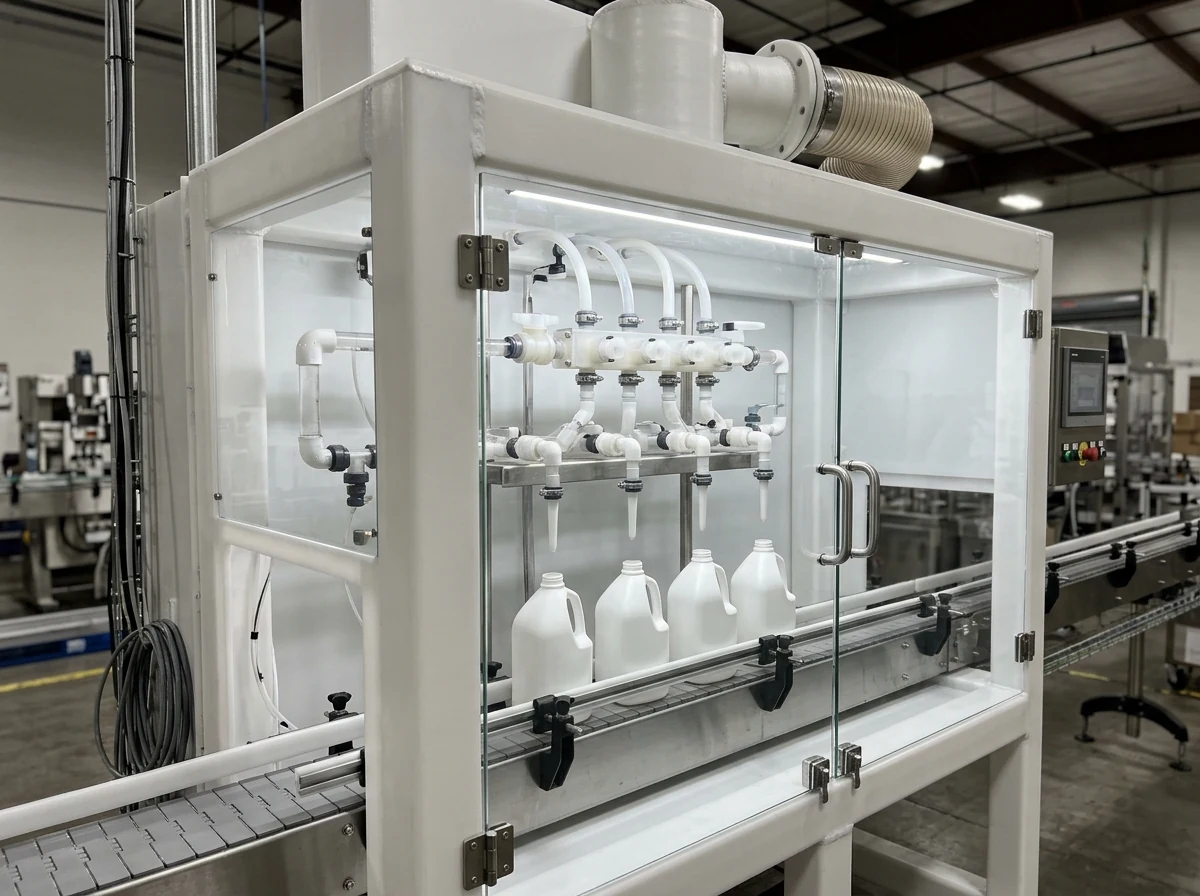
The JPACKS JTF-AC Automatic Anti-Corrosion Gravity Filling Machine is built for strong acid and strong alkali liquids, using non-metallic liquid-contact parts, Teflon-coated metal parts, diving filling nozzles, and a corrosive-liquid float level switch. The JPACKS JTF-AC Automatic Anti-Corrosion Gravity Filling Machine (12 heads) has a production speed of ≤4000 bottles/hour (filling 50ml), applicable bottle diameter 40-95mm and height 80-330mm, measurement accuracy of ±0.5%, and filling range of 50-1000ml. The JPACKS JOF-AC Series Anti-Corrosion Bottle Liquid Pressure Overflow Filling Machine is built on a heavy-duty welded PP frame with one to sixteen heads, a 120L overflow tank, fill capacity 5L-30L, and viscosity limit ≤200 cps for acid solutions, etching chemicals, lime/calcium removers, bleaches, and brine solutions.
Sources
- United States Government Publishing Office — Code of Federal Regulations Net Quantity and Food-Contact Material Rules
- National Institute of Standards and Technology — Checking the Net Contents of Packaged Goods Handbook and Gravimetric Volume Procedures
- Association for Packaging and Processing Technologies — ProSource Directory for Gravity Fillers and Liquid Filling Systems
- Packaging Digest — Engineering Analysis of Flow Control Valves and Pinch Tubing on Liquid Fillers
- Oden Machinery and Accutek Packaging Machinery — Time-Gravity Volumetric, Corrosive Gravity, and Rotary Overflow Technical Literature
- Jpacks and Makwell Machinery — Time-Gravity, Overflow Recirculation, and Anti-Corrosion Bottle Filling Documentation
- Our LINEVO Engineering Library, Tranfull Machinery, Cleveland Equipment, and Wolf Packing Machine — Chemical Compatibility, Viscosity Tiers, and Flexible Liquid Packaging Guides
Common questions
How does a time-gravity liquid filling machine differ from an overflow filler on clear bottles?
Time-gravity fillers meter a fixed fluid volume per cycle using timed valve opening under constant overhead head pressure, delivering identical net volume even when bottle wall thickness varies—but leaving uneven liquid heights in blown glass or plastic containers. Overflow fillers seal onto the bottle mouth and pump liquid until it reaches a vent port at a fixed height, returning excess fluid and foam to the supply tank so every clear bottle displays an identical cosmetic fill line.
What federal net quantity and reference temperature rules apply to liquid foods, cosmetics, and household commodities?
FTC 16 CFR § 500.7 and FDA 21 CFR § 101.7(a)–(b)(2) require liquid commodities, foods, and cosmetics to declare net contents by fluid measure (U.S. gallons, quarts, pints, and fluid ounces), whereas solid, semisolid, or viscous products declare by weight. Volume is standardized at 40 °F (4 °C) for refrigerated foods and malt beverages, 60 °F (15.56 °C) for distilled spirits, and 68 °F (20 °C) for liquid cosmetics, wine, and non-refrigerated liquid foods.
How is liquid package volume verified gravimetrically on a quality control scale?
Under NIST Handbook 133 Chapter 3, inspectors convert net weight to volume using liquid density at the reference temperature when batch density is uniform, verifying both the lot average and the Maximum Allowable Variation (MAV) for individual packages. For non-viscous liquids, the scale graduation must not exceed MAV/6—for example, a 1 L package with a 29 mL MAV and 0.943 g/mL density has MAV/6 = 4.557 g, which a 1 g resolution scale satisfies.
What viscosity limits separate gravity and overflow fillers from piston or pump filling machines?
Standard overflow recirculation fillers (such as the JPACKS JOF and JOF-AC series) are rated up to ≤200 cP, and timed-flow gravity fillers (such as the Accutek ACF) handle thin liquids from <1 to 1,000 cP. Above those free-flowing tiers, medium-viscosity fluids (500–5,000 cP) transition to pneumatic or servo piston fillers (±1% accuracy on liquids, ±2% on creams) or gear pumps, while heavy pastes (5,000–50,000 cP) require servo piston or rotary lobe pumps.
Which wetted materials are used when filling corrosive acids, bleaches, or sanitary food and drug liquids?
Sanitary food and pharmaceutical liquids require non-reactive, corrosion-resistant contact paths under 21 CFR § 211.65(a) and § 117.40, typically pairing 316L stainless steel with FDA-compliant fluoropolymers (§ 177.1550 PTFE/FEP) and elastomers (§ 177.2600 Viton/EPDM). Strong acids, alkalis, and sodium hypochlorite bleach rapidly attack 304 stainless steel and instead require welded polypropylene (PP) frames, non-metallic PVDF/ceramic/PTFE wetted manifolds, or Hastelloy C-276 with top fume extraction.
What to send us
Swipe to compare all columns.
| Item | Why we need it | Example format |
|---|---|---|
| Liquid formulation and viscosity profile | Match free-flowing versus viscous rheology and foaming behavior to the valve and nozzle path. | Product description, centipoise range at filling temperature, and foaming or shear notes |
| Container format and neck geometry | Verify whether the project uses rigid bottles requiring neck sealing or flexible pouches and sachets. | Dimensioned container drawing, neck opening diameter, height range, and wall rigidity |
| Net quantity basis and inspection scale | Align volumetric dosing or visual fill height with gravimetric lot average and scale division checks. | Labeled fluid volume, reference temperature, liquid density, and quality control scale increment |
| Chemical corrosiveness and sanitation regime | Select compatible wetted metals, fluoropolymers, elastomers, and fume extraction connections. | Acid, bleach, or sanitary food classification, washdown method, and exhaust duct requirement |
We reply within 24 hours.