
At a glance
Swipe to compare all columns.
| Review area | Bring to the discussion | Decision to record |
|---|---|---|
| Botanical variety and crystal state | Floral origin, fructose-to-glucose profile, glucose-to-water ratio, and incoming crystal fraction | Whether indirect water-bath decrystallization and fine filtration are required ahead of dosing |
| Filling temperature and thermal window | Target warming temperature, residence duration, enzyme preservation goal, and ambient humidity | Jacketed tank agitation setup, manifold heating path, and moisture protection protocol |
| Cap-cavity volume and nozzle cutoff | Dimensioned cap drawing, usable cavity volume, target gram weight, and foil membrane material | Volumetric stroke calibration for specific gravity, suck-back micro-nozzle tuning, and heat-seal window |
Why Honey Crystallization and Sugar Ratios Govern Dosing-Cap Filling
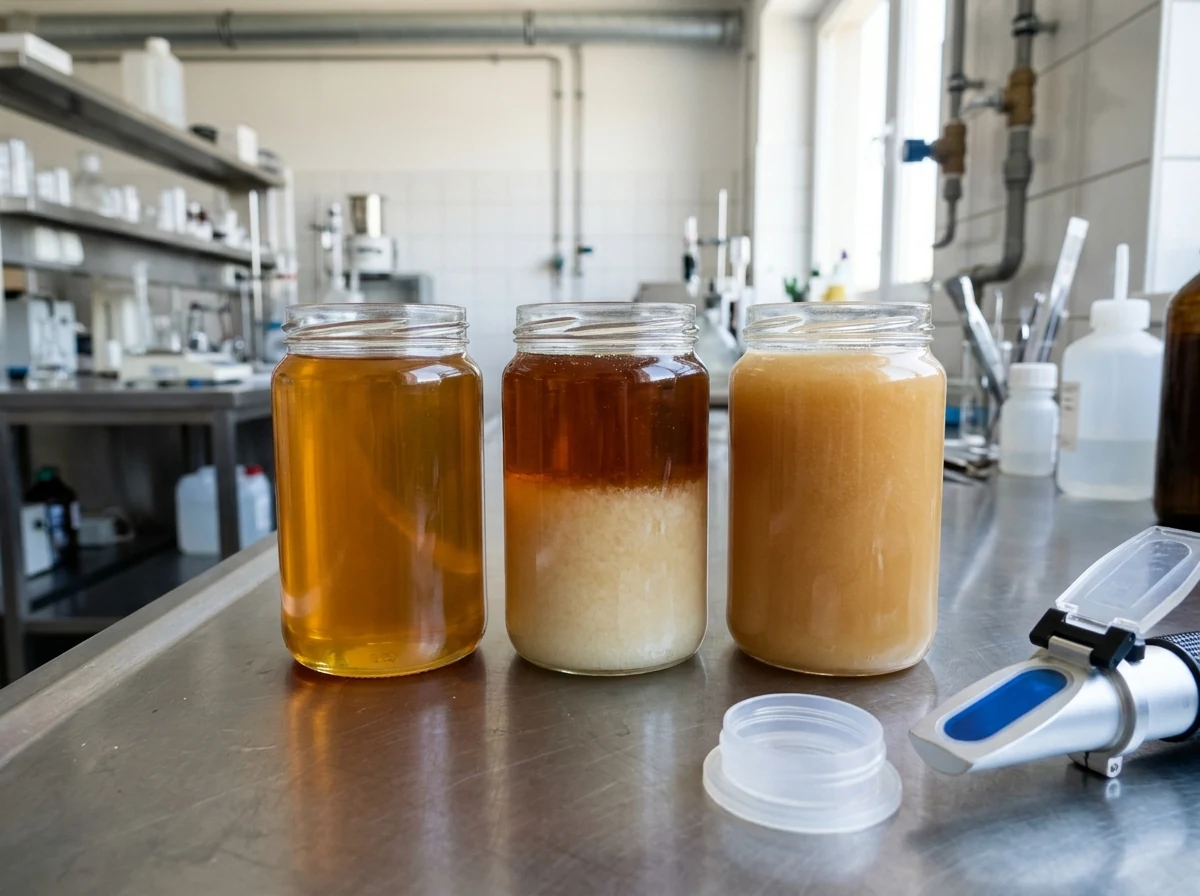
Honey consists essentially of different sugars, predominantly fructose and glucose, and its consistency can be fluid, viscous, or partly to entirely crystallised. Honey is a highly concentrated sugar solution containing more than 70% sugars and less than 20% water. In honey, fructose generally ranges from 30–44% and glucose from 25–40%; glucose crystallizes due to its lower solubility while fructose is more soluble in water and remains fluid.
Honey high in glucose with a low fructose-to-glucose ratio crystallizes more rapidly (such as alfalfa, cotton, dandelion, mesquite, mustard, and rape), whereas honey with a higher fructose-to-glucose ratio containing less than 30% glucose (such as robinia/black locust, sage, longan, tupelo, and jujube/sidr) crystallizes slowly and can stay liquid for several years without special treatment. Three sugar-and-water ratio formulas predict honey crystallization tendency: (1) Glucose/Water below 1.7 stays liquid and above 2.1 will crystallize; (2) Fructose/Glucose above 1.64 stays liquid and below 1.25 will crystallize; and (3) (Glucose - Water)/Fructose below 0.27 stays liquid and above 0.42 will crystallize. Honey crystallization is most rapid around 10–15 °C (50–59 °F), whereas below 10 °C (52 °F) crystallization is slowed down because low temperature increases honey viscosity and retards the formation and diffusion of crystals. Southern Cross University and AgriFutures Australia report that the optimal temperature for honey crystallization is around 14°C (57°F). Teams evaluating dosing-cap filling architectures should align botanical sugar ratios, hopper conditioning, and cavity geometry before locking the mechanical layout.
Viscosity-Temperature Curves and Botanical Rheology at the Micro-Nozzle
The viscosity of honey decreases rapidly as its temperature rises, and a 1% change in moisture content is equivalent to about 3.5°C in its effect on honey viscosity. At 25°C, honey viscosity in Table 4 of the National Honey Board Reference Guide drops from 138.0 poise at 15.5% water content to 69.0 poise at 17.1% water, 48.1 poise at 18.2% water, 34.9 poise at 19.1% water, and 20.4 poise at 20.2% water. At 25°C and 16.5% water content, honey viscosity varies by floral source: sage honey is 115.0 poise, clover honey is 87.5 poise, and white clover honey is 94.0 poise.
For honey at 16.1% water content, dynamic viscosity drops steeply with temperature: from 600.0 poise at 13.7 C to 68.4 poise at 29.0 C, 21.4 poise at 39.4 C, 10.7 poise at 48.1 C, and 2.6 poise at 71.1 C in testing. For clover honey at 16% moisture, Airborne Honey reports typical viscosity values of 600 poise at 14°C, 190 poise at 20°C, 65 poise at 30°C, 20 poise at 40°C, 10 poise at 50°C, and 3 poise at 70°C in technical tables. Heather (Calluna vulgaris), Manuka (Leptospermum scoparium), and Carvia callosa honeys are thixotropic—meaning they are gel-like and extremely viscous when standing still and turn liquid when agitated or stirred—whereas a number of Eucalyptus honeys exhibit the opposite behavior where viscosity increases with agitation. Choosing between piston vs pump filling mechanisms therefore depends on whether the honey behaves as a pure Newtonian liquid or a thixotropic crystal suspension during dosing.
Decrystallization Temperature Limits, HMF Kinetics, and Jacketed Tank Heating
Under Section 3.2 and Section 3.3, honey shall not be heated or processed to such an extent that its essential composition is changed and/or its quality is impaired, and chemical or biochemical treatments shall not be used to influence honey crystallisation. Under Annex Section 1.2, the diastase activity of honey determined after processing and/or blending is in general not less than 8 Schade units, and in the case of honeys with a low natural enzyme content not less than 3 Schade units. Under Annex Section 1.3, the hydroxymethylfurfural (HMF) content of honey after processing and/or blending shall not be more than 40 mg/kg, or not more than 80 mg/kg for honey of declared origin from countries or regions with tropical ambient temperatures and blends of these honeys. Under Annex Sections 2.1, 2.2.2, and 2.2.3, honey samples for the determination of diastase activity (AOAC 958.09) and hydroxymethylfurfural content (AOAC 980.23) are prepared without heating.
Honey resists crystallization best at temperatures above 25 °C (77 °F); at 40 °C (104 °F) crystals dissolve, and temperatures above 40 °C (104 °F) damage the properties of honey. Natural beehive temperature is about 35 °C (95 °F) and can rise to 40 °C (104 °F) in summer; to liquefy crystallized honey without overheating, it is best heated indirectly at 35–40 °C (95–104 °F). During water-bath warming at 35–40 °C (95–104 °F) for 20–30 minutes, honey should be stirred occasionally to distribute heat evenly because crystallized honey is a poor conductor of heat. When warming honey to reduce crystallization or return crystallized honey to liquid form, Southern Cross University and AgriFutures Australia specify that honey should not be heated higher than 45 degrees Celsius and for no longer than 14 hours, because heating above 45 degrees Celsius for longer than 14 hours begins to destroy beneficial enzymes and increases hydroxymethylfurfural (HMF) content. The optimum room temperature for storing honey in tightly closed containers is 21 to 27 °C (70–80 °F), while cold storage temperatures of 11 to 18 °C (52–64 °F) are ideal for crystal formation and should be avoided.
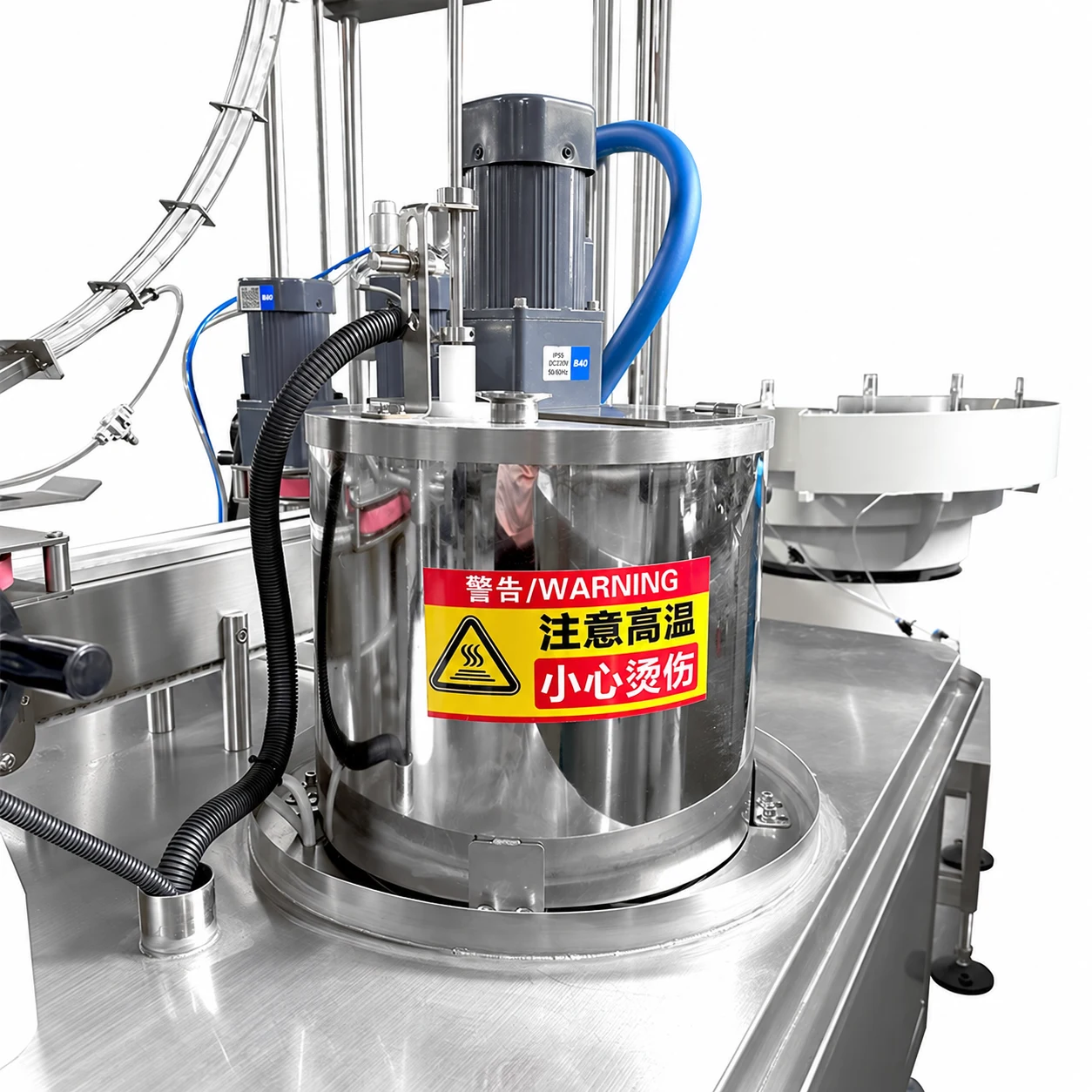
To remove small particles such as pollen grains, wax flecks, crystals, and air bubbles that initiate crystallization, honey is filtered through an 80 micro filter or fine nylon cloth. Commercial US supermarket honey packers heat liquid honey to 63 °C (145 °F) for 30 minutes, or flash-heat to 71 °C (160 °F) for 1 minute and rapidly cool to 49–52 °C (120–125 °F), which kills fermentation yeast cells and delays crystallization. In water-bath decrystallization tests on crystallized honey (Table 1), time until full decrystallization was 960 min at 45 °C, 380 min at 60 °C, 50 min at 75 °C, and 23 min at 90 °C in water-bath trials. In crystallized honey decrystallization tests (Table 4), HMF content increased from 6.79 ± 1.50 mg/kg in the unheated control to 9.89 ± 0.40 mg/kg at 45 °C, 24.85 ± 0.46 mg/kg at 60 °C, 27.50 ± 1.47 mg/kg at 75 °C, and 55.11 ± 1.04 mg/kg at 90 °C, where the 90 °C treatment exceeded the 40 mg/kg Codex Alimentarius limit. Liquid honey has a specific heat of 0.54-0.60 cal/g/C while finely granulated honey has a higher specific heat of 0.73 cal/g/C, and honey thermal conductivity increases with temperature and total solids from 118 x 10 -5 to 143 x 10 -5 cal/cm sec C across the range. The relatively low thermal conductivity of honey combined with its high viscosity leads to rapid overheating from point-heat sources, requiring careful stirring and heating only in water baths. The Shemesh Automation STRATUM double-servo-driven piston filling machine for honey offers both hot and cold filling using a heated double-jacket tank capable of heating liquids up to 95° Celsius, available with 2 to 12 heads or 40-180ppm for up to 500ml liquid volume.
Dosing-Cap Chamber Volume vs. Target Gram Weight and Stratification
Once crystallization fraction changes flowability and specific gravity, the geometric dosing-cap chamber volume no longer corresponds to a fixed gram weight without density compensation. In volumetric filling versus net-weight filling, volumetric filling dispenses a predetermined volume without measuring mass, so a fixed volume equals a given mass only through mass = density × volume at a recorded temperature; a change in density changes the mass of a fixed volume, and 1 g must not be treated as 1 mL. True specific gravity of honey at 20 C decreases as water content rises: 1.4457 at 13.0, 1.4404 at 14.0, 1.4350 at 15.0, 1.4295 at 16.0, 1.4237 at 17.0, 1.4171 at 18.0, 1.4101 at 19.0, 1.4027 at 20.0, and 1.3950 at 21.0. Because honey density varies with water content, honey in large storage tanks can stratify with higher-water-content (less dense) honey settling above denser, drier honey unless avoided by thorough mixing. In honey crystallization, monohydrate glucose crystals form and water is freed, increasing the water content of the remaining liquid phase and raising the risk of fermentation in partially crystallized honey.
Under Section 3.4 Moisture Content, honeys not listed below shall have a moisture content of not more than 20%, and heather honey (Calluna) shall have not more than 23%. Under Section 3.5.1, the sum of fructose and glucose content shall be not less than 60 g/100g for honey not listed below, and not less than 45 g/100g for honeydew honey and blends of honeydew honey with blossom honey. Under Section 3.6, water-insoluble solids content shall be not more than 0.1 g/100g for honeys other than pressed honey, and not more than 0.5 g/100g for pressed honey. Under Section 7.2, the determination of moisture content in honey uses AOAC 969.38B / MAFF Validated method V21. USDA standards for extracted honey specify that Grade A and Grade B require a minimum total solids of 81.4 and a maximum water content of 18.6, while Grade C requires a minimum total solids of 80.0 and a maximum water content of 20.0. Because the refractive index of honey differs from that of a sucrose solution at the same concentration, honey moisture must be measured using the special moisture chart in AOAC Method 969.38 rather than a standard Brix or sucrose scale. The average pH of honey is 3.9, with a typical range of 3.4 to 6.1, and organic acids average 0.57% (range 0.17–1.17%). Fermentation in honey is caused by osmophilic yeasts and will not occur in honey that has a carbohydrate content above 83%, a moisture content below 17.1%, a storage temperature below 52°F (11°C), or that has been heat-treated. Normal honey with a water content of 18.3% or less absorbs moisture from ambient air at relative humidities above 60%; equilibrium water content of clover honey rises from 15.9% at 50% RH and 18.3% at 60% RH to 20.9% at 65% RH, 24.2% at 70% RH, 28.3% at 75% RH, and 33.1% at 80% RH.
Under Clauses 3.2 and 3.3, the average actual quantity of product in prepackages shall be at least equal to the nominal quantity, a homogenous group of prepackages shall contain no more than 2.5% of packages having T1 errors, and no prepackage shall have a T2 error. Under Table 1, for prepackages with a nominal quantity Qnom of 0 to 50 g or mL, the tolerable deficiency T is 9 Percent of Qnom (rounded up to the next 0.1 of a g or mL for Qnom less than or equal to 1 000 g or 1 000 mL), and for 50 to 100 g or mL, T is 4.5 g or mL. Gravimetric testing of net weight requires a scale with at least 100 scale divisions and a scale division no larger than 1/6 of the Maximum Allowable Variation (MAV/6) for the package size being weighed. Under Table 2-5, for packages labeled by weight at less than 36 g (0.08 lb or 1.28 oz), the Maximum Allowable Variation (MAV) is 10% of the labeled quantity; for 36 g or more to 54 g, the MAV is 3.6 g. Pairing quality and inspection procedures with filling accuracy and speed verification keeps tare-corrected cap weights stable across long production runs.
Micro-Nozzle Suck-Back Cutoff, Rim Cleanliness, and Foil Sealing
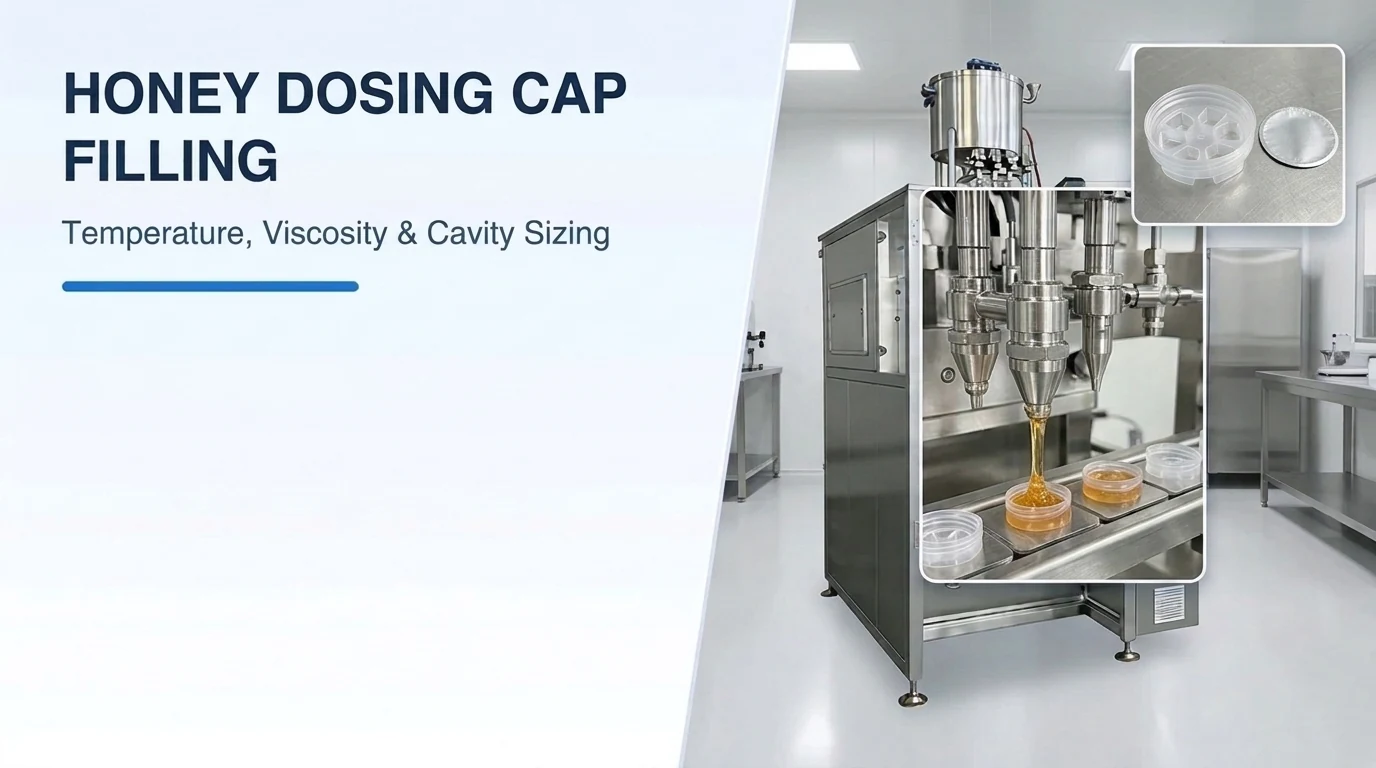
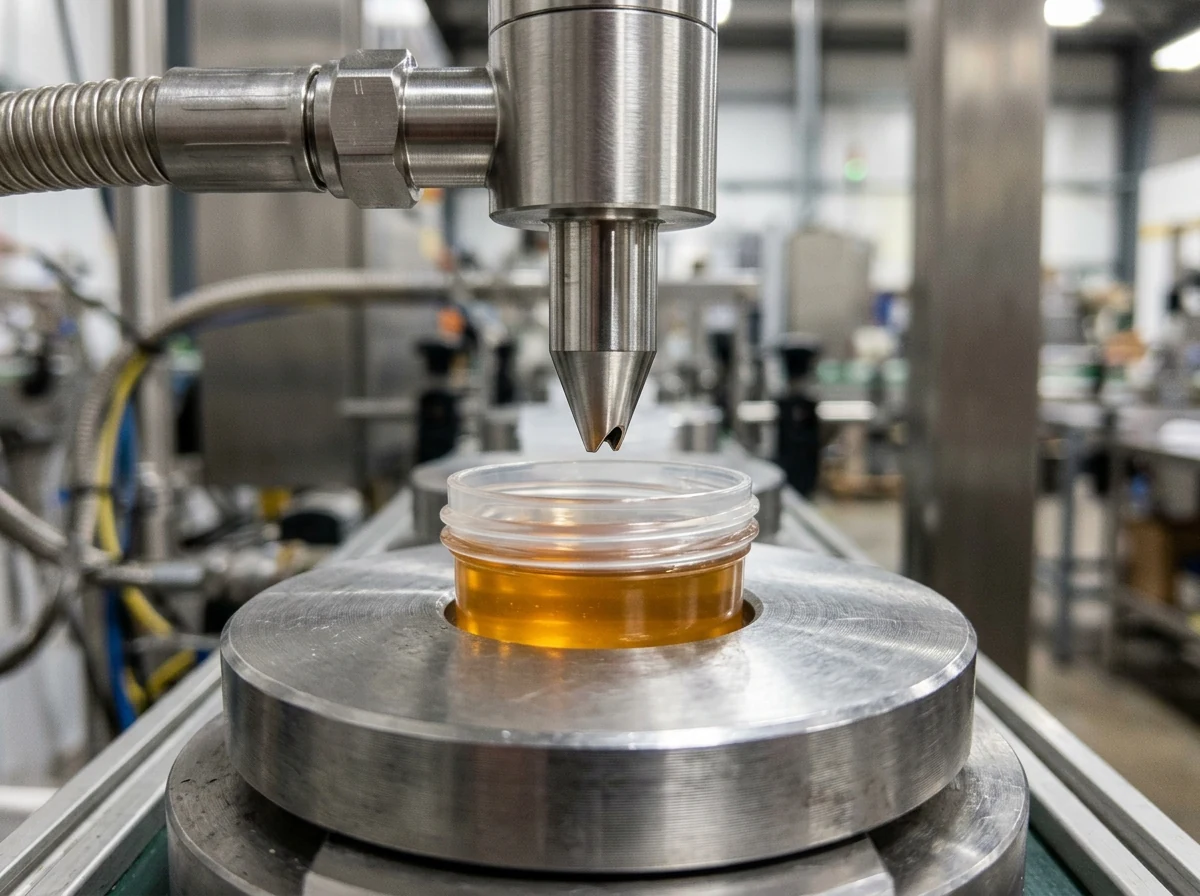
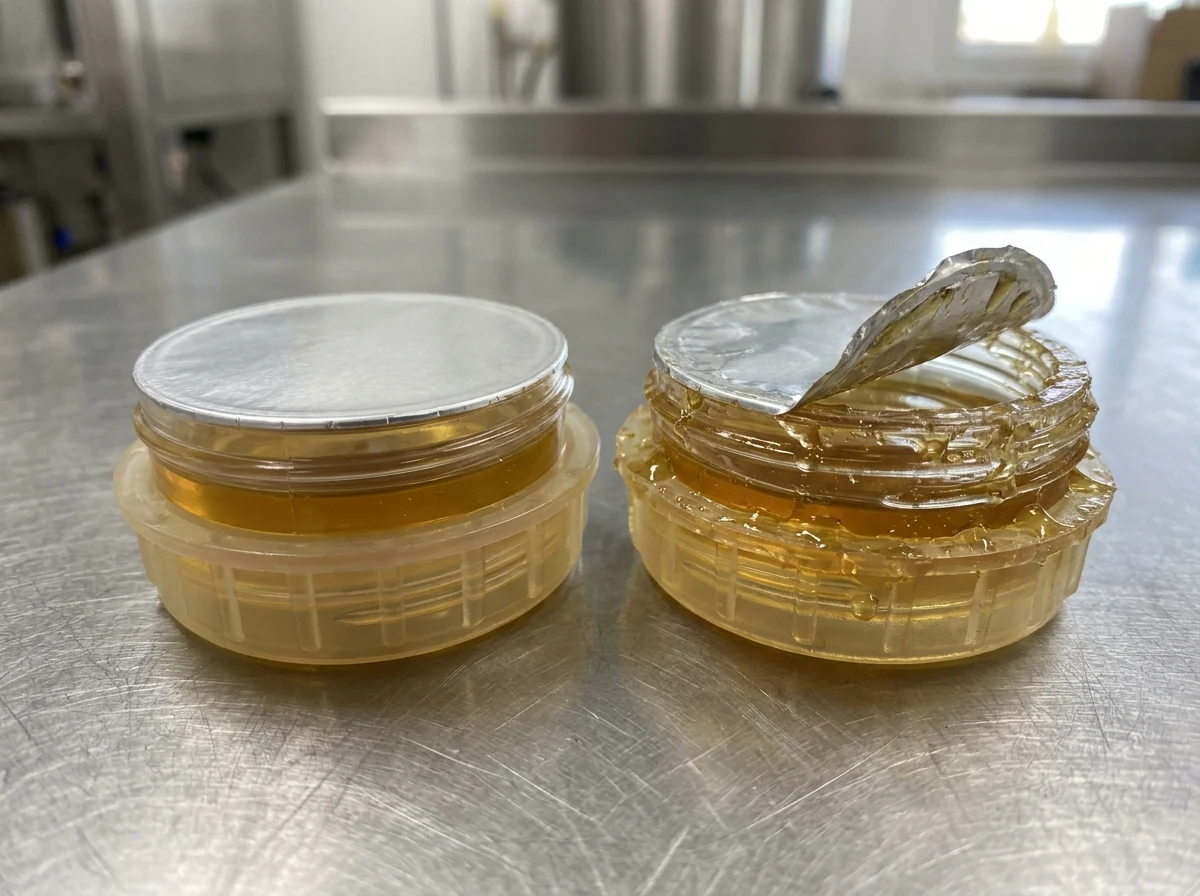
A honey dosing-cap filling line puts a measured honey portion into a dedicated cap cavity and links that filling step to membrane or foil sealing and downstream handling, which is a different job from filling a retail honey jar or capping a bottle; heating is not assumed to be needed on every honey project, and individual wrapping is included only when specified. On a honey dosing-cap filling line, the filling outlet must access the usable cavity while the cap sits supported in tooling without honey trailing from the nozzle onto the sealing flange, because product on the flange sits directly between the rim and the membrane during sealing. A reference automatic cap-cavity honey filling, sealing, and packaging line configuration uses servo-driven volumetric piston or peristaltic pumps with an active suck-back micro-nozzle to cut off honey flow after volumetric dosing and prevent honey from stringing or contaminating the cap-cavity sealing rim prior to thermal foil or peelable film sealing, constructed in SUS304/SUS316 stainless steel.
On the Graco PR70e, the snuff-back adjustment knob sets anti-drip cutoff at the tip after dispensing; Open Dispense Valve Timing should be adjusted for material viscosity. According to Greener Corporation, heat melts the sealant layer of packaging film, dwell time allows heat to penetrate through to and melt the sealant layer, and pressure moves the melted sealant layer to caulk off leaks; their total sum must fall within the optimal sealing window. According to Greener Corporation, product build-up on sealing faces degrades seal quality and decreases productivity by causing problems with jaw pressure, alignment, poor heat transfer, and cutting issues, and hard metal tools like scissors or screwdrivers can damage the sealing face. When preparing to request a quote for a honey dosing-cap project, packaging teams should share the botanical honey variety, crystallization state, target filling temperature, and cap-cavity volume drawings so nozzle suck-back and foil sealing are engineered around real production inputs.
Sources
- FAO and WHO Codex Alimentarius Commission — Codex Alimentarius Honey Composition, Diastase, and Hydroxymethylfurfural Criteria
- Food and Agriculture Organization — Agricultural Services Bulletin on Honey Viscosity, Specific Gravity, Hygroscopicity, and Crystallization
- National Honey Board — Honey Crystallization and Physical Properties Reference Bulletins
- Southern Cross University and AgriFutures Australia — Honey Crystallisation and Warming Guidelines
- Airborne Honey — Technical Information for Food Manufacturers on Crystallization Ratios and Viscosity Curves
- NIH PubMed Central — Experimental Water-Bath Decrystallization Time and Hydroxymethylfurfural Kinetics in Crystallized Honey
- International Organization of Legal Metrology and National Institute of Standards and Technology — Prepackage Net Content and Gravimetric Scale Verification
- Graco and Greener Corporation — Dispense Valve Snuff-Back Adjustment and Heat-Sealing Interface Maintenance
- Shemesh Automation and Automatic Filling Machine — Honey Piston Filling and Dosing-Cap Cavity Packaging Engineering
Common questions
What temperature range dissolves honey crystals without exceeding hydroxymethylfurfural or enzyme limits?
Natural beehive temperature is about 35 °C (95 °F) and can rise to 40 °C (104 °F) in summer; to liquefy crystallized honey without overheating, it is best heated indirectly at 35–40 °C (95–104 °F). When warming honey to reduce crystallization or return crystallized honey to liquid form, Southern Cross University and AgriFutures Australia specify that honey should not be heated higher than 45 degrees Celsius and for no longer than 14 hours, because heating above 45 degrees Celsius for longer than 14 hours begins to destroy beneficial enzymes and increases hydroxymethylfurfural (HMF) content. Under Annex Section 1.3, the hydroxymethylfurfural (HMF) content of honey after processing and/or blending shall not be more than 40 mg/kg, or not more than 80 mg/kg for honey of declared origin from countries or regions with tropical ambient temperatures and blends of these honeys.
Why does dosing-cap cavity volume in milliliters not equal target gram weight when honey crystallizes?
In volumetric filling versus net-weight filling, volumetric filling dispenses a predetermined volume without measuring mass, so a fixed volume equals a given mass only through mass = density × volume at a recorded temperature; a change in density changes the mass of a fixed volume, and 1 g must not be treated as 1 mL. True specific gravity of honey at 20 C decreases as water content rises: 1.4457 at 13.0, 1.4404 at 14.0, 1.4350 at 15.0, 1.4295 at 16.0, 1.4237 at 17.0, 1.4171 at 18.0, 1.4101 at 19.0, 1.4027 at 20.0, and 1.3950 at 21.0. In honey crystallization, monohydrate glucose crystals form and water is freed, increasing the water content of the remaining liquid phase and raising the risk of fermentation in partially crystallized honey.
Which sugar and water ratios predict whether honey will crystallize inside a sealed dosing cap?
Three sugar-and-water ratio formulas predict honey crystallization tendency: (1) Glucose/Water below 1.7 stays liquid and above 2.1 will crystallize; (2) Fructose/Glucose above 1.64 stays liquid and below 1.25 will crystallize; and (3) (Glucose - Water)/Fructose below 0.27 stays liquid and above 0.42 will crystallize. Honey crystallization is most rapid around 10–15 °C (50–59 °F), whereas below 10 °C (52 °F) crystallization is slowed down because low temperature increases honey viscosity and retards the formation and diffusion of crystals. The optimum room temperature for storing honey in tightly closed containers is 21 to 27 °C (70–80 °F), while cold storage temperatures of 11 to 18 °C (52–64 °F) are ideal for crystal formation and should be avoided.
How does a honey dosing-cap filling line prevent honey strings from contaminating the foil-sealing rim?
A reference automatic cap-cavity honey filling, sealing, and packaging line configuration uses servo-driven volumetric piston or peristaltic pumps with an active suck-back micro-nozzle to cut off honey flow after volumetric dosing and prevent honey from stringing or contaminating the cap-cavity sealing rim prior to thermal foil or peelable film sealing, constructed in SUS304/SUS316 stainless steel. On the Graco PR70e, the snuff-back adjustment knob sets anti-drip cutoff at the tip after dispensing; Open Dispense Valve Timing should be adjusted for material viscosity. On a honey dosing-cap filling line, the filling outlet must access the usable cavity while the cap sits supported in tooling without honey trailing from the nozzle onto the sealing flange, because product on the flange sits directly between the rim and the membrane during sealing.
What metrological tolerances apply to small prepackaged honey dosing caps?
Under Clauses 3.2 and 3.3, the average actual quantity of product in prepackages shall be at least equal to the nominal quantity, a homogenous group of prepackages shall contain no more than 2.5% of packages having T1 errors, and no prepackage shall have a T2 error. Under Table 1, for prepackages with a nominal quantity Qnom of 0 to 50 g or mL, the tolerable deficiency T is 9 Percent of Qnom (rounded up to the next 0.1 of a g or mL for Qnom less than or equal to 1 000 g or 1 000 mL), and for 50 to 100 g or mL, T is 4.5 g or mL. Gravimetric testing of net weight requires a scale with at least 100 scale divisions and a scale division no larger than 1/6 of the Maximum Allowable Variation (MAV/6) for the package size being weighed.
What to send us
Swipe to compare all columns.
| Item | Why we need it | Example format |
|---|---|---|
| Botanical honey variety and sugar ratio | Predict crystallization speed, thixotropic flow behavior, and viscosity sensitivity across temperature. | Floral source, glucose-to-water ratio, fructose-to-glucose ratio, and refractometric moisture reading |
| Crystallization fraction at line intake | Prevent tank stratification and nozzle plugging when crystal settling shifts liquid-phase water content. | Clear liquid lot, two-phase stratified drum, or finely granulated suspension sample |
| Target filling temperature and thermal history | Balance micro-nozzle flowability against diastase enzyme preservation and hydroxymethylfurfural limits. | Indirect water-bath warming setpoint, filtration mesh size, and heated hopper residence time |
| Dosing-cap cavity volume and sealing membrane | Convert usable cavity milliliters into target gram mass and keep the sealing flange free of honey strings. | Cap-cavity engineering drawing, usable volume in milliliters, target gram weight, and peelable or pierceable foil spec |
We reply within 24 hours.