
At a glance
Swipe to compare all columns.
| Review area | Bring to the discussion | Decision to record |
|---|---|---|
| Beverage acidity and microbial pathway | Equilibrium pH (≤4.6 vs >4.6), water activity (aw), and 5-log lethality target | 80–92 °C hot-fill-hold with cap tilt sterilization vs ambient sanitary filling |
| Container polymer and bottle handling | PET Tg (67–71 °C), double-blow heat-set crystallinity (92–95 °C), and neck drawing | Heat-set PET with vacuum panels or NitroHotfill dosing vs standard PET |
| Pulp fraction and metering mechanism | Juice sac dimensions (up to 10×10×10 mm), conductivity (≥20 µS/cm), and pouch/bottle format | Dual-stage pulp/slurry valve vs contactless flowmeter or suck-back pouch filler |
Why Juice Hot-Fill vs. Ambient Water Filling Machine Architecture Diverges
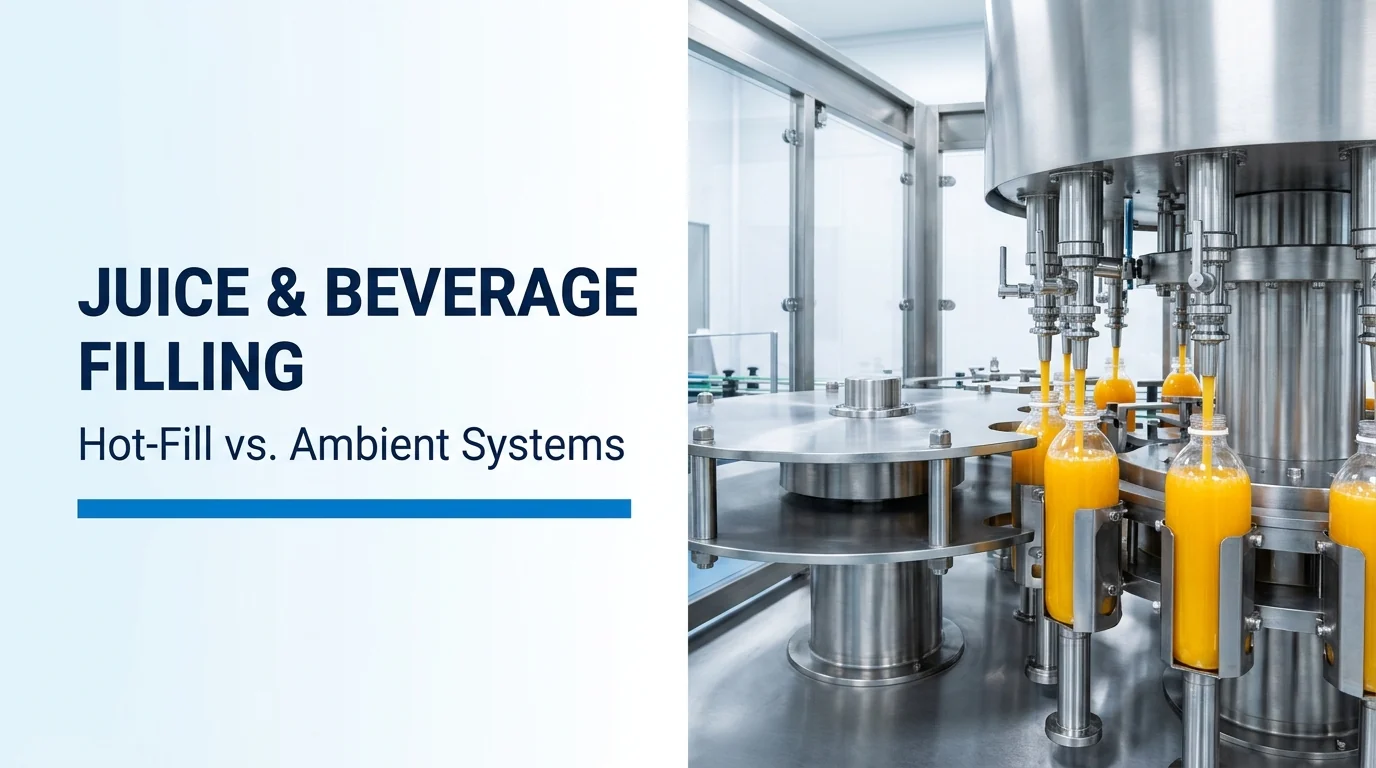
Selecting a juice filling machine or a water filling machine begins with how the beverage achieves microbial stability inside the sealed package, which divides liquid filling machines into thermal hot-fill-hold lines and ambient sanitary dosing systems. Under § 120.24(a), juice processors must include HACCP control measures that consistently produce at least a 5 log reduction in the pertinent microorganism for a period at least as long as the shelf life of the product when stored under normal and moderate abuse conditions, except for juice processors subject to part 113 or part 114 or using a single thermal processing step sufficient to achieve shelf-stability (defined in the regulation as a hermetically sealed product that should not demonstrate any microbial growth when stored at room temperature). FDA's Juice HACCP Guidance distinguishes acidic juices (pH 4.6 or less, associated with vegetative enteric pathogens) from low-acid juices (pH greater than 4.6, where spore-forming Clostridium botulinum is a potential hazard) and states an FDA action level for patulin in single-strength apple juice of 50 micrograms per kilogram (50 parts per billion) because thermal processing does not destroy patulin. In the FDA Juice HACCP Guidance, the National Food Processors Association (NFPA) states that a typical hot fill/hold process used for shelf-stable juices might be to treat the juice at 90 degrees C (194 degrees F) for 2 seconds, followed by filling at 85 degrees C (185 degrees F) and holding for 1 minute at that temperature, which achieves a 50,000 log reduction without counting cool-down lethality. The same FDA Juice HACCP Guidance recommends that thermally processed concentrates receive a thermal treatment of at least 80 degrees Centigrade for thirty seconds. Under § 114.3 and § 114.80, acid foods have a natural pH of 4.6 or below, low-acid foods have a finished equilibrium pH greater than 4.6 and a water activity (aw) greater than 0.85, and acidified foods (low-acid foods to which acid or acid food is added with aw above 0.85) shall be manufactured, processed, and packaged so that a finished equilibrium pH value of 4.6 or lower is achieved and maintained. Under FDA bottled drinking water sanitation regulations, adequate ventilation shall be provided to minimize condensation in processing rooms, bottling rooms, and container washing and sanitizing areas; the washing and sanitizing of containers for bottled drinking water shall be performed in an enclosed room; product water-contact surfaces of multiservice containers, utensils, pipes, and equipment shall be clean and adequately sanitized; and filling, capping, closing, sealing, and packaging of containers shall be done in a sanitary manner to preclude contamination.
Hot-Fill-Hold Cap Sterilization and Tunnel Cooling Sequence
When engineers evaluate food and beverage filling applications, the thermal hold window and closure contact step determine whether the line needs heated recirculation, immediate capping, container tilting, and water spray cooling tunnels. University of Georgia Cooperative Extension Circular C 1328-02 states that the hot-fill-hold (HFH) process involves five steps—heat the product, fill containers with the hot product, invert the containers to sterilize the headspace, maintain a minimum hold temperature for a specified process time, and cool the product—typically heating products to around 180–200 °F and holding for 2–5 min in the container for flowable foods with equilibrium pH below 4.6 and water activity above 0.85. Kansas State University Extension fact sheet MF3671 states that unlike low-acid foods requiring 240° to 250°F under pressure, acid and acidified foods (pH less than 4.6) can be processed by Hot-Fill-Hold above 180°F (82°C) or published time-temperature combinations: for equilibrium pH 4.1 or below, 140°F for 12.7 min., 141°F for 11.3 min., 161°F for 1.1 min., or 180°F for 0.1 min.; and for equilibrium pH 4.1- 4.6, 141°F for 77.8 min., 142°F for 67.7 min., 179°F for 0.4 min., or 180°F for 0.4 minutes; manufacturers of acidified foods file Form FDA 2541e. In the Sidel hot filling process, the beverage is sterilised first, followed by the bottle and cap once filled, capped, and tilted, requiring a heating temperature as high as 80 to 92 °C, which exceeds the normal thermal resistance of conventional PET bottles. Sidel's BoostPRIME packaging solution addresses the single-serve market of JNSDIT (juice, nectar, soft drink, isotonics, tea) filled in PET bottles up to 1.2L at a temperature of 85–88°C during bottling. In 1986, Sidel pioneered the PET heat-resistant (HR or Heat Set) stretch blow moulding process, and Sidel's hot-fill portfolio is backed by 45 years of experience and more than 1,000 proven Sidel Hot Fill solutions worldwide. Once a hot beverage is filled and capped, the Sidel cap steriliser sterilises the headspace and cap by tilting and rotating the bottle up to 110 degrees for a flexible contact time ranging between 7 and 30 seconds, removing air bubbles and keeping the hot beverage in contact with the cap. After cap sterilisation, Sidel's cooling unit cools bottles to ambient temperature with uniform water spraying in a 20% reduced footprint and, when correctly sized, can handle different beverage viscosities and bottle sizes without changeovers, and integrating warm-water recovery with Tetra Pak processing for pasteuriser pre-heating yields energy savings up to 45%.
Valve Hydraulics, Flowmeter Control, and Ambient Water Filling Systems
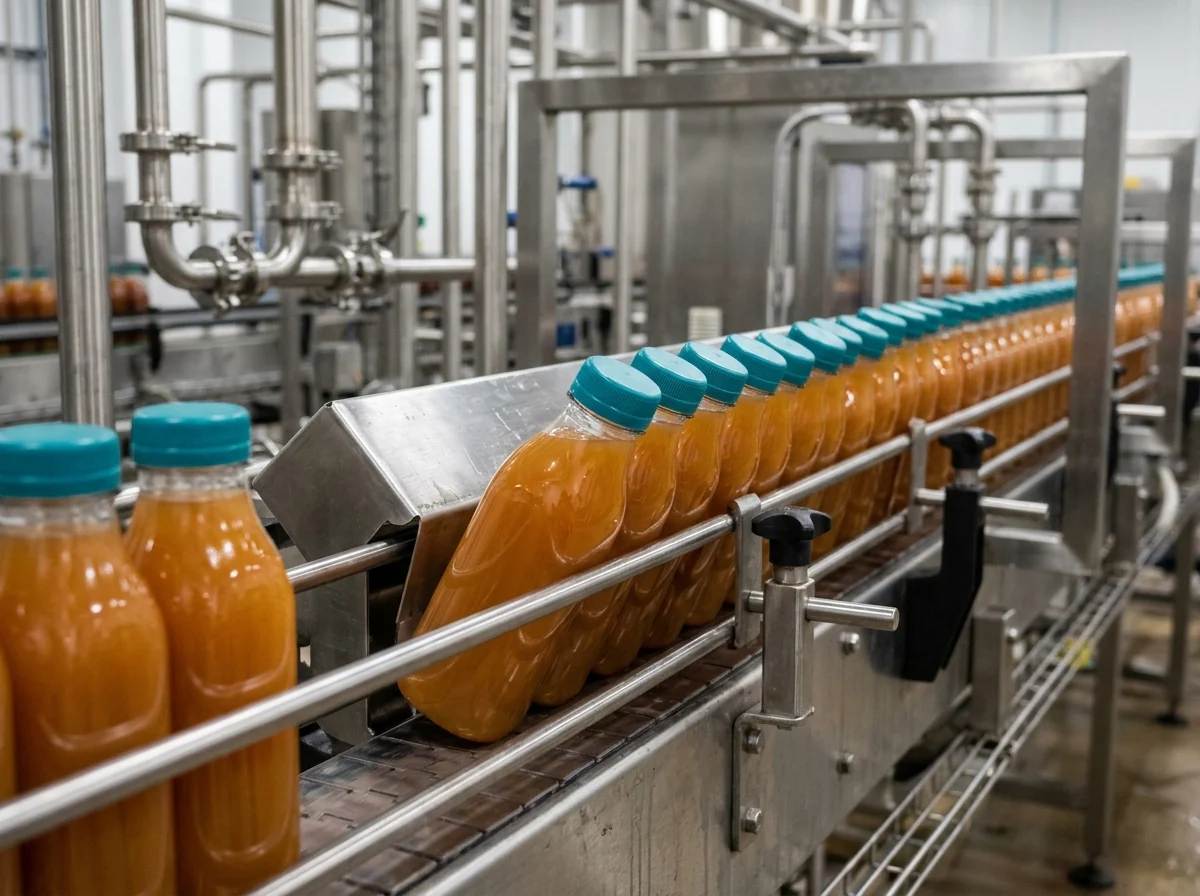
On the Sidel Matrix hot filler, an external product buffer tank, recirculation flow monitoring that keeps each filling-valve temperature under control, and dual-speed or dual-stream dosing support accurate filling. The Sidel Matrix hot filler SF700 handles teas, isotonics, and juices with or without pulps or particles (up to 10 x 10 x 10 mm), fills hot or cold beverages into PET bottle sizes from 200 ml to 3 litres, and operates at production rates from 6,000 to 60,000 bottles per hour. On the Sidel Matrix hot filler, all product-contact components are made from stainless steel 316L, contactless filling valves avoid contact with the bottle neck, fluid speed in the filling valves is monitored during cleaning to ensure more than 1.5 metres per second, and recirculation flow monitoring controls the temperature in each filling valve. On the Sidel Matrix hot filler, an external product supply tank outside the filling carousel acts as a buffer and feeds an overhead product distributor ring via a pump, while electronic filling valves with individual flow meters, dual-speed filling (to eliminate foam), dual-stream dosing (for pulp or particles), and automatic dummy bottles for the 316L cleaning loop maintain quality. The Sidel Matrix hot filler mechanical output table specifies: with 40 filling valves, 24,000 bph (500 ml), 14,000 bph (1L), and 8,000 bph (2L); with 60 filling valves, 36,000 bph (500 ml), 24,000 bph (1L), and 14,000 bph (2L); and with 90 filling valves, 60,000 bph (500 ml), 40,000 bph (1L), and 20,000 bph (2L). The Sidel Matrix Combi Hot Fill integrates the Sidel Matrix eHR blower and SF700 filler in a single enclosure, achieving up to 4% higher efficiency and reducing operating costs by up to 12% compared to standalone machines, in 500 ml configurations of 20,000 bph (10 blowing stations, 40 filling valves, 10 capping heads), 32,000 bph (16 blowing stations, 60 filling valves, 15 capping heads), and 52,000 bph (26 blowing stations, 90 filling valves, 30 capping heads). The Sidel Matrix Filler SF700 FM uses an electronic magnetic flow meter across 32 - 108 valves (up to 60,000 bph for 500 ml bottles), offering a grid valve for still beverages, a plunger valve for pulpy beverages, and an Integrated Slurry Doser (ISD) configuration for double-stage filling of beverages containing particles. The Sidel Matrix Filler FM operates with no vertical movement of the bottles, uses a pressure-less volumetric dosing system with a contactless conical valve (no filling tube, no dripping, no product push-back), includes CIP automatic dummy cups, and offers a reduced filler enclosure under positive pressure (HEPA filters) that takes up 80% less space than traditional enclosures and achieves up to 98% efficiency with 30% less maintenance downtime.
By contrast, an ambient water filling machine dispenses still or carbonated water through inductive or mass flowmeters and proportional flow regulators while guiding bottles across integrated filling lines. The Krones Modulfill VFJ (Volumetric filling system, Flow meter, Full jet) fills non-carbonated water into PET containers (with and without conductivity) at outputs up to 100,000 bottles per hour using neck-handling grippers, contact-free full-jet filling, an inductive or mass flow meter, a Krones Proportional Flow Regulator (PFR) valve for infinitely variable filling speed, and a discharge sieve to prevent dripping. For the Krones Modulfill VFJ, optional parameters include automatic CIP cups, conductivity above 20 µS/cm, and viscosity below 10 mPa·s, and using PFR valves achieves a reduction of the energy demand of the machine by about 90 percent. The Krones Modulfill VFS (Volumetric filling system, Flow meter, Short tube) fills both carbonated and non-carbonated water into PET containers at outputs up to 86,000 bottles per hour using an inductive or mass flow meter, PFR valve, swirl insert, and snifting valve, with stated limits of conductivity above 20 μS/cm, viscosity below 10 mPa·s, pulp ≤ 0.4 mm/proportionally below 10 %, and fibres 1 x 5 mm/proportionally below 5 %. On the Krones Modulfill VFS, operating without a lifting cam increases the filling angle and raises annual water output by up to 25 per cent (72 million bottles, based on 0.5 litre bottles and a pitch diameter of 4,320 mm), CIP cups swing into place automatically using a magnet without pneumatic components, and electronic PFR valves save 30 percent of compressed air compared to electropneumatic filling. The Krones Hydrofill is developed for filling non-carbonated water with or without conductivity—including water with an ozone content from ≥ 0.5 ppm—using a mass flow meter, PFR valve in full-jet mode, a pressureless product tank with top feed and sterile-air supply (with malfunction warning), and a CIP trough with recirculation pump for returning CIP media into the CIP circuit. Sidel's EvoFILL PET filling system is available from 24 to 144 filling valves, delivers over 90,000 bottles per hour (bph) at 99% efficiency using volumetric flowmeter control and a no-contact filling principle (eliminating part replacement when changing fill levels), and provides automatic format changeover in less than 5 min alongside a -15% internal CIP cycle time reduction and -13% external COP cleaning time reduction. KHS's published bottle-filler ratings include the KHS Innofill PET ESL-L linear hygienic filler (up to 28,000 bottles/h for cold-chain liquid milk), Innofill PET DVF (up to 60,000 bph), Innofill PET NV still water filler (up to 81,000 bottles/h), Innofill PET DRV (up to 82,000 bottles/h), InnoPET TriBlock and InnoPET BloFill (up to 90,000 bottles/h), and Innofill Glass NRF/DNRF for hot and cold filling (up to 48,000 bph).
Heat-Set PET Bottle Crystallinity, Nitrogen Dosing, and Cap Sterilization
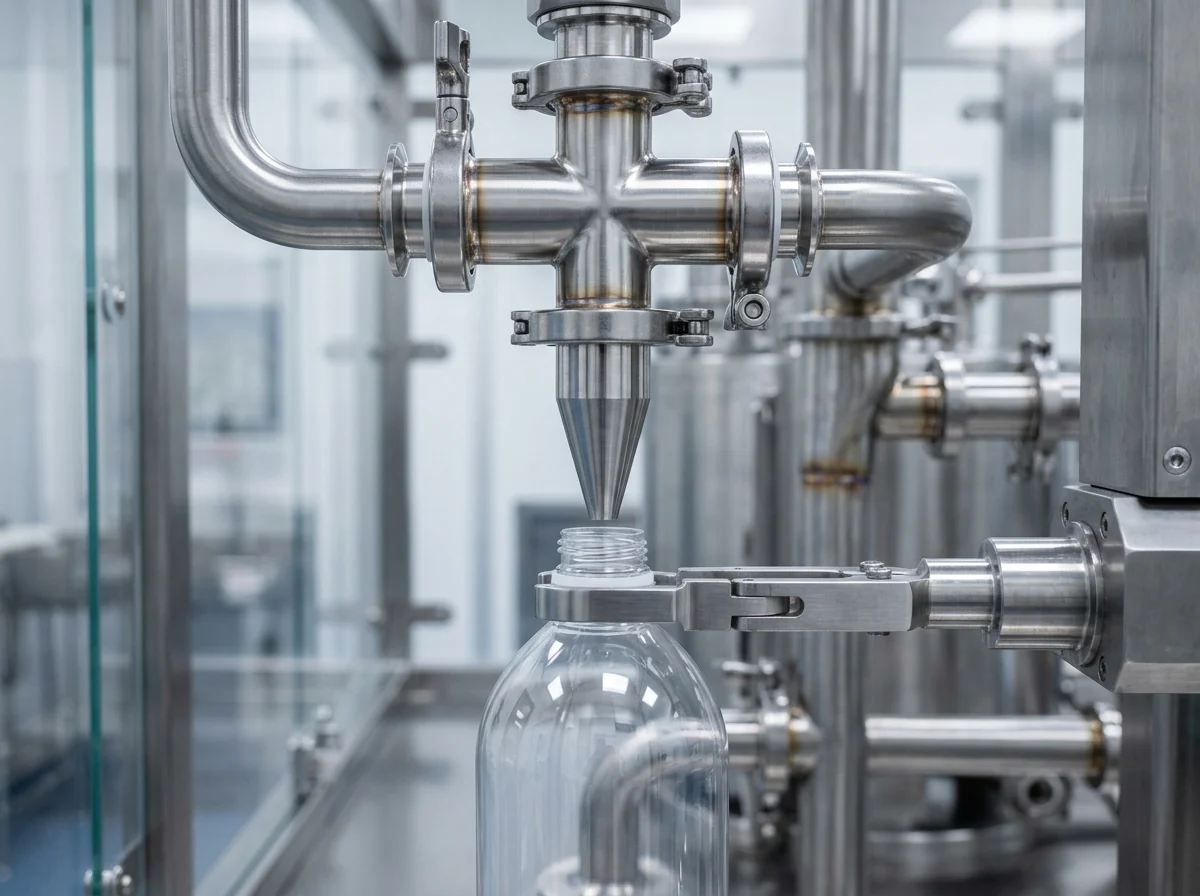
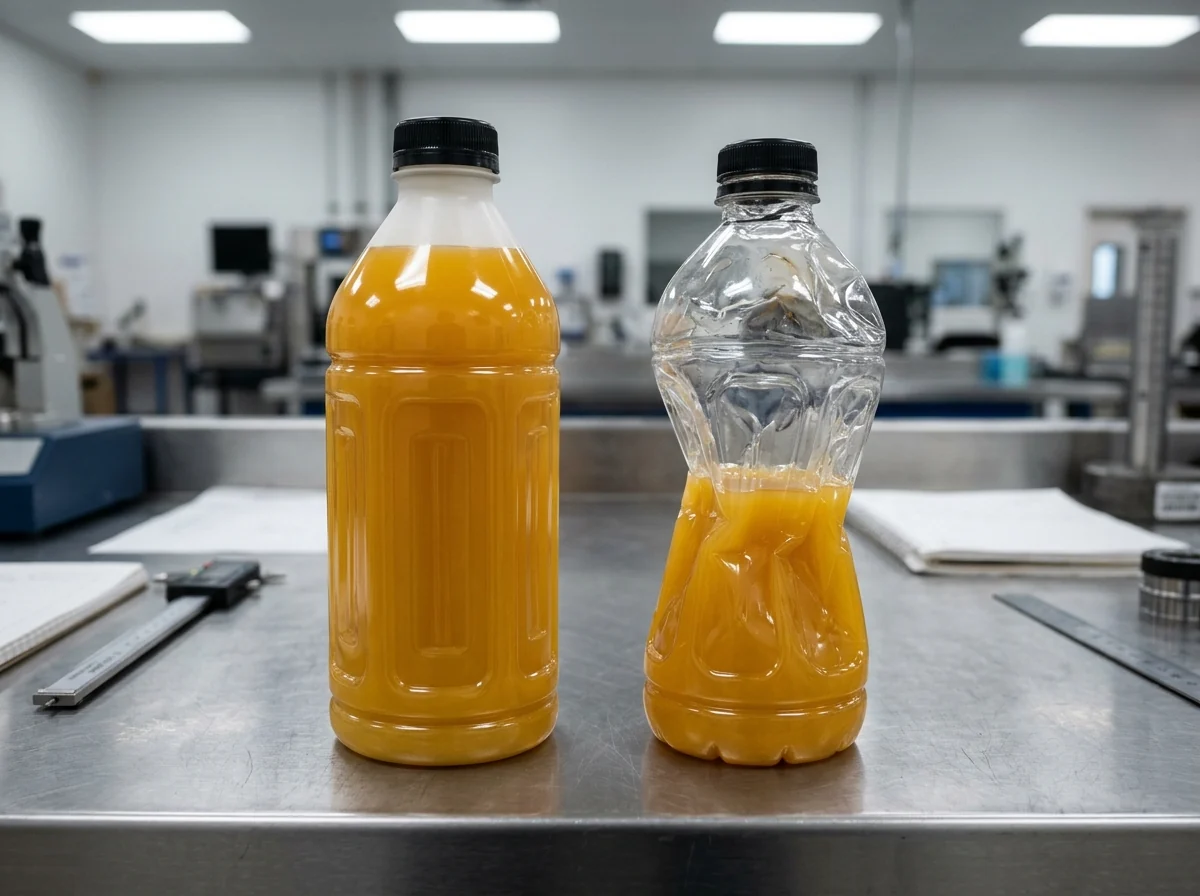
Hot filling or post-filling pasteurization of juice subjects PET containers to temperatures close to or beyond the glass transition temperature, requiring heat-setting (double-blow heat-set process) to prevent uncontrolled shrinkage; neck crystallization where the cap or heat-resistance specification requires it. In standard stretch blow molding, locked-in molecular stress causes a PET container to suffer increasing and uncontrolled shrinkage if heated close to and beyond PET's glass transition temperature (Tg) of 67~71°C, whereas the double-blow heat-set process encourages crystal growth in the body while relieving stress by controlled shrinkage to produce containers with up to 92~95°C heat resistance. Nissei ASB's 4-station one-step double-blow heat-set series includes the ASB-12M/DB for small bottles or small-scale production and the ASB-70DPH/DB for 0.35 ~ 2-liter class heat-resistant bottles or jars. Nissei ASB's PM-CM-HSB heat-set line combines PM Series preform injection molding (6 to 48 cavities), optional CM Series neck crystallization (2,000~12,000 preforms per hour) where cap type or heat-resistance specification requires it, and HSB Series double-blow heat-set molding of bottles up to ~6,000bph or wide-mouthed jars up to 110mm neck diameter. Sidel's heat-resistant (HR) PET bottle designs include TRIANGULAR (24 g, 28 mm neck, up to 1,500 b/h/m, online filling at 90 °C), SKYWARD (20 g, 28 mm neck, up to 1,800 b/h/m, 90 °C), PANELLESS (35 g / 20 oz, 43 mm neck, up to 1,200 b/h/m, 90 °C), CURVY (19 g, 28 mm neck, up to 1,800 b/h/m, 85 °C), FREESHAPE (28 g, 38 mm neck, up to 1,500 b/h/m, 85 °C), and GRINGO (20 g, 28 mm neck, up to 1,800 b/h/m, 85 °C). The Sidel Matrix eHR blower uses four electrical resistances and one temperature probe per mould half-shell instead of oil heating, increasing mould temperature three times faster, running up to 2,000 bottles per hour per mould across models SBO 6 (12,000 bph) to SBO 28 (56,000 bph) for HR bottles up to 2L (max height under neck 300 mm, max diameter 115 mm with or 120 mm without adjustable mould panels), while reducing electrical consumption by 45% by combining the eHR heating process on moulds with water heating for the base, Ecoven energy by 25%, and air consumption by up to 45% (with AirEco2).
Krones' NitroHotfill process adds a small dose of nitrogen after hot filling products up to 90 °C into PET containers (up to 2.0 litres, 38 mm neck finish diameter) at line outputs up to 70,000 containers per hour (and stretch-blow station outputs of 2,500 containers per hour), increasing interior pressure to balance shrinkage without compensating vacuum panels and enabling material savings of up to 30 percent. An industry study by Plastic Technologies, Inc. (PTI) tested 25%, 50%, and 100% recycled PET (rPET) content in 500 mL hot-fill bottles made from 27 g preforms, recommending up to 50% rPET without significant adverse impact while noting that above 50% rPET, yellowing, haze, and shrinkage increased slightly without preventing the bottles from meeting performance specifications. Jerry Packaging (JPACKS) contrasts Overflow/Gravity Filling (which fills still wine, juice, syrup, non-carbonated cider, and oil to a consistent visual level in transparent bottles and allows foam to escape) with Volumetric Filling (Piston/Pump) (which fills a precise pre-set volume), Isobaric (Pressure-Gravity) Filling for carbonated beverages, Aseptic/Sterile Filling, and hot-fill juice lines where juice is heated to 85-95°C, filled hot, and cooled in the sealed bottle to create a vacuum.
Twin-Stage Pulp Dosing, Electromagnetic Flowmeters, and CIP Sanitization
Beverages containing fruit cells and suspended sacs may use dedicated plug-valve pulp dosing, dual-stream or Integrated Slurry Doser valves that differ from single-stream clarified liquid fillers. The JPACKS JFM Series Automatic Electromagnetic Flowmeter Liquid Filling Machine features a 304 SS frame and 316L SS product path, ±0.25% Std. Dev. accuracy across a 50ml to 5000ml fill range, sanitary flow meters with tri-clamp fittings, bottom-close valves, servo diving nozzles for bottom-up filling, a servo transfer pump, and CIP option, and is specified for liquids with high conductivity such as mineral water, pulp-free juices, milk, and plant-based beverages. The JPACKS JFM-2B Semi-Automatic Electromagnetic Flowmeter Filling Machine uses KROHNE electromagnetic flowmeter technology with double filling nozzles, bottom-close valves, and a servo-motor-controlled rotary lobe pump (to stabilize pipeline pressure, transport materials, and clean pipelines) while compensating for changes in viscosity, temperature, pressure, and specific gravity of conductive liquids. SinoPAK's Juice & Still Beverage Filling Machine series operates at an 85-90 degC filling temperature and 3,500-18,000 BPH capacity range for PET and glass bottles (150 ml to 2.5 L), offering the RXGF 3-in-1 monoblock (neck-held inverted bottle rinsing, 85-90 degC micro-negative-pressure hot filling, and capping) for standard liquid juice and the RXGGF 4-in-1 monoblock (which adds a dedicated plug-valve pulp-filling stage before liquid juice filling) for juice with pulp. King Machine's RCGF18-12-18-6 is a 4 in 1 monoblock combining bottle rinsing, pulp filling, juice filling, and capping in one body for hot-filling juice with pulp, listed alongside models RCGF 14-12-4 (3000BPH), RCGF 18-18-6 (5000BPH), and RCGF32-32-12 (12000BPH). AccuPacking's 300 ML - 1000 ML Hot Fill Bottling Equipment (models MT16/12/6, MT18/18/6, MT24/24/8, MT32/32/10, and MT40/40/12 with 16 to 40 rinsing heads, 12 to 40 filling heads, and 6 to 12 capping heads) uses 316L stainless steel liquid-contact parts and handles bottle sizes of H: 130-300mm or H: 150-340mm, D: Φ50-110mm.
IC Filling Systems outlines multi-stage hot water, caustic soda, and peracetic or steam sanitization sequences for beverage filling machines, while spouted pouch fillers may connect to a CIP cleaning system. IC Filling Systems outlines the main CIP (Clean in Place) stages for beverage filling machines: initial rinsing with clean hot water to remove particles, flavours, and sugars; a second phase circulating hot water at 80C with a 1.5 % Caustic Soda solution or 120C pressurised steam; final hot water rinse; and sanitising with steam at 120C or a cold-water solution of peracetic disinfectant at 1.5 %. Chlbpack's Automatic Spout Pouch Filling Machine for juice production integrates automatic pouch loading, spout positioning, liquid filling (customized for low-viscosity juice, milk drinks, fruit puree, or thick beverages), controlled-torque capping, and sealing inspection for stand up, center, or side spout pouches, and can connect with a CIP cleaning system, conveyor, coding machine, and cartoning equipment.
Flexible Pouch and Sachet Beverage Dosing, Density Calibration, and Line Selection
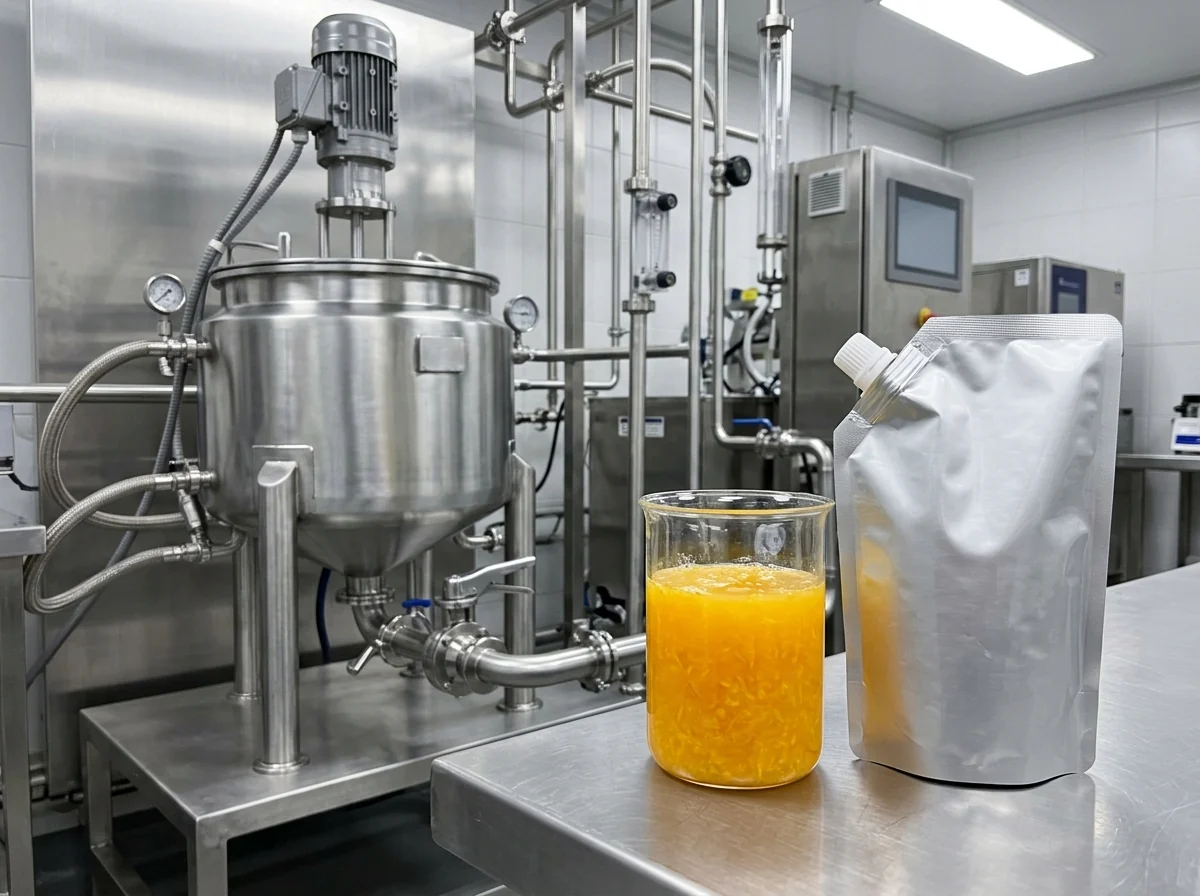
When beverages move from rigid bottles into premade pouches or vertical film sachets on a liquid pouch filler or a sauce sachet filler, manifold sizing and timed suck-back cutoff prevent seal-zone wetting, as covered in our guide to liquid sachet fill height and seal contamination. In our liquid filling lineup, our equipment range focuses on flexible packaging—supplied premade pouches and sachets formed from a film roll—and bottle-handling scope for rigid containers is confirmed separately from our pouch and sachet equipment. On our premade-pouch filling machines, the system picks supplied bags from a magazine, opens them, fills the liquid, seals the opening, and discharges the finished pack, and features such as zippers, spouts, gussets, and stand-up bases are confirmed specifically against your exact bag drawing and production-intent samples. In our servo-piston and rotary-valve liquid sachet configurations, we cover a 5–100 ml standard range with selectable 19 / 25 / 32 / 38 / 51 mm manifold inlets matched to viscosity and particulates, and use a timed suck-back stroke to draw residual liquid back from the nozzle tip before the cross-seal jaws close. On our multi-lane liquid sachet systems, low-viscosity liquids (1–100 cP, such as water, vinegar, soy sauce) run at 40–50 bags/min per lane, medium-viscosity condiments (500–5,000 cP) run at 25–40 bags/min, and high-viscosity pastes (5,000–50,000 cP) run at 15–25 bags/min, while our multi-lane liquid sachet machines (4–12 lanes, 30–45 cycles/min, 1–150 ml dosing with piston, ceramic or peristaltic pumps, up to 180 mm × 120 mm sachet size) integrate an automatic hopper level sensor and optional jacketed heating/agitation.
Verifying net content across single-lane and multi-lane beverage fillers also requires recording product density at the filling temperature and distinguishing target bias from fill-to-fill variation, building on the principles in filling accuracy and speed before teams request a quote. In our liquid filling consultations, we ask buyers to lead with the formulation and its normal filling temperature because foam behavior, viscosity, and supply shift with temperature, and when a volume target is checked by weight, product density at the stated temperature and empty-pack tare must be recorded. In our piston and pump comparisons, we treat a pump filler not as a single technology: we identify whether a proposal uses a piston (defined by cylinder geometry and stroke), gear pump, rotary lobe pump, screw pump, or time-based pump, and compare the complete product path from hopper to outlet including particle passage, rotor/gear clearances, and cleaning disassembly. During our factory trial evaluations, we distinguish target error (bias, how far the average fill sits from the target) from variation between fills (how much individual fills scatter around their own average), agree on package tare and the mass-to-volume conversion at the filling temperature before starting a trial, and sample every active lane individually on a multi-lane machine so opposite lane errors do not cancel out inside a single overall average.
Sources
- U.S. Food and Drug Administration — Juice Hazard Analysis and Critical Control Point Guidance, Acidified Foods, and Bottled Drinking Water Regulations
- University of Georgia Cooperative Extension and Kansas State University Extension — Hot-Fill-Hold Thermal Processing Guidelines for Acid and Acidified Foods
- Sidel — Hot-Fill Line Brochure, Matrix Hot Filler, EvoFILL, and Heat-Resistant Bottle Engineering Documentation
- Krones — NitroHotfill, Modulfill Flowmeter, and Hydrofill Water Filling Technical Documentation
- KHS and Nissei ASB — Hygienic Bottle Filling and Double-Blow Heat-Set Molding Technical Literature
- Food Packaging Forum and Plastic Technologies — Recycled Bottle Resin Performance in Hot-Fill Beverage Applications
- IC Filling Systems, Jerry Packaging, SinoPAK, King Machine, AccuPacking, and Chlbpack — Beverage CIP, Electromagnetic Flowmeter, Pulp Monoblock, and Spout Pouch Filling References
- Our LINEVO Engineering Library — Liquid Filling Machines, Premade Pouch Filler, Sachet Seal Contamination, Piston vs. Pump, and Filling Accuracy Engineering Guides
Common questions
What filling temperature and inversion hold time are required on a hot-fill juice filling machine?
Hot-fill juice lines heat acidic or acidified beverages (pH ≤ 4.6, aw > 0.85) to 80–92 °C (typically 85–88 °C / 185 °F at the filler after a 90 °C / 2 s flash treatment), cap immediately, and tilt or invert bottles up to 110° for 7–30 seconds to sterilize the closure and headspace. Depending on equilibrium pH, container hold times typically run 1–5 minutes at 180–200 °F (or published schedules down to 0.1 min at 180 °F for pH ≤ 4.1 and 0.4 min at 180 °F for pH 4.1–4.6) before entering a water-spray cooling tunnel.
Why do conventional water bottles deform on a hot-fill juice line and how do heat-set bottles or nitrogen dosing prevent shrinkage?
Amorphous PET softens and shrinks uncontrollably once heated past its 67–71 °C glass transition temperature (Tg). Hot-fill lines prevent deformation either by using double-blow heat-set PET bottles (such as Sidel HR or Nissei ASB heat-set designs) with increased sidewall crystallinity, crystallized necks, and vacuum panels rated up to 92–95 °C, or by dosing a drop of liquid nitrogen before capping (such as Krones NitroHotfill up to 90 °C) to pressurize the bottle and eliminate vacuum panels with up to 30% resin weight savings.
How does a juice filling machine dose suspended fruit sacs or pulp without plugging valves?
Clarified juices can run through standard grid valves or electromagnetic flowmeters, whereas beverages with suspended fruit cells or particles (up to 10 × 10 × 10 mm) require wide-clearance plunger valves, dual-stream Integrated Slurry Dosers (such as on the Sidel Matrix SF700 / SF700 FM), or 4-in-1 rotary monoblocks (such as SinoPAK RXGGF or King Machine RCGF series) that separate plug-valve pulp dosing from the liquid juice top-up stage.
How do electromagnetic and mass flowmeter water filling machines differ from hot-fill juice recirculation systems?
Hot-fill juice fillers use 316L heated recirculation loops and valve temperature monitoring to maintain 80–92 °C thermal sterility, plus CIP velocities above 1.5 m/s. Ambient water fillers (such as Krones Modulfill VFJ/VFS and Hydrofill, up to 86,000–100,000 bph) operate without heated product return, using inductive or mass flowmeters and proportional flow regulators (PFR) for low-viscosity water (<10 mPa·s, conductivity >20 µS/cm or non-conductive/ozonated ≥0.5 ppm) inside enclosed, positively pressurized sanitary rooms.
What must buyers confirm when choosing between bottle monoblocks and flexible pouch or sachet juice fillers?
Our core liquid filling equipment focuses on flexible premade pouches and roll-stock sachets, while rigid bottle monoblock scope is confirmed separately. For flexible packs, we size manifold inlets (19–51 mm) and timed suck-back piston or rotary valves (5–100 ml standard, or 1–150 ml across 4–12 lanes at 15–50 bags/min per lane by viscosity) to keep the cross-seal dry, and we verify net fill by recording product density at the actual filling temperature, empty-pack tare, per-lane bias, and fill-to-fill variation.
What to send us
Swipe to compare all columns.
| Item | Why we need it | Example format |
|---|---|---|
| Beverage acidity and thermal regime | Determine whether hot-fill-hold sterilization or ambient sanitary filling governs valve and recirculation design. | Acidified fruit juice, still drinking water, functional tea, or cold-chain juice sample |
| Container resin and closure drawing | Prevent bottle shrinkage, sidewall paneling, and neck finish distortion during elevated-temperature filling and cooling. | Crystalline heat-set bottle drawing, lightweight water bottle sample, glass jar, or spouted stand-up pouch |
| Pulp fiber size and suspension behavior | Select nozzle bore clearance, hopper agitation, and rotary or piston metering without crushing juice sacs. | Clarified apple juice, cloudy nectar, fibrous fruit puree, or juice with suspended citrus sacs |
| Target line speed and net content rule | Size rotary pitch or inline nozzle count and configure volumetric vs gravimetric density verification. | Target bottles or pouches per minute, nominal fill volume in milliliters, and Brix range across batches |
We reply within 24 hours.