
What SIG announced on October 1
Using the wrong comparison machine can distort a capacity plan. SIG's October 1, 2026 announcement does not name the baseline behind its one-third output claim. Direct SIG equipment questions to SIG; the site’s WhatsApp is for separate pouch, sachet, stick-pack and dosing-cap projects.
For a US buyer researching a SIG Neo aseptic carton filler, the immediate task is to ask which older machine, pack and operating conditions produced that comparison. This page checks the public-rate arithmetic and turns the missing details into questions for SIG. It is an editorial reading of public material, not a machine test or an offer to supply SIG equipment. Separate the announced rate from the accepted finished output your project needs before putting the headline into an investment case.
SIG announced XSlim 32 Aseptic for single-serve XSlimBloc cartons at 32,000 cartons/hour across nine pack sizes, and Midi 15 Aseptic for multi-serve MidiBloc or MidiFit cartons at 15,000 cartons/hour, with three sizes per format. The release attributes a one-third improvement to both total output and output per square meter. These are manufacturer statements dated October 1, 2026.
Keep the machine name, carton format, document date and rate together in your comparison notes. A format is the named carton family; a size is a particular capacity within it. Those distinctions matter when you define the product and pack for a new filling project: a format count does not establish the exact capacities or configurations needed for your own SKU list.
- Baseline model: not named in the announcement.
- Single-serve and multi-serve figures describe different carton families.
- Public-rate arithmetic can check a percentage, but cannot establish a baseline.
- US ordering, trial and delivery milestones need a project-specific answer.
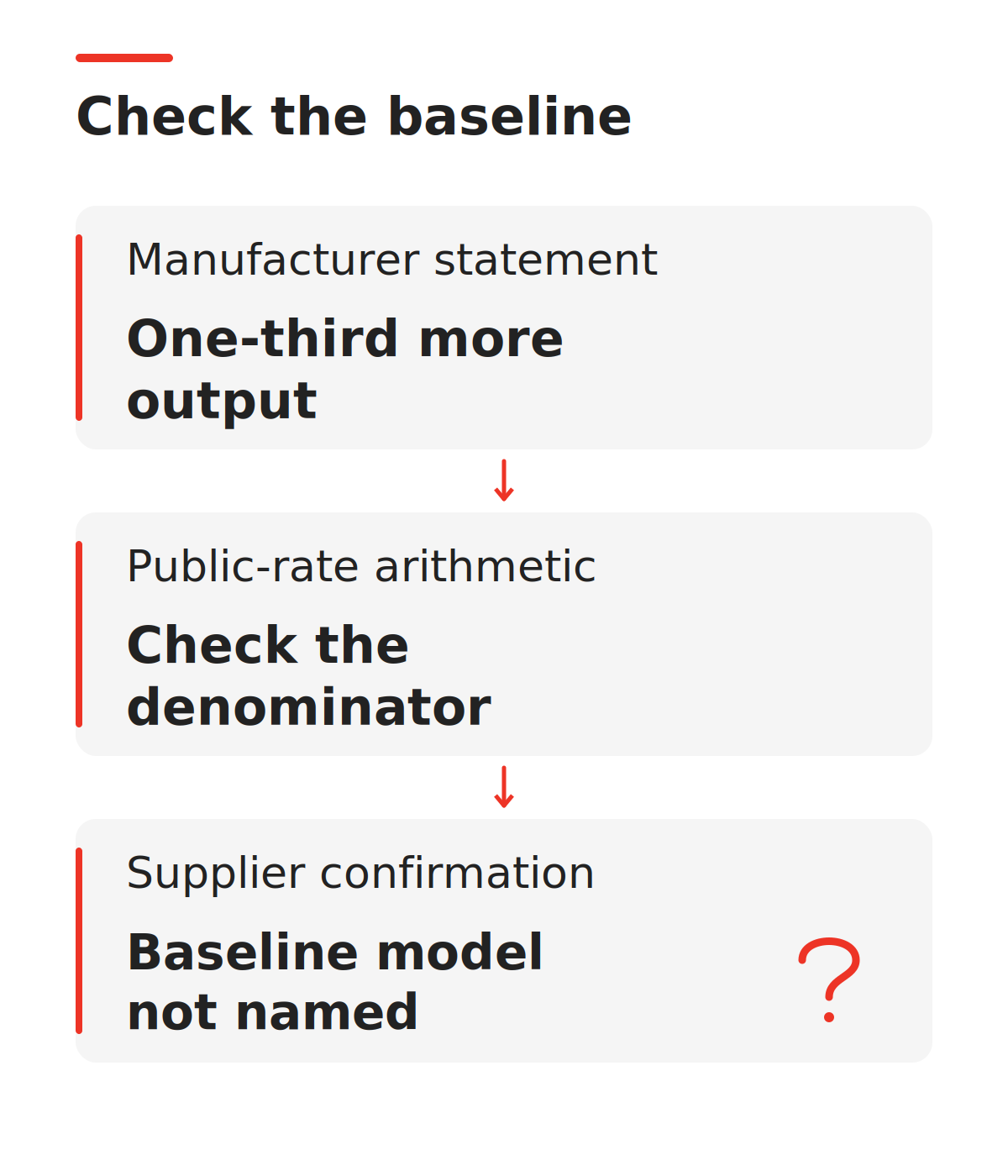
Which baseline makes the percentage work?
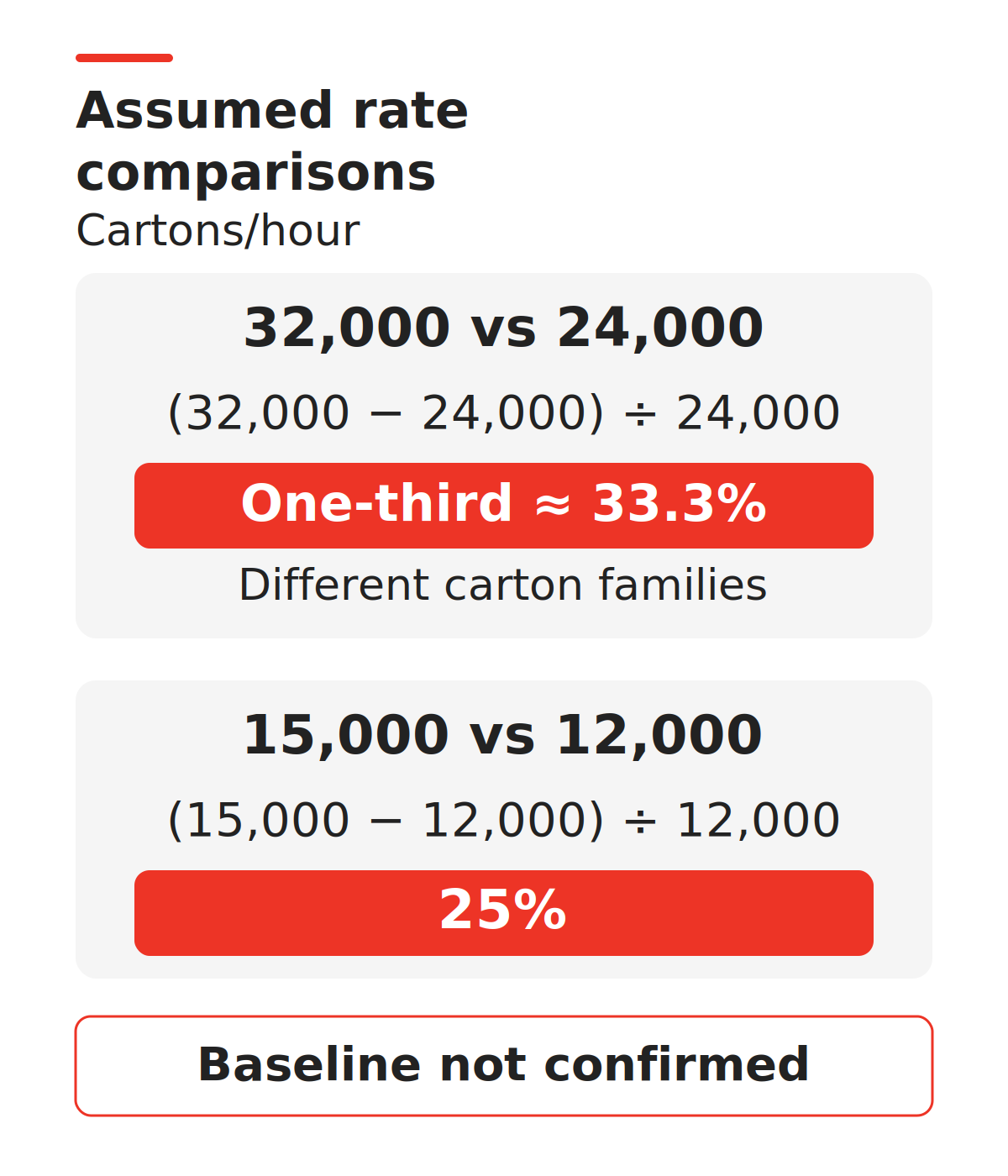
The public-rate calculations give different answers, and neither identifies SIG's chosen baseline. In its official Smile 24 product listing, SIG states 24,000 cartons/hour for the Smile family. Its July 24, 2024 Midi 12 press release states 12,000 MidiFit or MidiBloc cartons/hour. The table preserves those source identities so that the rates remain auditable.
Our assumed comparison of the published rates gives (32,000 − 24,000) ÷ 24,000 = 1/3, or approximately 33.3%. That is XSlim 32's announced rate against the Smile 24 listing, not a comparison confirmed by SIG. SmileSmall and SmileBig are the formats on the older product page; the new announcement specifies XSlimBloc. Arithmetic agreement alone does not establish equivalent packs or operating conditions.
For multi-serve, our separate assumed calculation is (15,000 − 12,000) ÷ 12,000 = 0.25, or 25%. Here the named carton families match, but the documents are from different dates and do not supply a common test protocol. The result shows why you should ask whether Midi 12 is the intended reference. It does not disprove a claim made against an unnamed alternative.
Use the old-rate denominator for percentage growth: subtract the old rate from the new rate, then divide by the old rate. Reversing that denominator answers a different question. Send both document references to SIG and request the same calculation with its actual baseline, exact carton, product and counting window. The measurement and acceptance guide explains how to keep cycle rate separate from acceptable packs when you later review a demonstration.
| Public source | Named carton family | Published cartons/hour | Evidence boundary |
|---|---|---|---|
| XSlim 32; October 1, 2026 announcement | XSlimBloc | 32,000 | SIG statement |
| Smile 24; official product listing | SmileSmall / SmileBig | 24,000 | Candidate arithmetic reference; different family |
| Midi 15; October 1, 2026 announcement | MidiBloc / MidiFit | 15,000 | SIG statement |
| Midi 12; July 24, 2024 official release | MidiBloc / MidiFit | 12,000 | Historical rate; baseline not confirmed |
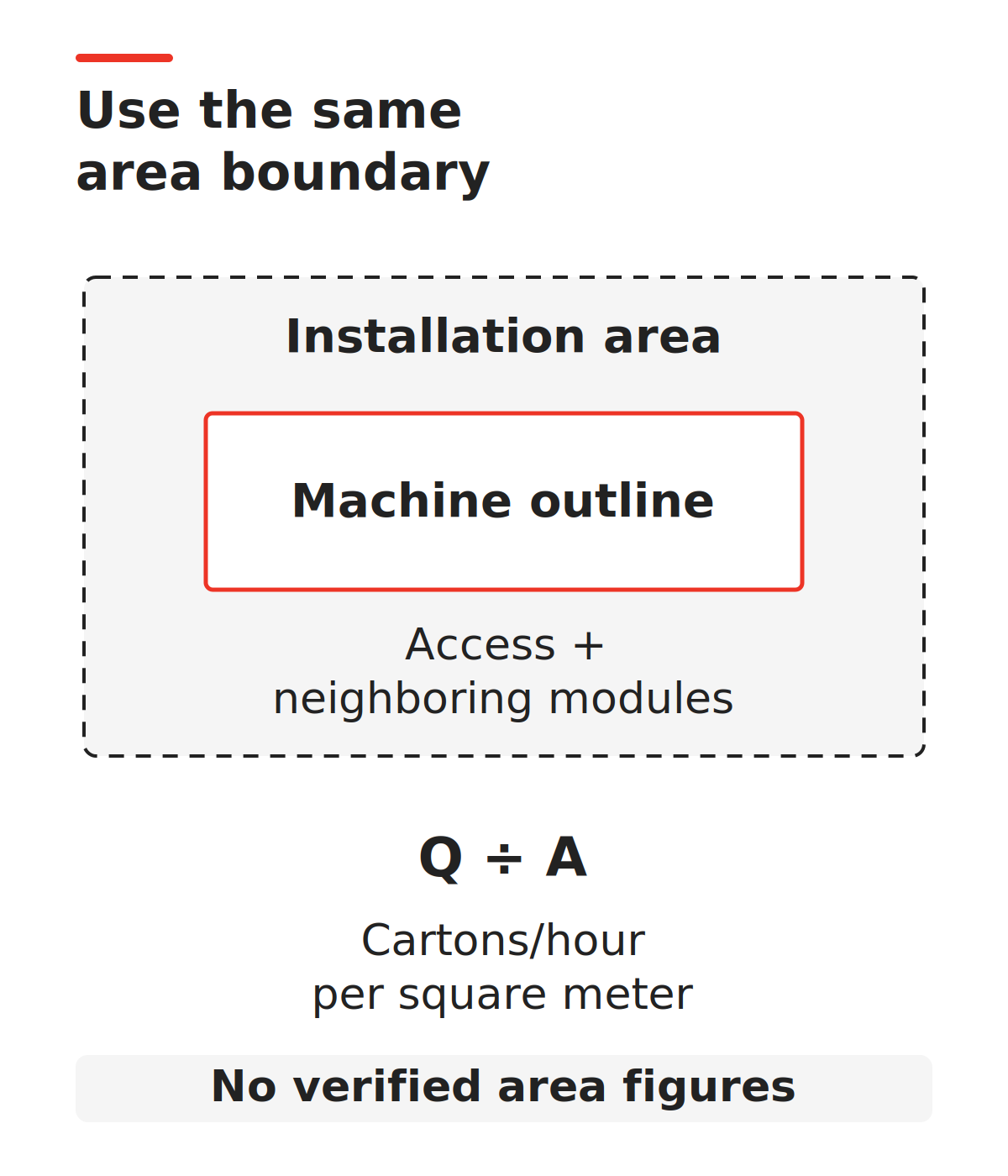
Does output per square meter use the same boundary?
Output per square meter requires an area denominator as well as a rate. Define Q as cartons/hour and A as square meters; Q ÷ A is cartons/hour per square meter. The ratio between new and old values is (Qnew ÷ Qold) × (Aold ÷ Anew). Subtract one to express its growth. This is a mathematical definition, not a published machine-footprint result.
If the compared areas are equal, the area terms cancel and the percentage growth equals rate growth. SIG also describes the new machines as maintaining the same compact footprint familiar from its standard machines in the October 1 release. That is a qualitative manufacturer statement: it supplies neither dimensioned comparison layouts nor the identity of the baseline models. If one area is the machine outline and the other includes service access, the calculation mixes boundaries. Ask for two dimensioned layouts using the same inclusion rules, and mark whether cabinets, access space and neighboring modules belong in each figure. This page has no verified area figures to substitute into the formula.
Your factory decision also depends on the full line. The line interface guide helps you identify where product supply, inspection and downstream packing enter a layout discussion. Keep the news comparison and the project layout as separate records: one checks what the announcement means, while the other checks the space needed for the proposed installation.
Who should review the announcement?
Review the announcement if your project involves the named carton routes and the missing baseline would change an expansion decision. The following buyer matrix is our editorial recommendation, not evidence of savings or suitability. Assign each question to the person who can obtain the relevant document rather than asking everyone to judge the headline speed alone.
For a single-serve buyer, the first question is whether the proposed XSlimBloc SKU list matches the supplier's comparison. For a multi-serve buyer, ask for the older reference behind Midi 15 and the corresponding pack conditions. For an existing-line owner, request an installation-specific compatibility statement. A shared platform name alone does not answer whether the installed equipment can be upgraded.
Food and beverage product assessment begins with the actual product and package. Use those inputs to frame the supplier discussion, then use acceptance review planning to name what a demonstration should record. These general guides help organize questions; their presence here does not establish our site's aseptic-carton engineering or supply capability.
| Buyer or project | Why review it | Evidence to request from SIG |
|---|---|---|
| Single-serve expansion | Check the relevant carton route | SKU-specific format and rate matrix |
| Multi-serve expansion | Resolve the comparison denominator | Baseline model and matched conditions |
| Space-constrained plant | Check area inclusion | Dimensioned layouts with equal boundaries |
| Existing SIG line owner | Check upgrade assumptions | Written compatibility and scope statement |
When should a US buyer act?
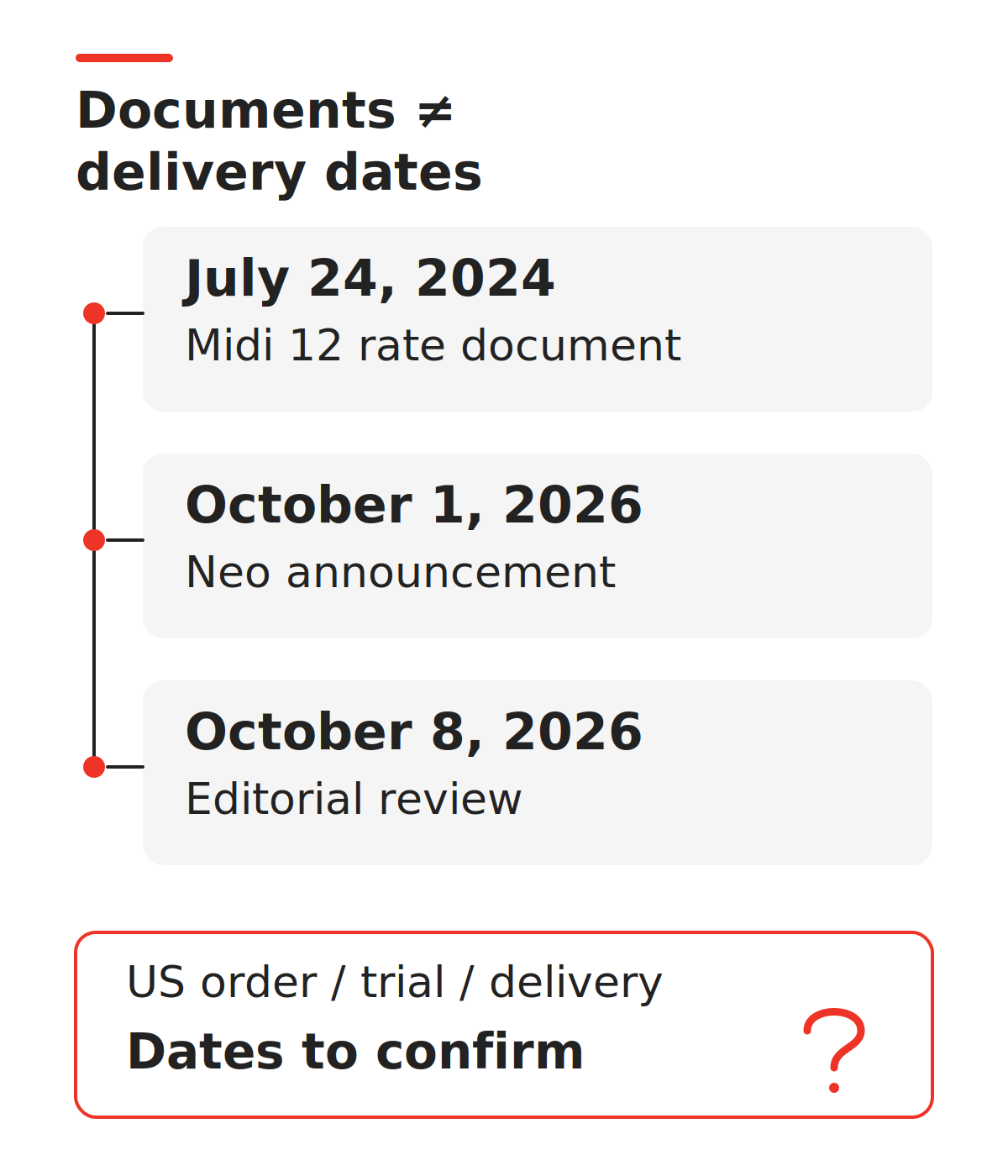
Start an information request now if the named carton route matches your project; use a supplier-confirmed commercial schedule before planning an order. October 1, 2026 is the announcement date, not a delivery commitment. Our October 8 review of the cited release found no US ordering, trial or delivery milestone. The timeline distinguishes dated documents from dates you still need to obtain.
Ask SIG's commercial contact responsible for the US project to identify availability, local service arrangements and the milestones that precede an order. Ask its technical contact when your product and carton can be evaluated, and which documents would define acceptance. Keep the response attached to the proposed configuration. A schedule for another format or location does not settle your own planning dates.
Prepare the demand and layout records while those answers are being collected. There is no need to turn a news date into a purchasing deadline. When a quotation arrives, use the quotation scope guide to compare the included modules, installation assumptions and running-cost inputs instead of inventing an investment figure from a headline.
| Date or milestone | What it establishes | Source nature |
|---|---|---|
| July 24, 2024 | Midi 12 historical rate document | Official manufacturer release |
| October 1, 2026 | XSlim 32 / Midi 15 announcement | Official manufacturer release |
| October 8, 2026 | This article’s source review | Editorial review date |
| Ordering / trial / delivery: date to confirm | US project commercial schedule | Written SIG project response required |
What still needs a written answer from SIG?
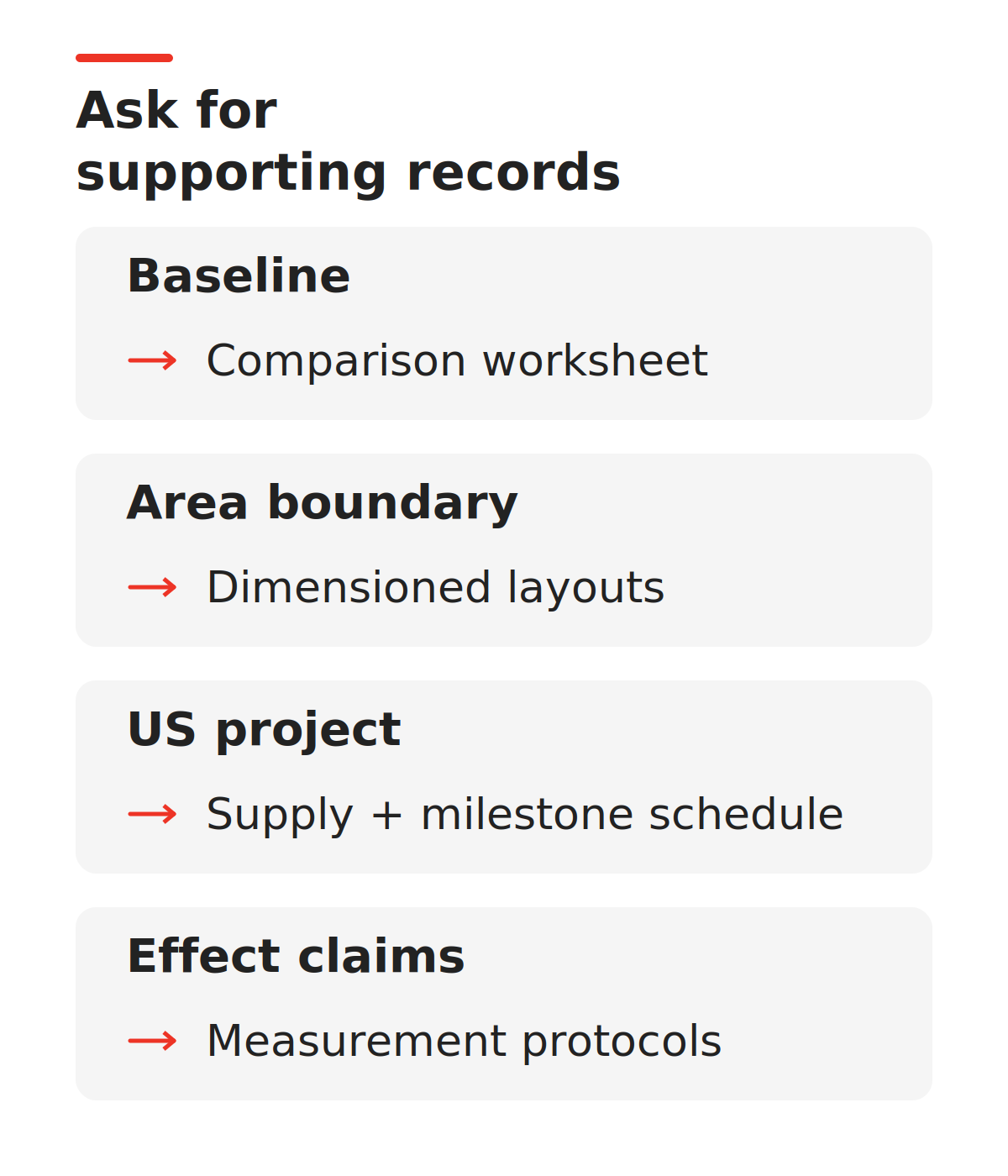
Ask for documents that resolve the comparison rather than another summary of the announcement. The most useful first response is a worksheet naming each baseline machine, pack, rated rate and area boundary. Then collect the US project schedule and a test protocol covering the proposed product. The matrix below is a purchasing question list, not a claim that the supplier lacks those documents.
Ask what the published changeover, waste and airflow statements measure. A changeover record needs a start and finish definition; a waste record needs its counting window and denominator. An airflow record needs particle size, sampling location and method. Do not reinterpret an airborne-particle statement as a verified microbiological result. Let your project specialists specify the separate evidence needed for their acceptance decision.
Keep capacity, exact pack sizes and compatibility in the same request so the reply describes one proposed configuration. For cost, ask for the scope and assumptions behind the supplier's calculation, including the production pattern it uses. A qualitative cost claim does not supply a price or a project payback figure. Document collection is the next action; a buying recommendation comes after the missing inputs are answered.
| Unresolved item | Who can confirm it | Document or record to request |
|---|---|---|
| Baseline model and conditions | SIG technical contact | Comparison worksheet with carton, product and rate |
| Footprint definition | SIG layout contact | Dimensioned layouts and inclusion rules |
| Exact capacities and pack compatibility | SIG applications contact | Proposed configuration and pack matrix |
| US availability and service | SIG commercial contact | Project-specific supply and service statement |
| Order, trial and delivery dates | SIG project contact | Milestone schedule with dependencies |
| Changeover, waste and airflow effects | SIG technical contact | Measurement protocols and supporting records |
| Costs and existing-line upgrade scope | SIG project/commercial contacts | Itemized scope and assumptions |
When this does not apply
This rate comparison addresses the cited aseptic-carton announcement. It does not select a bottle filler, a pouch filler or a powder machine. The liquid filling equipment overview describes a different set of product and packaging choices; the premade-pouch process page explains how that route handles supplied packs. Neither page establishes a substitute for the named carton equipment.
Automatic Filling Machine publishes equipment-selection material alongside its pouch, sachet, stick-pack and dosing-cap pages. We do not present this news article as a SIG dealership, a SIG quotation channel or proof that we supply its aseptic carton machines. Direct questions about SIG models, US availability and the announcement's claims to SIG. The site's inquiry blocks are for a separate project scope discussion within the packaging routes shown here.
For that separate discussion, describe the product, pack format, fill amount and output target. Those inputs explain why two machines described as automatic fillers can serve different jobs. The existing inquiry pack below keeps those variables together; it is not a request to submit a SIG procurement case to us.
Method and sources
Compiled from public manufacturer documents, this article uses SIG's October 1, 2026 Neo announcement, its July 24, 2024 Midi 12 press-release PDF and its official Smile 24 product listing. The editorial review date for this article is October 8, 2026. The documents establish what SIG published; they do not provide an independent matched-machine test. Reprints of the announcement are not additional independent evidence. The FAQ definition uses the FDA’s aseptic-processing inspection reference, updated July 14, 2005, for terminology only, not as evidence of new-machine validation or current project compliance.
The rate-growth calculations are our editorial arithmetic using published cartons/hour, assuming those nominal rates are the comparison inputs. They do not establish equivalent operating conditions or the announcement's actual baseline. No machine area, price, US delivery date or exact capacity for the new models has been inferred. The question matrices are editorial recommendations for resolving those gaps.
Version: October 8, 2026, first editorial review. Revisit the comparison when SIG identifies its baseline or supplies a relevant project record; a new document would justify revising the conclusion. For further reading, the filling equipment resources index helps locate the general selection, cost and output guides, while the machine selection guide helps separate packaging routes before a supplier discussion.
Common questions
How much does a filling machine cost?
The cited Neo announcement provides no machine price. Ask SIG for a quotation tied to the exact format, configuration, installation scope and US project. Its qualitative cost statements do not establish purchase price, operating cost or payback for your project.
What are the different types of filling machines?
One useful distinction is the packaging input. SIG describes the announced machines as using sleeve-based cartons and an open-sleeve filling process. The premade-pouch route on this site starts with bags supplied already made, then opens, fills and seals them. Specify that input and the required process before comparing models; a shared filling-machine label does not make the routes interchangeable.
What is aseptic carton packaging?
Aseptic processing and packaging brings a commercially sterilized product into presterilized packaging and closes it in an environment intended to prevent recontamination, as described in the FDA inspection guide. The machine-rate announcement alone does not establish validation or suitability for your product; ask your project specialists for the required evidence.
What to send us
Swipe to compare all columns.
| Item | Why we need it | Example format |
|---|---|---|
| Product and filling condition | Frame a separate project within the packaging routes on this site. | Product description and labelled photo |
| Package format and drawing | Identify pouch, sachet, stick-pack or dosing-cap scope. | Dimensioned drawing and material sheet |
| Fill amount and unit | Define the quantity for that project discussion. | Target quantity record with units |
| Acceptable finished output | Describe demand and the counting point. | Packs per shift and shift pattern |
We reply within 24 hours.